

Final Words — Rev. David J. Schreffler


image

November 24, 2015

“Now these are the last words of David: The oracle of David, son of Jesse, the oracle of the man whom God exalted, the anointed of the God of Jacob, the favorite of the Strong One of Israel: The spirit of the LORD speaks through me, his word is upon my tongue. The God of Israel has spoken, the Rock of Israel has said to me: One who rules over people justly, ruling in the fear of God, is like the light of morning, like the sun rising on a cloudless morning, gleaming from the rain on the grassy land. Is not my house like this with God? For he has made with me an everlasting covenant, ordered in all things and secure. Will he not cause to prosper all my help and my desire? but the godless are all like thorns that are thrown away; for they cannot be picked up with the hand; to touch them one uses an iron bar or the shaft of a spear. And they are entirely consumed in fire on the spot.” 2 Samuel 23:1-7

What is interesting, according to Professor Ralph Klein, is that this passage is the first of many “last words of David” in the Old Testament. Klein counts ten “last words” of David; the second and third of which can be found 1 Kings (2:2-4 and 5-9) and the fourth through the ninth in 1 Chronicles (22:7-16,17-19; 28: 2-10, 20-21; 29:1-5, 10-19; 23:27). Even more intriguing is the fact that David is unique in this regard — there are no recorded last words for any of David’s royal successors! So why is David accorded so many chances at having the final word?
In the legends, if not actual history, of ancient Israel, David’s stature only seems to increase as time passes. This is not so different than giants of history a little closer to home. It’s hard to imagine that more can be said about George Washington, but more than 40 biographies on Washington alone have been published since the early 1990s. The count is comparable for other greats such as Thomas Jefferson and Abraham Lincoln. And these books sell well — they often top bestseller lists. What is it about these men that fascinate us? Why do we return again and again to the smallest details of their lives (not always distinguishing history from legend)? Maybe we hope that combing through the minutia just one more time can elicit some insightful bit of wisdom or a kernel of previously undiscovered truth. That’s likely what David’s biographers within the biblical text were after in their emphasis on and inclusion of his last words. Last words, especially in pre-modern times, were significant. There was a sense that it in that brief moment between life and death, heroes would impart something profound, something to hold onto and to live by.” (Commentary on 2nd Samuel, Karla Suomala, Working Preacher website)

Have you ever googled “famous last words” and looked at some of the purported last words of famous people? I have. Here are a few:

Sir Winston Churchill’s last words were, “I’m bored with it all.”  

Actress Joan Crawford yelled at her housekeeper, who was praying as Crawford died. Crawford said, “Damn it! Don’t you dare ask God to help me!”

Bo Diddley died giving a thumbs-up as he listened to the song “Walk Around Heaven.” His last word was “Wow.”

Baseball player “Moe” Berg’s last words: “How did the Mets do today?”
Emily Dickinson’s last words were, “I must go in, for the fog is rising.”

Sometimes the last words from people come from a love and concern for their loved ones, sometimes from a haze of pain medications, sometimes they are just the random thought someone was having not knowing they were about to have a heart attack and die. Yet, there is this expectation that someone who is dying might indeed have some profound parting words. Martin Luther is purported to have said something to the effect of “We are all beggars.” Jesus, of course said “It is finished” in one Gospel, and in others he is said to have yelled “Eloi, Eloi lema Sabachthani”, or “My G*d, my G*d, why have you forsaken me.”

Jesus was just as profound with his final words as he was with his entire body of teachings. When you look at his final day, he did a lot of teaching on that day – he left a lot of final thoughts and teachings. Take time today to google the final words of Jesus – or take time to read the end of one of the Gospels. When faced with his own death, Jesus was able to tell his disciples to love one another, tell his mother she would be cared for, and tell the thief beside him on the cross that his faith would save him. The last words and the final deeds of Jesus are profound indeed.

Pastor Dave
Here Comes the Judge — Rev. David J. Schreffler


image September 24, 2015

“Save me, O God, by your name, and vindicate me by your might. Hear my prayer, O God; give ear to the words of my mouth. For the insolent have risen against me, the ruthless seek my life; they do not set God before them. Selah

But surely, God is my helper; the Lord is the upholder of my life. He will repay my enemies for their evil. In your faithfulness, put an end to them. With a freewill offering I will sacrifice to you; I will give thanks to your name, O Lord, for it is good. For he has delivered me from every trouble, and my eye has looked in triumph on my enemies.” Psalm 54:1-7

Perhaps you’ve heard the old (saying), “Announcing your plans is a good way to hear God laugh” (or something like that).  If making plans of our own (presumably in the face of God’s plans for us) is laughable, how about issuing commands to God, telling God the Divine’s own business in no uncertain terms? Who would dare to give God orders? Yet this is, in a sense, exactly what Psalm 54 does.

Our psalm begins with a four-fold plea: “save me…hear [me]…give ear [to me].” Each of these pleas — actually imperative verbs — and a fourth “vindicate me” (which in terms of tense is imperfect but in context clearly works like an imperative) quite literally command God’s attention, response, and action. These imperative clauses that form the introduction to the psalm demand God’s attention. And while some Hebrew language grammarians might call this particular use of the imperative a “jussive,” that is really just a delicate way of labeling the act of giving orders to someone who out-ranks you.

The most important technical term used in the psalm comes towards the beginning of the psalm however, in verse 2. And this is also probably the most innocuous of the worship related terms in the psalm, at least at first blush: the psalmist offers a “prayer.” The psalmist calls his appeal a “prayer.” There are several different terms in the Old Testament for “prayer,” but the Hebrew word used here is by far the most common. What may be telling is that this word is probably related to the word which means “judge” (cf. Exodus 21:22). In a sense, then, prayer is in-and-of-itself an appeal to God as judge. The psalmist directs his speech (an appealing or intercessory prayer) to God the Judge, who will speak in response to the false accusations of the psalmist’s enemies, these “insolent” and “ruthless” ones who have risen against him. “  Karl Jacobson, September 23, 2012 Commentary on Psalm 54 (Working Preacher Blog)

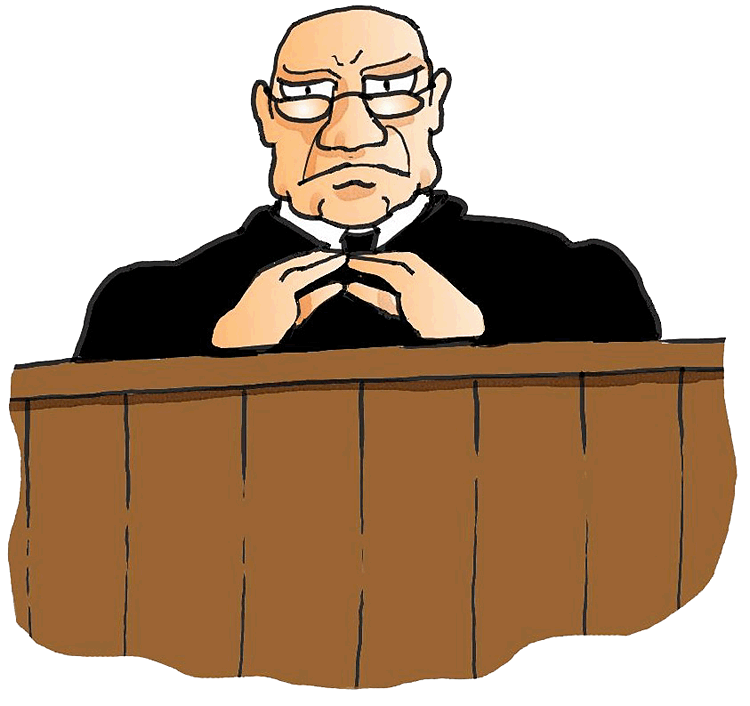
Does it hurt too much to see G*d as the judge of your life? Why do I ask that question? Well, it seems to me that so many people do not like being judged in any capacity, manner or form. How often do I have to hear someone say “Don’t judge me”? Here are some scriptural statements on judging:

Matthew 7:1-5 ESV
Judge not, that you be not judged. For with the judgment you pronounce you will be judged, and with the measure you use it will be measured to you. Why do you see the speck that is in your brother’s eye, but do not notice the log that is in your own eye? Or how can you say to your brother, ‘Let me take the speck out of your eye,’ when there is the log in your own eye? You hypocrite, first take the log out of your own eye, and then you will see clearly to take the speck out of your brother’s eye.”

Luke 6:37 ESV
Judge not, and you will not be judged; condemn not, and you will not be condemned; forgive, and you will be forgiven;”

Sounds like we are told not to judge – though we are called to rebuke. But we are also told to expect that when we do judge, we need to expect the same judgment. I was watching the news the other night when the story about the web site “Ashley Maddison” came up for discussion. This is a website for married people who want to meet other married people for the purpose of having an affair. Someone had “hacked” into the website and threatened to release the names and email addresses of people who use this despicable site if the website did not close down. It was mentioned by one of the news anchors that it would only be a short time until someone who is well known would be “outed” for using this site. And sure enough, in just two days, one of the Duggar boys from the reality TV show was outed as a member of this site. He was quoted as saying “I have been the biggest hypocrite.” He said this because he has been an outspoken advocate for “family values”.

Before we judge others and look for specks in their eyes, we better make sure we have no logs blinding our own judgment. The original meaning of the word “hypocrite” was “an actor on stage who plays a role”. In other words, the hypocrites in the vernacular of Jesus were those (like the religious leaders) who presented themselves in one manner, but actually lived in another manner — like the Duggar boy.

What we must decide is this: Are we acting like a Christian, or are we actually living like a Christian? Do we have room to judge others, or should we be constantly discerning how we are living out the Gospel?

Pastor Dave