
Staring Into the Face of Death — Rev. David J. Schreffler


image

November 11, 2015

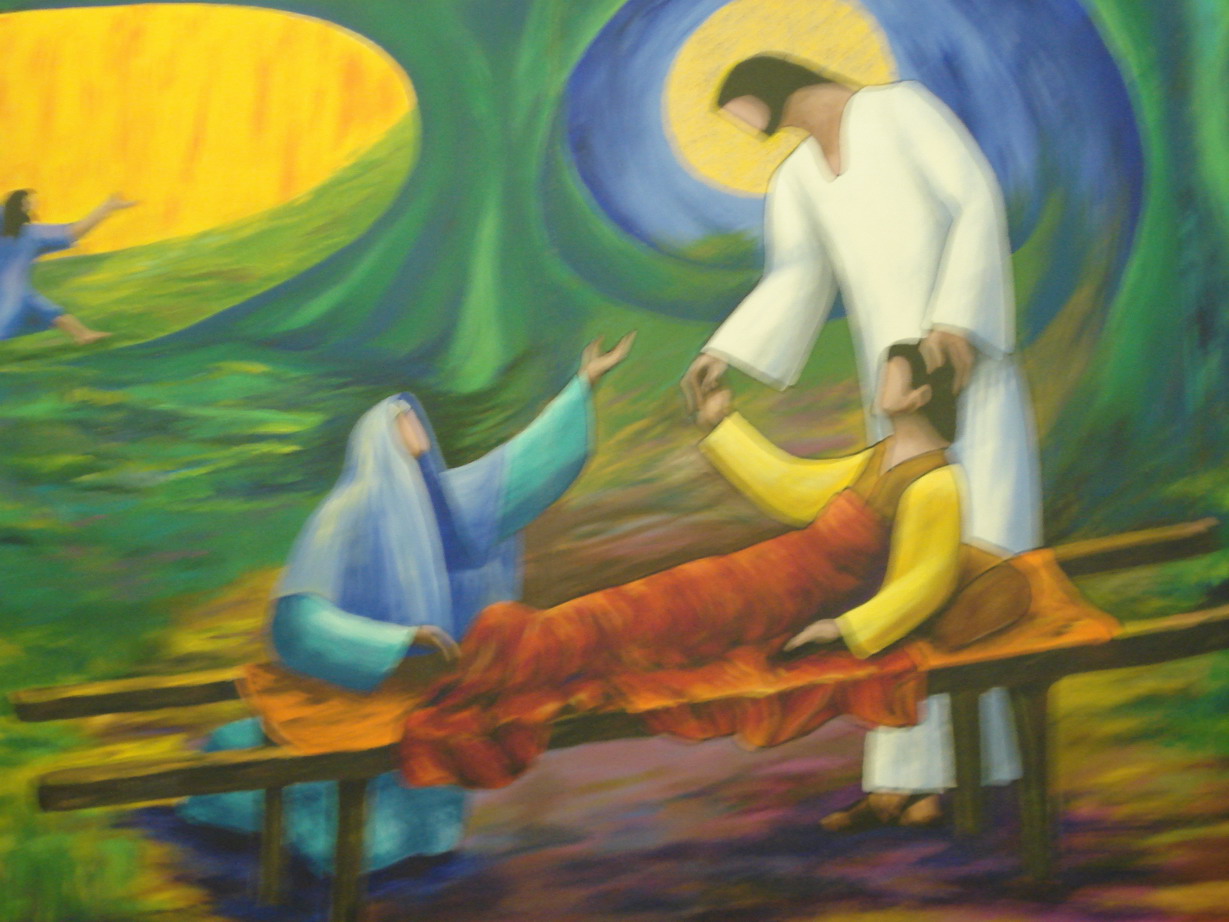
“Soon afterwards he went to a town called Nain, and his disciples and a large crowd went with him. As he approached the gate of the town, a man who had died was being carried out. He was his mother’s only son, and she was a widow; and with her was a large crowd from the town. When the Lord saw her, he had compassion for her and said to her, “Do not weep.” Then he came forward and touched the bier, and the bearers stood still. And he said, “Young man, I say to you, rise!” The dead man sat up and began to speak, and Jesus gave him to his mother. Fear seized all of them; and they glorified God, saying, “A great prophet has risen among us!” and “God has looked favorably on his people!” Luke 7:11 – 16

It is inevitable that we should be sad when those we love depart from us by dying. Although we know they are not leaving us for ever, that they have but gone a little ahead of us, that we who remain will follow them, nevertheless our nature shrinks from death, and when it takes a loved one we are filled with sorrow simply because of our love for that person. In the death of those who are close to us we experience both sadness at the necessity of losing them, and hope of getting them back.” Augustine, Bishop of Hippo, (354 – 430) Sermon 172, “For All The Saints”, volume II (p. 987)

I struggle with many different emotions when I meet with a family who does not want to hold a public service for someone who has passed away. Mostly I struggle with the reality that someone or perhaps the entire family is hoping to deny or delay the hurtful feeling that surrounds a death. Death hurts – it hurts to loose a loved one, it makes us sad, it gives us feelings and emotions we just do not like. But avoiding those feelings is not doing any of us any good. We cannot shrink from death, because death will not shrink from us. Death is all around us. We can try to run from death, but we cannot hide. One of the lessons we learn from the story of the Widow from Nain is how the community surrounded her in her grief. They did not shrink from her. They came together and allowed her to grieve personally, and she allowed the community to grieve as well.

There are so many ways that our society is trying to deny us a sense of community. We can drive home from our cubicles at work, sit in our cars to open the garage door, pull into the garage and close the same door, and never have to get out of the car or talk to any of our neighbors. We repeat the same actions when we leave in the morning. We are finding more and more ways to isolate ourselves – all to our own detriment. Funerals are one of the last ways that we can come together as a community and show our love for each other. Let us not deny this act of comfort, community, and caring simply because we would rather run away from death than face it head on.

As I write this devotion, a two year old child has been killed when struck by a car while attending a homecoming parade in Stillwater, Oklahoma. This young family will need the community to rally around them as they face this devastating loss. This is not a time to stick our heads in the sand, but a time to stand together as people of G*d and lament the brokenness of humanity and the fragility of life.

Of course, staring right into the face of death is just what so many of our Veterans have done, for so many years, protecting our country and rooting out evil in the world. Today we honor those Veterans who gave their life in service to this country, and those Veterans who struggle with moving on with life once they return home, and Veterans and families who have experienced a loss of brother, sister, father, mother, uncle, aunt, or comrade. On this day we stand together as grateful people and say thank you to all Veterans.


Pastor Dave

Sacrificial Giving — Rev. David J. Schreffler


image

November 8, 2015
Sunday

“As he taught, he said, “Beware of the scribes, who like to walk around in long robes, and to be greeted with respect in the marketplaces, and to have the best seats in the synagogues and places of honor at banquets! They devour widows’ houses and for the sake of appearance say long prayers. They will receive the greater condemnation.”

He sat down opposite the treasury, and watched the crowd putting money into the treasury. Many rich people put in large sums. A poor widow came and put in two small copper coins, which are worth a penny. Then he called his disciples and said to them, “Truly I tell you, this poor widow has put in more than all those who are contributing to the treasury. For all of them have contributed out of their abundance; but she out of her poverty has put in everything she had, all she had to live on.” Mark 12:38 – 44

The poor widow indeed exemplifies sacrificial giving, but only a perverted imagination can turn her story into a general example. Mark’s Gospel goes out of its way to make clear that she is just as much a victim as a hero. The most important hint lies in the context Mark provides. The poor widow’s story dos not stand alone. Instead, it follows Jesus’ condemnation of the scribes who run the very temple to which she contributes. “Watch out for the scribes,” Jesus says. They’re all about themselves and their status. But Jesus goes on: “They devour widows’ houses.” Having said this, Jesus immediately calls attention to one of those widows who have nothing left. Many preachers read only the widow’s story without Jesus’ condemnation of the scribes. The two stories belong together, the one story telling us how to read the other.

Finally, we might ask ourselves a simple question. Does Jesus seem like the kind of teacher who wants poor people, especially vulnerable widows, to give away their very last resources? Do we seriously imagine Jesus as rejoicing when a widow’s generosity deprives her of “her whole livelihood”? I hardly think so. The widow’s generosity places the reality of poverty before our eyes. It reminds us that the poor do not represent parasites who drain society of its resources. This story reminds us that we live in an economy that siphons its resources upward and leaves the vulnerable to face destitution on their own — and we inhabit churches that ignore the process. Whether our institutions and religious leaders recognize it or not, we have lots to learn from the poor and the vulnerable. If we would just look.” (Greg Carey Professor of New Testament, Lancaster Theological Seminary Mark 12:38-44: The Value of Chump Change)

Sacrificial giving – what does that mean to you? If we take the example of the poor widow, suddenly it seems to be something out of our reach. Who can give to G*d everything they have to live on? And what was the motive of the poor widow? Was she tormented by the Scribes who “devoured widow’s houses”, money that most likely ended up in the pockets of the Temple leaders? Her poverty is something we must address head on in this text, because we will always have the poor with us, and they are not all lazy and unwilling to work. And, as Greg Carey so eloquently put it, is Jesus the kind of Lord who wants poor people to give away their last resources?

No, we must face the reality that we live in a society that encourages the rich to get richer often on the backs of the poor and at the expense of the poor who labor long and hard and have little to show for their efforts. No, I do not consider myself a socialist. But I do have a problem with the unequal distribution of wealth and opportunity. People often live in poverty because it is a negative cycle in which families struggle for generations trying to break out.

I used to work for an outpatient head injury and spinal cord injury program, assisting patients as they tried to return to the work force after a debilitating injury. One day I was completing a vocational evaluation on a young man, when his wife came home from work. The family was poor – period. The husband’s injury had a devastating effect on the family and their ability to earn enough income. It was approaching dinner time, when they asked me if I wanted to join them for a meal. The wife got out her calculator and determined they had enough money to order a pizza – and invited me to join them. I declined because I could not accept food from any clients – and yet I marveled at the level of generosity they displayed in that one act. We have a lot to learn from the poor – and often it involves lessons around generosity.

Pastor Dave