

September 8, 2015
“In the morning they did not recognize the land, but they noticed a bay with a beach, on which they planned to run the ship ashore, if they could. So they cast off the anchors and left them in the sea. At the same time they loosened the ropes that tied the steering-oars; then hoisting the foresail to the wind, they made for the beach. But striking a reef, they ran the ship aground; the bow stuck and remained immovable, but the stern was being broken up by the force of the waves. The soldiers’ plan was to kill the prisoners, so that none might swim away and escape; but the centurion, wishing to save Paul, kept them from carrying out their plan. He ordered those who could swim to jump overboard first and make for the land, and the rest to follow, some on planks and others on pieces of the ship. And so it was that all were brought safely to land.” Acts 27:39-44
“The Dictionary of Christian Lore and Legend describes the nave (of the church) as “the central portion of a church, set aside for the congregation, lying west of the chancel or choir and often separated from it by a screen of wood or stone.” It also notes the word derives from the Latin navis, “a ship ” because the Church was compared to a ship in which the faithful could be saved.
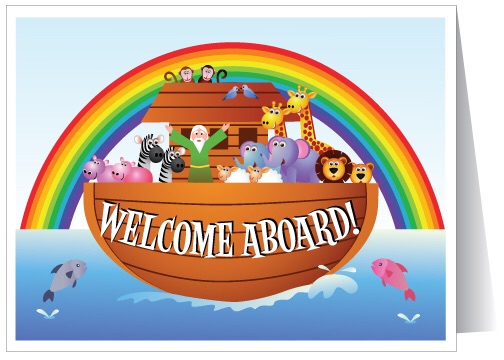
Once you pass through the doors from the narthex (which is the “porch at the west end of early churches” (used by penitents not admitted to the body of the church), 1670s, from Late Greek narthex) at which point maybe our greeters should say “Welcome aboard the ship” — you are in the nave…” Dean Myers (1917 – 1991), [A Sermon “Stay With The Ship” “For All the Saints” volume II (p. 799)
Dean Myers was a Lutheran layperson and advertising executive – a member of St. Matthew’s Lutheran Church, White Plains, NY. I like his suggestion that we should look visitors and regular attendees alike and say to them “Welcome aboard”. If we put more emphasis on welcoming people into our churches, we might see more of them coming back again and again. But not only is the emphasis on welcome, but we also need to remember the “aboard” as well. In other words, just as the ship does not “guarantee” a smooth ride, coming to church also does not guarantee your life will be smooth, nor will your experience in the church be without occasional gales.
The Psalmist says “Many are the troubles of the righteous.” (Psalm 34) It is because our lives have the potential to be trouble-filled that we need to be welcoming to all who visit — welcoming to everyone — when we welcome all aboard, we have more to support one another when the gales come blowing in.
Pastor Dave

 Lutheran Schreff