
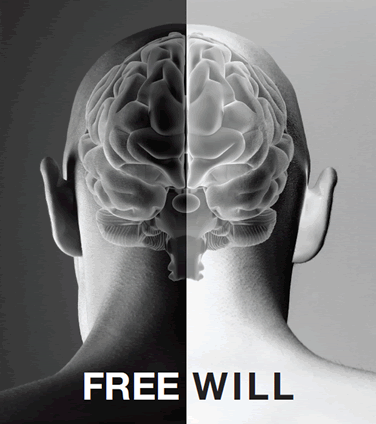
The Cost Of Free Will — Rev. David J. Schreffler

image

December 22, 2015

“For God so loved the world that he gave his only Son, so that everyone who believes in him may not perish but may have eternal life. “Indeed, God did not send the Son into the world to condemn the world, but in order that the world might be saved through him. Those who believe in him are not condemned; but those who do not believe are condemned already, because they have not believed in the name of the only Son of God. And this is the judgment, that the light has come into the world, and people loved darkness rather than light because their deeds were evil. For all who do evil hate the light and do not come to the light, so that their deeds may not be exposed. But those who do what is true come to the light, so that it may be clearly seen that their deeds have been done in God.” John 3:16 – 21

“G-d created things which had free will. That means creatures which can go either wrong or right. Some people think they can imagine a creature which was free but had no possibility of going wrong; I cannot. If a thing is free to be good it is also free to be bad. And free will is what has made evil possible. Why, then, did G-d give them free will? Because free will, though it makes evil possible, is also the only thing that makes possible any love or goodness or joy worth having. A world of automata—of creatures that worked like machines—would hardly be worth creating. The happiness which G-d designs for His higher creatures is the happiness of being freely, voluntarily United to Him and to each other in…..love.” (C. S. Lewis [1898 – 1963], Mere Christianity, “For All The Saints”, volume III, p. 102)

Free will. What a topic. Predestination is the concept that all events of history, past, present and future, have been decided or are known (by God, fate, or some other force), including human actions. This is a power that is contrary to free will. True free will would mean that nothing, no person, event or other factor would help to determine a decision or course of action. Does a person have free will? Does a person live in a place, world, community, or family where their decisions have no outside influence? Some people would claim that they have complete free will – while others would point to karma, fate, or influence of some kind affecting every decision.

There was a study completed a few years ago that seemed to point to the fact that true free will may not actually be “a thing”. Here was the study. They strapped electrodes to the brains of subjects, and asked them to make random selections of objects – to choose between one object or another. They were to clear their minds, and when directed, make a choice, spontaneously. What the study showed is this: though the subject making the choice seemed to do it free of any outside stimuli, something in the brain fired a few microseconds before the choice was made. It suggests that there may be nothing called “complete free will”.

In this country, we claim a lot of freedoms, and few of them are freedoms that happen on a molecular level. One of the freedoms we hold dear is the freedom of the will, or in other words, I hold that if my conscience is bound, I should not be forced to do certain things.

“God isn’t about making good things happen to you, or bad things happen to you. He’s all about you making choices–exercising the gift of free will. God wants you to have good things and a good life, but He won’t gift wrap them for you. You have to choose the actions that lead you to that life.”
― Jim Butcher

To exercise your power and freedom to choose, you have to make choices. G-d has freely chosen you, because G-d created you. You then have the choice to live into the blessings you have, or to let others squelch them. “It was for freedom that Christ set us free; therefore keep standing firm and do not be subject again to a yoke of slavery” (Galatians 5:1)

Pastor Dave

St. Thomas — Rev. David J. Schreffler

                                                                                    December 21, 2015

“Do not let your hearts be troubled. Believe in God, believe also in me. In my Father’s house there are many dwelling places. If it were not so, would I have told you that I go to prepare a place for you? And if I go and prepare a place for you, I will come again and will take you to myself, so that where I am, there you may be also. And you know the way to the place where I am going.” Thomas said to him, “Lord, we do not know where you are going. How can we know the way?” Jesus said to him, “I am the way, and the truth, and the life. No one comes to the Father except through me.” John 14:1 – 6

IMAGINATION WAS NOT Thomas’s long suit. He called a spade a spade. He was a realist. He didn’t believe in fairy tales, and if anything else came up that he didn’t believe in or couldn’t understand, his questions could be pretty direct. There was the last time he and the others had supper with Jesus, for instance. Jesus was talking about dying, and he said he would be leaving them soon, but it wouldn’t be forever. He said he’d get things ready for them as soon as he got where he was going, and when their time finally came too, they’d all be together again. They knew the way he was going, he said, and some day they’d be there with him themselves.

Nobody else breathed a word, but Thomas couldn’t hold back. When you got right down to it, he said, he personally had no idea where Jesus was going, and he didn’t know the way to get there either. “I am the way,” was what Jesus said to him (John 14:6), and although Thomas let it go at that, you can’t help feeling that he found the answer less than satisfactory. Jesus wasn’t a way, he was a man, and it was too bad he so often insisted on talking in riddles.

Then in the next few days all the things that everybody could see were going to happen happened, and Jesus was dead just as he’d said he’d be. That much Thomas was sure of. He’d been on hand himself. There was no doubt about it. And then the thing that nobody had ever been quite able to believe would happen happened too. Thomas wasn’t around at the time, but all the rest of them were. They were sitting crowded together in a room with the door locked and the shades drawn, scared sick they’d be the ones to get it next, when suddenly Jesus came in. He wasn’t a ghost you could see the wallpaper through, and he wasn’t just a figment of their imagination because they were all too busy imagining the horrors that were all too likely in store for themselves to imagine anything much about anybody else. He said shalom and then showed them enough of where the Romans had let him have it to convince them he was as real as they were if not more so. He breathed the Holy Spirit on them and gave them a few instructions to go with it, and then left.

Nobody says where Thomas was at the time. One good thing about not having too much of an imagination is that you’re not apt to work yourself up into quite as much of a panic as Thomas’s friends had, for example, and maybe he’d gone out for a cup of coffee or just to sit in the park for a while and watch the pigeons. Anyway, when he finally returned and they told him what had happened, his reaction was just about what they might have expected. He said that unless Jesus came back again so he could not only see the nail marks for himself but actually touch them, he was afraid that, much as he hated to say so, he simply couldn’t believe that what they had seen was anything more than the product of wishful thinking or an optical illusion of an unusually vivid kind. Eight days later, when Jesus did come back, Thomas was there and got his wish. Jesus let him see him and hear him and touch him, and not even Thomas could hold out against evidence like that. He had no questions left to ask and not enough energy left to ask them with even if he’d had a couple. All he could say was, “My Lord and my God!” (John 20:28), and Jesus seemed to consider that under the circumstances that was enough. Then Jesus asked a question of his own. “Have you believed because you have seen me?” he said and then added, addressing himself to all the generations that have come since, “Blessed are those who have not seen and yet believe” (John 20:29). Even though he said the greater blessing is for those who can believe without seeing, it’s hard to imagine that there’s a believer anywhere who wouldn’t have traded places with Thomas, given the chance, and seen that face and heard that voice and touched those ruined hands.” (Frederick Buechner, Thomas, From his webpage and blog)

There is a lot we know about Thomas, and a lot we do not. For example, why was he absent when Jesus first appeared to his disciples? Why was he called the twin? These are things we may never know. We do know that he needed to see Jesus before he celebrated the resurrection – he has been unfairly called a doubter – and he wanted to one the way of Jesus. Thomas reminds us that people who question and people who need more facts are not condemned by Jesus – instead they are given what they request. Thank you Thomas for being you….and me.

Pastor Dave