
Avoiding Spiritual Decay — Rev. David J. Schreffler


December 30, 2015

“Now that day was a sabbath. So the Jews said to the man who had been cured, “It is the sabbath; it is not lawful for you to carry your mat.” But he answered them, “The man who made me well said to me, ‘Take up your mat and walk.’ ” They asked him, “Who is the man who said to you, ‘Take it up and walk’?” Now the man who had been healed did not know who it was, for Jesus had disappeared in the crowd that was there. Later Jesus found him in the temple and said to him, “See, you have been made well! Do not sin any more, so that nothing worse happens to you.” The man went away and told the Jews that it was Jesus who had made him well.” John 9:5 – 15

“When I was a child I often had a toothache, and I knew that if I went to my mother she would give me something which would deaden the pain for that night…But I did not go to my mother—at least, not till the pain became very bad. And the reason I did not go was this. I did not doubt she would give me the aspirin; but I knew she would also do something else. I knew she would take me to the dentist the next morning. I could not get what I wanted out of her without getting something more, which I did not want. I wanted immediate relief from pain: but I could not get it without having my teeth set permanently right. And I knew those dentists;I knew they started fiddling about with all sorts of other teeth which had not yet begun to ache. They would not let the sleeping dogs lie…Our Lord is like the dentists. If you give him an inch, He will take an ell (an ell is a former measure of length from the textile industry – about 45 inches). Dozens of people go to him to be cured of some particular sin which they are ashamed of…or which is obviously spoiling daily life…He will cure it all right: but He will not stop there. That may be all you asked; but if once you call Him in, He will give you the full treatment.” (Mere Christianity, C. S. Lewis (1898 – 1963) “For All The Saints” volume III, (p. 163 – 164)

I remember, when I was about eight years old, having a visit to the dentist. I went because one of my older brother or sisters could not attend. I went knowing I had a few loose teeth. When I returned home, my mouth was minus eight teeth. Not only did the dentist find loose teeth, he found some that he believed were “in the way” and he removed them with his pliers. I did not allow my mother to send me back to the dentist until I was twenty-three years old, and then I went only because I could not open my mouth because my wisdom teeth were coming in at such a bad angle they were impeding the function of my jaw. I needed to stop seeing the dentist only when there was a problem, and more regularly to avoid problems.

We cannot run to G-d only when our lives have gone bad or we have run into problems, and then wait to return to G-d in similar circumstances. Yet this is how many people treat Jesus. They stay away when everything is fine. But as soon as something happens that severely impairs their life’s functioning, they run to Jesus looking for a fix. Once the fix is in, or not, they run away either complaining about the cost, complaining about the intrusiveness, or complaining about the fix. This is no way to treat your relationship with G-d, or your dentist. Your dentist wants to see you twice a year, and asks you to do certain things daily to avoid seeing him or her more than twice a year. G-d doesn’t want to see us twice a year (like many do) but wants to see each and every one of us every day. G-d doesn’t want to see us only when there is a problem, but gives us daily activities to strengthen our relationship with G-d. And, G-d doesn’t only want to see us twice a year, but asks that we go to G-d daily in prayer, and weekly in bible study, and weekly in worship. We may not be able to avoid problems, but we will have a scheduled appointment daily and weekly to help us with all of our spiritual decay.

Pastor Dave
Christmas Day — Rev. David J. Schreffler


christmas day             December 25, 2015

“In the beginning was the Word, and the Word was with God, and the Word was God. He was in the beginning with God. All things came into being through him, and without him not one thing came into being. What has come into being in him was life, and the life was the light of all people.

The light shines in the darkness, and the darkness did not overcome it. There was a man sent from God, whose name was John. He came as a witness to testify to the light, so that all might believe through him. He himself was not the light, but he came to testify to the light. The true light, which enlightens everyone, was coming into the world. He was in the world, and the world came into being through him; yet the world did not know him. He came to what was his own, and his own people did not accept him. But to all who received him, who believed in his name, he gave power to become children of God, who were born, not of blood or of the will of the flesh or of the will of man, but of God. And the Word became flesh and lived among us, and we have seen his glory, the glory as of a father’s only son, full of grace and truth. John 1:1 – 14

“The light shines on in the darkness, and the darkness has not overcome it.” I love the confident note of hope this verse sounds. One the one hand, it is the declaration of a state of fact: light is stronger than darkness. At the same time, it is also a promise: even when it seems otherwise – and even the briefest scan of the headlines can make it seem otherwise – yet the light continues to shine and the darkness has neither overcome nor understood it. There is an active, even tensive quality to this verse that strikes me as accurately capturing the life of faith. We live confident of the promise that light is stronger than darkness, love stronger than hate, and life stronger than death. Yet not only that is not always apparent in the meantime, but even when we believe it most confidently that doesn’t lessen the amount of struggle a faithful life entails. Christmas reminds us of God’s decision to become one of us, to take on our lot and our life that we might have hope, and to share our mortal life that we might enjoy God’s eternal life. This is not merely a season or celebration, it is a promise that requires our active participation every day of the year. God’s condescension simultaneously glorifies human flesh and endeavors. Our lives matter to God. Our welfare is of tremendous importance to the Almighty. There is no worry too small, no challenge too great, that God is not eager to share it with us. Indeed, God is eager to equip and empower us to share our worries and challenges, as well as our joys and hopes, with each other. As because of God’s decision to come to us in a form we recognize, we are empowered to reach out to those around us.” (David Lose, Dear Working Preacher, Christmas Continued, December 30, 2014)

What are the different ways G-d could come to this world? G-d could have come in the manner that Ezekiel left – a flaming chariot suddenly appearing in the heavens, surrounded by clouds and a multitude of other chariots leading, guiding, heralding his coming. Or, he could have appeared on something like a television, a large screen suddenly appearing in the heavens for every one to see. He could have come in a mighty wind, everyone having to avert their eyes until it calms down, and there stands Jesus in his full glory. None of these would do. G-d determined to come like every other child comes to this earth – through the birth canal. It is not the ordinary way a king announces his reign – but Jesus is not ordinary King.

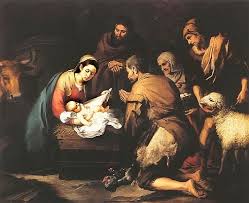
“But the angel said to them, “Do not be afraid; for see—I am bringing you good news of great joy for all the people: to you is born this day in the city of David a Savior, who is the Messiah, the Lord. This will be a sign for you: you will find a child wrapped in bands of cloth and lying in a manger.” (Luke 2:10 – 12)

He could have come on a fiery chariot, but instead he came to set the world on fire with love, mercy and grace.

Pastor Dave