

The Ordinary Becomes Extraordinary — Rev. David J. Schreffler


image


August 18, 2015

“On that day, when evening had come, he said to them, “Let us go across to the other side.” And leaving the crowd behind, they took him with them in the boat, just as he was. Other boats were with him. A great windstorm arose, and the waves beat into the boat, so that the boat was already being swamped. But he was in the stern, asleep on the cushion; and they woke him up and said to him, “Teacher, do you not care that we are perishing?” He woke up and rebuked the wind, and said to the sea, “Peace! Be still!” Then the wind ceased, and there was a dead calm. He said to them, “Why are you afraid? Have you still no faith?” Mark 4:35-40

“…in a boat on the sea of Tiberias, the Redeemer rose and rebuked the storm. Was the miracle merely a proof of His divine mission? Are we merely to gather from it, that then and there on a certain day, in a certain obscure corner to the world, Divine power was at work? It is conceivable that a man might credit that miracle: that he might be exceedingly indignant with the naturalist who resolves it into a natural phenomenon — and it is conceivable that very man might tremble in a storm. To what purpose is that miracle announced to him? He believes in G*d existing in the past, but not in the present; he believes in a Divine presence in the supernatural, but discredits it in the natural; he recognizes G*d in the marvelous, but does not feel Him in the wonderful of every day: but unless it has taught him that the waves and winds now are in the hallow of the hand of G*d, the miracle has lost its meaning.” Frederick W. Robertson (1816 – 1853)
Sermons, “For All The Saints” volume II, (p. 359)

It is true that we all must work to see G*d as active in our lives every day, not just reflect on G*d’s work in the past. It is hard to see how Jesus performed a miracle 2000 years ago, and the impact that same miracle has on each one of us right now. When the people of the 1st century gazed upon a miracle by Jesus, it was truly an act of G*d, or the Devil. When we see something miraculous happen before us today, we are more likely to say “it was done with smoke and mirrors” or “it is some act of illusion” — rather than to say “thanks be to G*d”.

My friends, even today, G*d can act through the ordinary to do extraordinary things. Every Sunday when the bread and wine are consecrated in Holy Communion, we believe that G*d is “bodily in, under and through the bread and wine” — G*d is doing the extraordinary through ordinary bread and wine. It is being streamed to us live right at that moment — it is not a memorial — G*d comes to us and into us through that act of Communion. And if G*d can act through ordinary bread and wine, who is to say that G*d cannot do amazing things through ordinary you and me? We are fed on bread and wine by an amazing G*d — so let’s get going doing amazing things in the name of the Lord.

Pastor Dave
Eat His Flesh – Drink His Blood — Rev. David J. Schreffler


image


August 16, 2015
Sunday

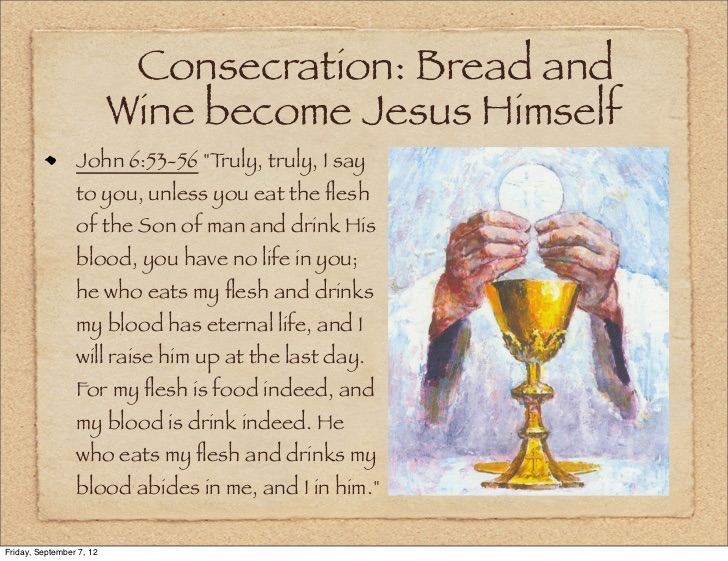
“Those who eat my flesh and drink my blood have eternal life, and I will raise them up on the last day; for my flesh is true food and my blood is true drink.”
John 6:54-55

No wonder early Christians faced accusations of cannibalism! This is gross. And yet we recall this kind of imagery every time we participate in the Eucharist. As I receive the bread, I hear the words, “the Body of Christ,” and then another phrase, usually, “the bread of heaven.” As I receive the wine, I hear the words, “the Blood of Christ,” and then usually “the cup of salvation.” These four phrases have at least one thing in common:

Their meaning is obscure — unless, minimally, you’ve spent a fair amount of time hanging out with and hearing from Christians. “The bread of heaven”? How would those words be understood by us were it not for their association with Christian liturgy and tradition? Another way to think about it is to ask how a hypothetical tourist from Mars who’d memorized a decent English dictionary but had little other exposure to Earth cultures might hear those words. “Bread from heaven,” our Martian visitor might muse, “it surely can’t be about its origin, as that woman over there bought it from a store called a ‘church supply house,’ and its ingredients — none claimed to be extraterrestrial in origin — are listed on the box. Perhaps they mean ‘heavenly,’ as in very good or pleasant — but this stuff tastes like cardboard!”

Flesh and blood are the seat of life — life belonging only to God, life that can be claimed rightly only by God. And yet in Jesus, God has willingly poured out that life for the sake of the world — not just the good people, the people who try hard to do the right thing, the people who praise and encourage the saints, but as much or more for the people who hate, and who act on their hatred, even to the point of killing a righteous woman or man, an innocent child.” (dylan’s lectionary blog, Sarah Dylan Breuer, saralaughed website)

I am glad that the above blog points out that Jesus poured out his life for all people — both the good and the bad. We all struggle to be good, to do good deeds, to think good thoughts, to be the best “good” people we can be. Still, that doesn’t mean that we are always good. And sometimes we do hateful things, and we encounter hateful people, and we witness the hate of the world, and we need to remember that Jesus died for those people as well. Through Jesus Christ, G*d has acted for the sake of the world — human, animal, vegetable, mineral, and insect. All creation is reconciled to G*d through Jesus Christ, whether we like it or not.

We come to the table of Holy Communion believing that Jesus is present in the meal because Jesus promised to be present. And so no matter who partakes of that meal, whether in the right state of mind or not, in the right state of forgiveness or not, in the right state of peace, love, mercy and Grace or not, Jesus is still there — flesh and blood — poured out for our benefit. Thank G*d that is the kind of G*d that we have……

Pastor Dave