
All Saints — Rev. David J. Schreffler

image

November 1, 2015
Sunday

“So they took away the stone. And Jesus looked upward and said, “Father, I thank you for having heard me. I knew that you always hear me, but I have said this for the sake of the crowd standing here, so that they may believe that you sent me.” When he had said this, he cried with a loud voice, “Lazarus, come out!” The dead man came out, his hands and feet bound with strips of cloth, and his face wrapped in a cloth. Jesus said to them, “Unbind him, and let him go.” John 11:41-44

The Body of Christ, the community of the baptized, and the Communion of Saints – we are all Lazarus. We stinketh, until Jesus calls us out, frees us, and gives us life. In fact this is what binds us together, the biologically alive church and the biologically dead church: we haven’t all been called out of the tomb and unwrapped. In this sense, the raising of Lazarus isn’t just a miracle that Jesus performed thousands of years ago in a land far, far away. It’s the work of Jesus today.

And, I don’t know about you, but I’m glad that Jesus still calls us out, because I still need it. I still stinketh. And some days I stinketh more than others. I still find myself from time to time bound up and wound up; by the expectations of others, by my own insecurities, by my sin. But, the promise of the story of Lazarus is that, like Lazarus, Jesus loves us. He weeps for us. He is deeply moved by us. And he brings life to our death, freedom to our bondage, and a shining light to our every darkness.” (Rick Morley, Who Stinketh, October 23, 2012)

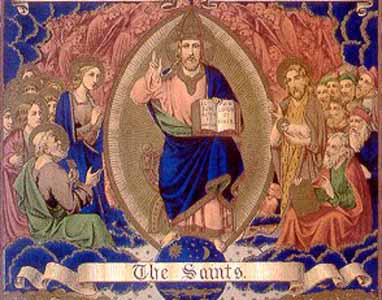
Today is the day we celebrate the people in our congregations who have passed away since last All Saints Sunday. It is a day to lift up the names of the saints who have received their crown, the fruit of eternal life, their room prepared for them. We ring bells, we name names, we light candles, families gather to read a scripture lesson. But when all is said and done, when we gather as a family around the grave of a loved one, most of us have one feeling that remains deep within our gut: death stinks.

This week I will participate in the grave-side service for the nephew of close friends. They young man was 25 years old when he died of a drug overdose. He had been clean for a short time, but life became too difficult, a path appeared in front of him, and he chose the path of least resistance, turned again to drugs, and over-dosed on heroin. For the immediate time now, and for the next year, this family will try to deal with the fact that death stinks, and sometimes it not only stinks, but it is painful beyond words. As a pastor, I see the times when death feels like an old friend. Death for some people comes as a relief – it is the relief from pain, suffering, and/or a long journey. But in a case like this, death is unresolved – it is not welcome, it is not a friend, it is not an acceptable end to this life. In other words, in this case death “Stinketh”.

There will not always be good answers for the questions life presents. But even if life “Stinketh”, we must remember that Jesus defeated the “Stench” of death – and gives us all the promise of new life.

Pastor Dave

Justification — Rev. David J. Schreffler

image


October 31, 2015
Halloween, Nailing of the 95 Theses

“For “no human being will be justified in his sight” by deeds prescribed by the law, for through the law comes the knowledge of sin. But now, apart from law, the righteousness of God has been disclosed, and is attested by the law and the prophets, the righteousness of God through faith in Jesus Christ for all who believe. For there is no distinction, since all have sinned and fall short of the glory of God; they are now justified by his grace as a gift, through the redemption that is in Christ Jesus, whom God put forward as a sacrifice of atonement by his blood, effective through faith. He did this to show his righteousness, because in his divine forbearance he had passed over the sins previously committed; it was to prove at the present time that he himself is righteous and that he justifies the one who has faith in Jesus. Then what becomes of boasting? It is excluded. By what law? By that of works? No, but by the law of faith. For we hold that a person is justified by faith apart from works prescribed by the law.” Romans 3:20-28

Paul, in his letter to the Romans, argues against those believers who think that law-obedience is the way toward the full attainment of God’s promised blessings. Up to this point in his letter, Paul has explained that all humanity stands under the righteous judgment of God, irrespective of whether they are a highly moral person or not. Paul now explains that attaining the fullness of new life in Christ is “apart from the law.” Being right with God, approved and blessed, doesn’t rest on our faithfulness, but on the faithfulness of Christ – his sacrifice on our behalf. So therefore, all “boasting” before God on the basis of a person’s faithful attention to the law is “excluded.” A believer stands eternally approved in the sight of God (ie. “justified”) on the basis of Christ’s faithfulness appropriated through faith”. (Lectionary Bible Studies, Rev. Bryan Findlayson)

On October 31, 1517, Martin Luther nailed the 95 Theses or points for discussion on the door of All Saints Church in Wittenberg, Germany. They were 95 issues he had with the church, mostly regarding the practice of selling indulgences, and he was hoping to have a scholarly debate on these points. What they sparked was not just a conversation but a complete Reformation – the Protestant Reformation.

Today we realize that in two years we will celebrate the 500th anniversary of that seminal moment in history, and yet I think we have lost that Reformation Spirit in the Lutheran Church. The church that was born out of challenging the norm and questioning the practice of the church now fights so hard NOT to change, NOT to reform in any way, and to hold onto what now we call the “norm” even if it means our demise. Society and the church of Luther’s time were both experiencing great changes. The “One” Catholic church soon found itself challenged with the growing “Protestant” churches, fracturing into numerous denominations. The bible was translated into the vernacular so that the cobbler, the baker, and the printing press maker could read holy scripture and find meaning for themselves. And with the advent of the printing press, writings and sermons and the like could be duplicated and distributed so that the masses were no longer in the dark with new ideas.

My friends, we need to re-capture the essence of the Reformation. On this night, children will dress up to go door to door to ask for “treats”. The treat I ask for this October 31 is to be treated by disciples of Jesus who do not just “dress up” as Christians, but actually will live in the Reformation Spirit, seeking to keep the gospel of Jesus in their hearts as they stop holding themselves and others hostage to ways that may need to be reformed – and will hold onto only those traditions that are necessary to point to the cross of Jesus, as they live the Christ-like life.

Pastor Dave