
July 15, 2017: Timeline of the Reformation: The 39 Articles

July 15, 2017
Devotions: Timeline of the Reformation: The 39 Articles 1563
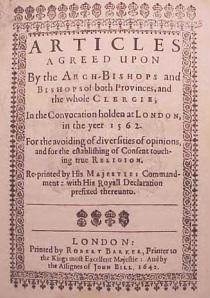
The “Thirty-nine Articles” of religion contain the rules and the practices of the Church of England. They were written following the English Reformation. They are contained in the Book of Common Prayer (devotion July 11) used by the Episcopal Church and the Church of England. These articles were written once Henry VIII established his own church and named himself Supreme Head of the Church. They began as Ten Articles in 1536. These original articles defined the Church of England in comparison to the rules of the Roman Catholic Church and the Protestant Reformation. These documents were written and revised over a 30 year period between when Henry VIII was excommunicated and when Elizabeth I was excommunicated in 1570. During the period of 1536 and 1570, the Thirty-nine Articles went through five alterations. The first draft of the Ten Articles was somewhat more pro-Protestant. This was because the English monarchs wanted to maintain a political relationship with the German monarchy, who were Protestant. In 1539 the next set of changes resulted in policies that did not have a pro-Protestant bent. The Archbishop of Canterbury Matthew Parker directed the Convocation of 1563 where the Thirty-nine Articles were instated. These final articles were less Calvinist and are the Church of England practices that are known today. (Adapted from “englishhistory.net”; “The 39 Articles of Religion”)

Here are the first Six Articles of the 39 Articles:
1. Of Faith in the Holy Trinity
2. Of Christ the Son of God
3. Of his going down into Hell
4. Of his Resurrection
5. Of the Holy Ghost
6. Of the Sufficiency of the Scriptures

Here are the first Six Articles of the Augsburg Confession:

1. God
2. Original Sin
3. The Son of God
4. Justification
5. The Ministry
6. New Obedience

Pastor Dave

Please collect bottles of shampoo and packages of deodorant for Trinity’s Table.

July 14, 2017: Timeline of the Reformation: The French Wars of Religion

July 14, 2017
Devotions: Timeline of the Reformation: The French Wars of Religion 1562 – 1598

France had its own split in regards to religion. The majority of the country remained faithful to the Catholic Church, but a strong group was faithful to the Protestant Reformation. As in Germany, and in England, war between the factions would result. Eight wars of religion were to succeed each other over 36 years, with periodic interruptions of fragile peace. The wars will cease with the Edict of Nantes (April 30, 1598), an edict that established a limited civil tolerance. In 1562, the Duke Francois de Guise massacred a hundred Protestants attending a worship service in the town of Wassy. This event is considered the beginning of the first war of religion. Louis de Bourbon, prince of Condé, called upon the Protestants to take up arms. War would spread throughout France. The second war of religion began in 1567. The Huguenot leaders decided to take up arms and the Protestants were able to take over several towns in the South of France. On St. Michael’s Day, September 30 1567, there was a massacre of leading Catholic citizens by Protestants – and in Paris, Huguenots were attacked by Catholics. A peace treaty would be signed on the 23rd of March, 1568 – it would only last five months. The wars in France were influenced by international events, especially by the revolt of the so-called “gueux”: subjects of Philip II of Spain in the Netherlands. The Duke of Albe, in the name of Philip II caused great repression in France and the Huguenots, seeking foreign alliances, concluded an agreement with them. And besides, each of the two sides benefited from foreign aid:

• the Protestants were allied to the Prince of Orange and Elizabeth of England ; the latter financed the expedition in Burgundy of the Palatine Count Wolfgang, Duke of the Two Bridges, in 1569;
• the Catholics received help from the King of Spain, the Pope and the Duke of Tuscany. (Adapted from The eight wars of religion, 1562 – 1598; museeprotestant.org)

The resulting wars that occurred throughout Europe over religious tolerance or intolerance and the resulting persecution and suppression and death and destruction that occurred because of these wars should give us pause every time we come to church on Sunday, or Saturday, or Thursday, or whenever you enter your space of worship. We are the fortunate ones who gather because our forefathers and mothers fought, died, fled, and sought out places where they could worship as they wished. Thank the Lord they had the courage and the fortitude to change. Yes, that should give us pause……

Pastor Dave

Please collect bottles of shampoo and packages of deodorant for Trinity’s Table.