
July 17, 2017 — Timeline of the Reformation: The Book of Concord 1580

July 17, 2017
Devotions: Timeline of the Reformation: Book of Concord, 1580
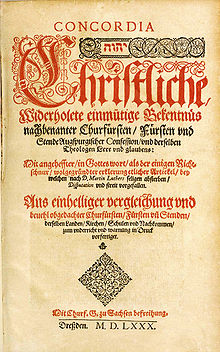
The Book of Concord of 1580 contains the most important writings of the Lutheran Church. Though it is not possible to give you a true taste of all of the writings included, it does include the Apostles’ Creed, the Nicene Creed, the Athanasian Creed, the Augsburg Confession, the Apology [Defense] of the Augsburg Confession, the Smalcald Articles, the Treatise on the Power and Primacy of the Pope, the Small Catechism, the Large Catechism, and the Formula of Concord.
For years the Lutheran Protestants were writing defenses and explanations of their beliefs and outlining the areas they could not agree with the Catholic Church – and other Protestant theologies. Luther himself was a prolific writer. After his death in 1546, there continued to be various controversies within the Lutheran Church in Germany. After much debate and struggle, the Formula of Concord was adopted in 1577 by over eight thousand princes, political rulers, theologians, and pastors. The Formula of Concord was meant to be an authoritative Lutheran statement of faith that contains two parts – the Epitome and the Solid Declaration. These two writings make up the final section of the Book of Concord.

The Formula of Concord, which was composed shortly before the publishing of the Book of Concord, was written and included in the Book of Concord for the overarching purpose of unifying the growing Lutheran movement. The ancient creeds, Apostles’, Nicene, and Athanasian, which appear in the Book of Concord were prepared by early church pastors and theologians. Philip Melanchthon, a layman, was a professor of Greek and theology at the University of Wittenberg is chiefly responsible for writing the Augsburg Confession, the Apology of the Augsburg Confession, and the Treatise on the Power and Primacy of the Pope. Martin Luther wrote the Small and Large Catechisms and the Smalcald Articles. A group of Lutheran theologians (Jacob Andreae, Martin Chemnitz, Nicholas Selnecker, David Chytraeus, Andrew Musculus, and Christopher Koerner) prepared the Formula of Concord.

The Lutheran Confessions are a summary and explanation of the Bible. They are not placed over the Bible. They do not take the place of the Bible. The Book of Concord is how Lutherans are able to say, together, as a church, “This is what we believe. This is what we teach. This is what we confess.” As you can discern, I hope, is the main reason we have the Book of Concord: it allowed the Lutheran theologians and adherents to put together, into one book, the teachings and understandings of Lutheranism – as it would become known. The Book of Concord continues to be our main educational and theological standard upon which we make decisions and teach the faith.

Pastor Dave

Please collect packs of toilet paper and rolls of paper towels for Trinity’s Table.

July 16, 2017 — Pentecost 6A

July 16, 2017 Pentecost +6A

“That same day Jesus went out of the house and sat beside the sea.2Such great crowds gathered around him that he got into a boat and sat there, while the whole crowd stood on the beach. And he told them many things in parables, saying: “Listen! A sower went out to sow. And as he sowed, some seeds fell on the path, and the birds came and ate them up. Other seeds fell on rocky ground, where they did not have much soil, and they sprang up quickly, since they had no depth of soil. But when the sun rose, they were scorched; and since they had no root, they withered away. Other seeds fell among thorns, and the thorns grew up and choked them. Other seeds fell on good soil and brought forth grain, some a hundredfold, some sixty, some thirty. Let anyone with ears listen!” “Hear then the parable of the sower. When anyone hears the word of the kingdom and does not understand it, the evil one comes and snatches away what is sown in the heart; this is what was sown on the path. As for what was sown on rocky ground, this is the one who hears the word and immediately receives it with joy; yet such a person has no root, but endures only for a while, and when trouble or persecution arises on account of the word, that person immediately falls away. As for what was sown among thorns, this is the one who hears the word, but the cares of the world and the lure of wealth choke the word, and it yields nothing. But as for what was sown on good soil, this is the one who hears the word and understands it, who indeed bears fruit and yields, in one case a hundredfold, in another sixty, and in another thirty.” (Matthew 13:1-9, 18-23)

“…who qualifies as “good soil”? Since soil cannot change itself, is there any hope for the hardened, rocky, and thorny soil? Are these destined to be unproductive forever? One can find examples of each kind of response to the word in Matthew’s Gospel. There are many in Matthew’s story who “hear the word of the kingdom and do not understand” (3:19), including the religious leaders who are antagonistic to Jesus’ ministry from the beginning. The crowds respond positively to Jesus, especially to his miracles of healing (9:8; 15:31; 21:8-9), yet turn against Jesus at the end and demand his crucifixion (27:15-23), leaving us to wonder whether they ever truly understood. The disciples themselves might be included among those who fall away “when trouble or persecution arises on account of the word” (3:21; cf. 26:56b, 69-75). What is remarkable is that in spite of these failings, Jesus does not give up on the disciples. In fact, he continues to invest in them, even to the point of entrusting the future of his mission to them. Jesus calls Peter the rock upon which he will build his church (16:13-20), even though Peter’s understanding of what it means that Jesus is the Messiah is confused at best (16:21-23). Although Jesus knows full well that all the disciples will desert him and that Peter will deny him, he nevertheless promises them, “But after I am raised up, I will go ahead of you to Galilee” (26:32). Jesus does meet them in Galilee as promised, and with all authority in heaven and on earth given to him, turns them loose in the world to carry out his mission (28:16-20). Matthew’s story has given us little reason to have confidence in the disciples. Little reason, that is, except for Jesus’ promises. Especially significant is Jesus’ promise at the very end of the Gospel: “And remember, I am with you always, to the end of the age” (28:20).” (workingpreacher.org, Commentary on Matthew, Elisabeth Johnson, July 10, 2011)

Back when I was doing my Teaching Parish experience in 2001, I was having a conversation with one of the parishioners. He was talking to me about one of their previous seminarians – actually he was there to do his internship. He said to me “I remember the sermon that so and so preached – the title was “The day the Devil came to Mechanicsburg”. That moment has stuck with me, some thirteen years later. You see, as a pastor, we never know how a sermon is going to be heard, or remembered. We preach and preach and preach, and write and read. One sermon is written, and preached and, as God is my witness, I start working on the next sermon on Sunday evening. However, the people who hear my sermon, the soil onto which I cast the seed of God’s word, or throw the words at you, how you receive that word is unknown to me. Some of you will lock on to a story or stories, while others will hear one or two phrases and will be transported to “I don’t know where”. Others, well you will remember either the first or the last thing that I say. But you may find some word, some seed of this message that may make a difference how you move forward this day – this week – this month. And yet……..maybe not. If any of these words have any staying power depends on the soil onto which they are cast – and the soil into which it is planted is out of my control.

Pastor Dave