

July 28, 2017
Devotions: Lutherans in North America: Muhlenberg and the Problems, Conflicts, and Pretenders
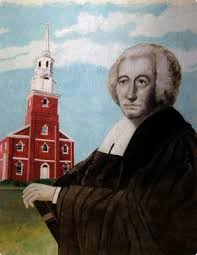
Immediately upon reaching Philadelphia Muhlenberg would meet with whomever he could to determine the state of the church. He would travel to places like “New Hanover” (Hanover) and Providence to establish his credentials with congregations who had hired schoolmasters and “Pretenders” to serve their congregations because of a lack of ordained pastors sent across the ocean from Amsterdam and Germany. Muhlenberg carried letters from Rev. Court Preacher Frederick Michael Ziegenhagen establishing his true status as an ordained pastor. What Muhlenberg would soon discover was a church with its many growing pains. Lutherans in North America would, over time, face three specific challenges: use of language in worship, “Pretender” pastors, and how to ordain pastors in North America.
The first to talk about is the use of language in worship. The Dutch had first come to settle this area, as we have learned, but the emigration of people from Amsterdam would slow to a trickle by the mid 1700’s. However, German immigrants were arriving and increasing in the New York area. Services in these churches were conducted in the Dutch language, and the Germans tolerated this fact for a time. But by 1742 there were enough German Lutherans in Manhattan to request to occasionally conduct a service in their own language. By 1745 they were requesting half of the services in the German language.
The Dutch language was the first language used for all transactions in the Dutch colony on The Hudson. All people of different nationalities would accommodate the Dutch language. After the English conquest, the situation slowly changed where by the middle of the 18th century most young people spoke English, while the older folks spoke Dutch. The Swedes settled on the Delaware, and many understood the Dutch language as well as Swedish. But by the mid 1700’s the Swedish language gave way to English as well. One Swedish minister wrote: “Many understand Swedish as well as English, but when I try to speak to them in Swedish they do not answer me and act as if they do not understand.” Now, we experience a similar dilemma with our Hispanic friends who come to Trinity’s Table. They appear to not understand English, but we have our suspicions that they actually do, they just choose to converse in their native language. The third major language group to settle in North America were the Germans, who came in large numbers after the Dutch and the Swedes. But the Germans, unlike the Dutch and Swedes were more stubborn in holding onto their native language. But the change over from German to English would happen over time – and it too would happen with the youth.
Rev. Muhlenberg would be an advocate for children to learn English stating: “…for this is the predominant language and is employed in trade, social intercourse, and the courts. Accordingly we preach in our churches, wherever it is necessary in English as well as German…we should look at language as we look at a bridge over a river. Whether it is made of oak or birch is not important, so long as it holds and enables us to get across and toward our goal.” (Adapted and adopted from The Lutherans in North America, revised edition, E. Clifford Nelson)
When I was assigned a congregation for my internship year in my seminary education, I was assigned St. John’s Lutheran Church in Colombia, Lancaster County. About a year before my arrival, St. John’s had merged with another congregation in Colombia – First English Lutheran Church. Just from the name of the congregation you can guess it origins. If you pay attention to the names of various Lutheran congregations in America, you will notice names like Augustana Swedish Lutheran Church (South Dakota), and Bethany Danish Evangelical Lutheran Church (Iowa), as well as St. John’s (Barners) Lutheran Church (Liverpool, PA). These congregations tell their origins and their original languages simply by their names – except St. John Barners, which became known by the name of the founding family, I assume. You can make a good guess without doing much research that First English parish was established in response to the language question many German immigrants would eventually need to address – should they worship in the German language of their ancestry, or in the English language of their new home? We see these same questions being asked by congregations in cities and towns across America who find their communities changing by demographics, which often includes language. The Lutheran church has always found a way to accommodate change – they just have not found a way to adjust quickly, and seamlessly – but as we all know, change is difficult. But with the help of the Holy Spirit, the church will continue and the word of G-d will continue to be preached, in whatever language is necessary.
Pastor Dave
Please collect bottles of laundry soap and packages of diapers (sizes 2 and 3) for Trinity’s Table.
 Lutheran Schreff