

July 24, 2017
Devotions: Lutherans in North America: Lutherans on the Delaware 1638-1703
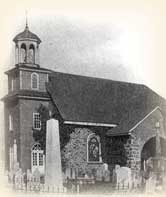
The Lutherans on the Delaware did not start out like those on the Hudson – small and without religious freedoms. The Lutherans on the Delaware were numerous, practically the entire population in the region, and they enjoyed the favor and the support of the colonial government. The few Dutch settlers on the Delaware had the freedom to practice the Reformed religion of their native land. Therefore the Lutherans enjoyed a more ordered church life on the Delaware – ministers were supplied from the Sweden consistory. The first minister to serve them was Rev. Reorus Torkillus, who conducted services from 1639 until his death in an epidemic four years later. It was during his pastorate that the first log church was built near Wilmington, Delaware. Rev. John Campanius replaced Rev. Torkillus and he remained pastor there for six years. A second church would be built in Tinicum, Pennsylvania and a third in “Wicaco” (near what is now Philadelphia). When this colony was taken over by the Dutch in 1655, the Lutherans were allowed to continue to freely meet and worship as they wished, unlike those Lutherans on the Hudson. The reasons appear to include the fact that the Reformed church did not have a pastor who spoke their (Swedish) language and there were troubles in Manhattan that needed their attention. Therefore the Lutherans continued to worship under the newly called Rev. Lars Lock. Rev. Lock was a native of Finland. He had moved to the Delaware area in 1647 – and would remain until his death in 1688. Rev. Lock, like Rev. Fabritius previously mentioned, liked his brandy and wine. The Dutch Reformed members in New Amsterdam would write about Rev. Lock saying: “This Lutheran preacher is a man of impious and scandalous habits, a wild, drunken, unmannerly clown, more inclined to look into the wine can than into the Bible. He would prefer drinking Brandy two hours to preaching one.” He would serve the Lutherans on the Delaware until 1671 when Rev. Jacob Fabritius moved into the area from New York. Rev. Fabritius would take charge of the congregations in Philadelphia and Tinicum, while Rev. Lock would concentrate on the lower Delaware regions of Wilmington, and New Castle, Delaware. Rev. Lock’s health would decline to the point where he could neither take care of himself or his flocks. Rev. Fabritius appeared to continue in his discourteous and drunken ways while in Delaware. He would be hauled into court for “using bad words which do not become a priest”, and “causing a tumultuous disturbance.” After both pastors died, it would take another decade to get a replacement. (adapted and adopted from The Lutherans in North America, revised edition, E. Clifford Nelson)
Being a pastor is not an easy business to be called into. It is not so easy in the 21st century, so I can only imagine how difficult it was in the 17th century. Without the conveniences we have today, like the telephone that allows us to be in touch, to have a car to make it easier to visit parishioners, and to have heat and lights to be relatively comfortable, living a life of trying to meet the spiritual and often physical needs of others would have been a physical and mental challenge. But G-d does not always call us to ventures that are comfortable, easy and within reach. Often G-d calls us to the unthinkable – like leaving home and traveling to a distant country to serve in areas that have little conveniences. And yet, we trust that G-d provides – at least provides us the strength to endure, if little else.
Pastor Dave
Please collect bottles of laundry soap and packages of diapers (sizes 2 and 3) for Trinity’s Table.
 Lutheran Schreff