

July 20, 2017
Devotions: Timeline of the Reformation: Edict of Nantes
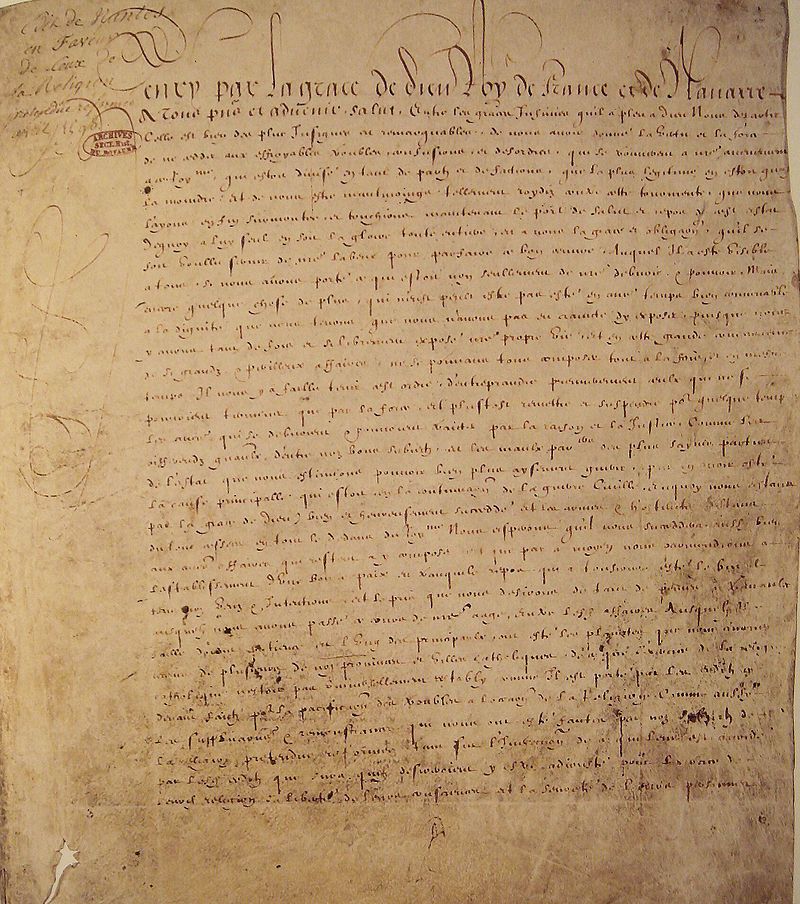
In 1572, there was a massacre of French Huguenots that is known as the St. Bartholomew’s Day Massacre. It was part of a wave of Catholic mob violence that would eventually lead to the signing of the Edict of Nantes a quarter of a century later. The Massacre took place on the wedding day of Margaret, the sister of King Charles IX. She was marrying a Protestant Henry III of Navarre who would become King Henry IV of France. Many of the most wealthy and prominent Huguenots had gathered in Paris, a majority Catholic city, to attend the wedding. The French Calvinists, who were known as Huguenots, were only in a minority in France, but they had created a virtual state within a state and held numerous fortified towns. But the St. Bartholomew’s Day massacre was just one of many religious wars that had torn France apart. Finally, King Henry IV would sign the Edict of Nantes, in the city of Nantes in 1598, temporarily putting an end to these religious wars. Estimates of the number killed in the massacres have varied from as few as 2,000 to as many as 70,000.
After much deliberation, a document of ninety-two articles was agreed upon, granting the Huguenots a measure of religious toleration as well as social and political equality. Huguenots were to be entitled to worship freely everywhere in France in private, and publicly in some 200 named towns. They were permitted to inherit property, engage in trade, attend all schools and universities, and be treated in hospitals on the same basis as everyone else. There was a full amnesty for crimes committed during the wars by both sides, and government agreed to pay the Protestant pastors and subsidize the garrisons of some fifty Huguenot fortified towns.
The agreement, though not accepted by all initially, would strengthen the French monarchy, which was able to neutralize the two rival factions. Henry IV was the first of the Bourbon kings of France and, though himself a notable Protestant leader, he would eventually became a Roman Catholic because that was the religion of the great majority of his subjects. The Edict would eventually weaken Protestantism in France until Louis XIV’s revocation of the edict in 1685 led to mass emigration of Huguenots to England and other countries. (Adapted from historytoday.com, The Edict of Nantes)
Pastor Dave
Please collect packs of toilet paper and rolls of paper towels for Trinity’s Table.
 Lutheran Schreff