

July 18, 2017
Devotions: Timeline of the Reformation: The King James Bible 1611
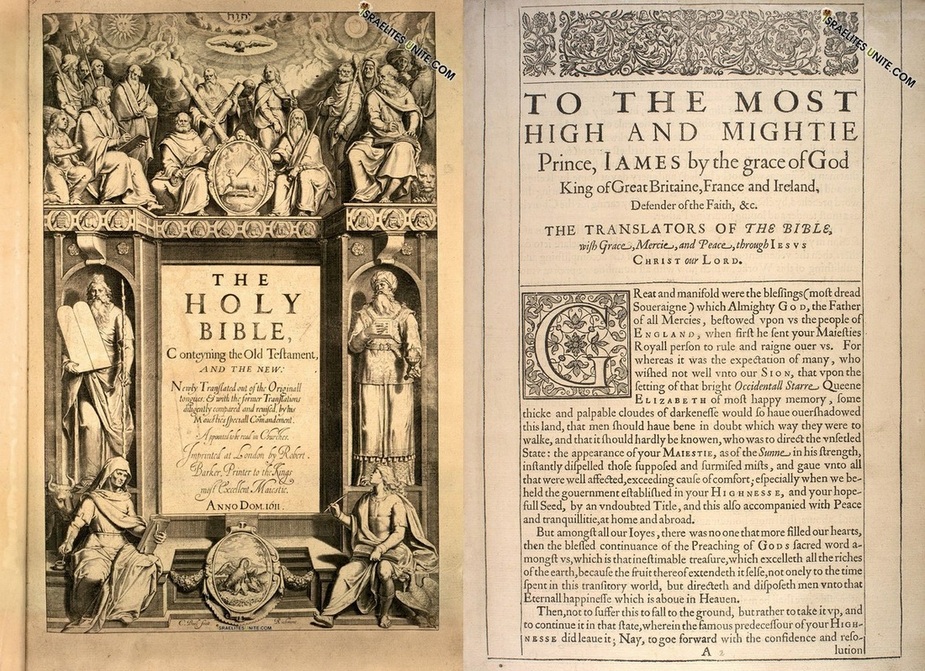
The King James Bible was named for the “mighty Prince James”. Who was this Mighty Prince? He was the son of Mary Queen of Scots, who was executed by her half-sister, England’s Queen Elizabeth I. When Elizabeth died she did not have a child, and so James was the next male in the royal line. At the time he was already the king in Scotland, and so he traveled to London to be crowned the king of England as well. History knows him as King James I of England, and King James the VI of Scotland. It is nice to be known as two separate kings, I guess, other than King Labron James of basketball fame.
Under Queen Elizabeth, the Church of England was an Episcopal form of Protestantism. But many of the Puritans felt Elizabeth had created a “compromise” church that wasn’t Protestant enough. These “Puritans” were a group of English Reformed Protestants who believed the Church of England under Elizabeth did not “Purify” itself enough of the Catholic practices. They wanted to see the Church of England completely separate from the Catholic faith. Before James had reached London, the Puritans presented him with the “Millenary Petition” (so called because it contained one thousand signatures) asking for moderate changes. However, James liked the Episcopal structure and the title he assumed as “Defender of the Faith” as the supreme head of the church. James agreed to a conference, which met in January 1604 at Hampton Court. Here, however, James warned the Puritans that if they did not conform, he would “harry them out of the land.” The conference was a failure for the Puritans, except on one point: James gave his approval to the making of a new translation of the Bible – which we know today as the King James Bible.
King James I of England, being a pretentious sort, wanted something to replace the popular Geneva Bible. This version, completed in 1560 (see July 13 devotion) and published by John Calvin, John Knox, Miles Coverdale, John Foxe, & other English refugees in Geneva was perceived by King James to have a Calvinistic slant. James wanted to give England one version that churches and individuals, and the Church of England and the Puritans, could read with benefit. In 1607, James appointed nearly fifty scholars and divided them into six companies. For two years and nine months they worked individually and in conference. Once they each had completed their work, the whole text was reviewed by a committee of twelve. It did use the original Hebrew and Greek in some cases, but primarily it closely followed previous translations, like the Geneva Bible and “The Great Bible” by Miles Coverdale of 1539 (July 7 devotion). Therefore it probably is inappropriate to call the King James Version a translation, for, as the “Preface of the Translators” explains, it is more accurately a revision of earlier versions. For example, the work of William Tyndale (1525), the first major English translator, is evident in many passages. The KJV has been called the “Authorized Version,” although, oddly, no proof has survived that James formally approved it. Officially, the new version was “appointed to be read in churches,” replacing the Bishops’ Bible. But it was a long time before it replaced the Geneva Bible as the Bible of the individual reader. (christianitytoday.com, 1611 Publication of the King James Bible)
To me, as a pastor, to hear so many churches use the King James Version of the bible claiming it as the only authoritative translation and version of scripture is confusing. Not only is it not a translation from the original languages, it is only a translation of a translation of a translation from manuscripts of which we have older and more authoritative copies. And, actually, as long as we are reading and studying scripture from all kinds of translations, we will be the better for it as we will see how different translators make decisions trying to give an accurate accounting of the words and thoughts and teachings of the original authors.
Pastor Dave
Please collect packs of toilet paper and rolls of paper towels for Trinity’s Table.
 Lutheran Schreff