

July 17, 2017
Devotions: Timeline of the Reformation: Book of Concord, 1580
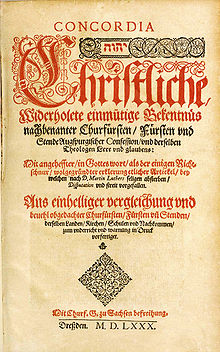
The Book of Concord of 1580 contains the most important writings of the Lutheran Church. Though it is not possible to give you a true taste of all of the writings included, it does include the Apostles’ Creed, the Nicene Creed, the Athanasian Creed, the Augsburg Confession, the Apology [Defense] of the Augsburg Confession, the Smalcald Articles, the Treatise on the Power and Primacy of the Pope, the Small Catechism, the Large Catechism, and the Formula of Concord.
For years the Lutheran Protestants were writing defenses and explanations of their beliefs and outlining the areas they could not agree with the Catholic Church – and other Protestant theologies. Luther himself was a prolific writer. After his death in 1546, there continued to be various controversies within the Lutheran Church in Germany. After much debate and struggle, the Formula of Concord was adopted in 1577 by over eight thousand princes, political rulers, theologians, and pastors. The Formula of Concord was meant to be an authoritative Lutheran statement of faith that contains two parts – the Epitome and the Solid Declaration. These two writings make up the final section of the Book of Concord.
The Formula of Concord, which was composed shortly before the publishing of the Book of Concord, was written and included in the Book of Concord for the overarching purpose of unifying the growing Lutheran movement. The ancient creeds, Apostles’, Nicene, and Athanasian, which appear in the Book of Concord were prepared by early church pastors and theologians. Philip Melanchthon, a layman, was a professor of Greek and theology at the University of Wittenberg is chiefly responsible for writing the Augsburg Confession, the Apology of the Augsburg Confession, and the Treatise on the Power and Primacy of the Pope. Martin Luther wrote the Small and Large Catechisms and the Smalcald Articles. A group of Lutheran theologians (Jacob Andreae, Martin Chemnitz, Nicholas Selnecker, David Chytraeus, Andrew Musculus, and Christopher Koerner) prepared the Formula of Concord.
The Lutheran Confessions are a summary and explanation of the Bible. They are not placed over the Bible. They do not take the place of the Bible. The Book of Concord is how Lutherans are able to say, together, as a church, “This is what we believe. This is what we teach. This is what we confess.” As you can discern, I hope, is the main reason we have the Book of Concord: it allowed the Lutheran theologians and adherents to put together, into one book, the teachings and understandings of Lutheranism – as it would become known. The Book of Concord continues to be our main educational and theological standard upon which we make decisions and teach the faith.
Pastor Dave
Please collect packs of toilet paper and rolls of paper towels for Trinity’s Table.
 Lutheran Schreff