

July 11, 2017
Devotions: Timeline of the Reformation: Book of Common Prayer 1549
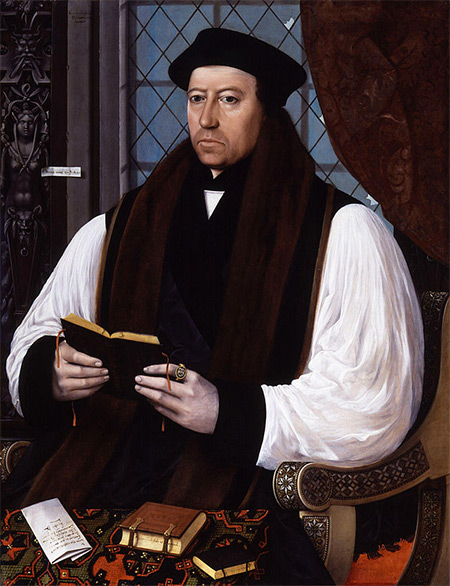
The Latin Mass was abolished by the House of Lords in England in 1549. For the first time in England, English services would be the only legal services held throughout the country – services that were to be found in the new Book of Common Prayer. The Book of Common Prayer was approved by a committee of thirteen clerics – and was written by Thomas Cranmer, a superb writer and cleric. Cranmer had been the Archbishop of Canterbury – appointed by Henry VIII at the prompting of Anne Boleyn. People who knew him called him a “quiet man of scholarly bent, and liked by most who knew him.” The Prayer Book was influenced by Lutheran services including blending into the book matins and evensong services.
The Book of Common Prayer went through many changes and adaptations over the years – sometimes made to please the Protestant critics, and sometimes made to please the Catholic critics. In fact it was revised in a more Catholic spirit in 1559, to be succeeded eventually by the 1662 Anglican prayer book, more Catholic still and the familiar one which has lasted down into this century. Among Cranmer’s innovations, retained in the new book was the requirement of holding weekly Communion services. The practice before the English Reformation was that the laity received Holy Communion on rare occasions – in some cases just one time a year. Practice, however, varied from place to place: in some churches, regular communion was very popular, in other places families stayed away or sent “a servant to be the liturgical representative of their household.” Few parish clergy were initially licensed to preach by the bishops; in the absence of a licensed preacher, Sunday services were required to be accompanied by reading one of the homilies written by Cranmer. (Adapted from The First Book of Common Prayer, historytoday.com, January 1, 1999; wikipedia)
Pastor Dave
Please collect bottles of shampoo and packages of deodorant for Trinity’s Table.
 Lutheran Schreff