

July 8, 2017
Devotions: Timeline of the Reformation: The Council of Trent 1545
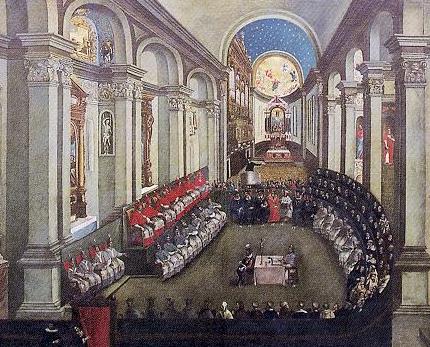
Pope Paul III appointed a commission to examine the state of the church, and the commissioning was called the Council of Trent. The commission’s report, Concerning the Reform of the Church, was pointed: Popes and cardinals had become too worldly; bribery to gain church office was widespread; monasteries had lost their discipline; and the selling of indulgences was widely abused.
The pope did not attend the meetings of the Council. But his legates ensured that the pope’s views would always be put forward to those in attendance. The council held a number of meetings, with the three main sessions occurring in 1545–7, 1551–2, and 1562–3. Because there were long lapses in between sessions, those representatives in attendance changed over the course of the council. And the attendance was small; the opening session attracted only 34 leaders, and the largest meeting of the third session had only 255. The council brought together a variety of competing agendas. Some priests and cardinals resisted any reforms that would hinder their lifestyles. Bishops from Spain and France wanted a stronger, independent role. The Jesuits, on the other hand, stood firmly for papal supremacy. Some council delegates, like Emperor Charles V (who faced a Protestant challenge in his realm, the vast Holy Roman Empire), wanted Protestants and Catholics to reach a compromise. In a few instances, the delegates came to blows. Finally, as just a brief overview of the Council and their decisions, on the issues of Scripture and authority, the Catholic Church moved that the only official version of the Bible was the Latin Vulgate, and that no private interpretations of Scripture could depart from the church’s teachings. It also rejected the Protestant view of “Scripture alone” and declared that along with the Scriptures, tradition as preserved by the church was a source of authority.
The Council of Trent helped to bring much-needed reform to the Catholic Church. It also refined the church’s structure and on matters of doctrine, the council made the gulf between Catholics and Protestants deep and lasting. Any remaining hopes of reunion were dashed. The Council of Trent defined what the Catholic Church would be for four centuries. Not until Vatican II, in the 1960s, did a major reexamination take place. (Adapted and adopted from the historylearningsite.co.uk, and christianitytoday.com, The Council of Trent Begins)
Vatican II did bring about some changes in the Catholic Church that we see still in effect today. Perhaps one of the most immediate changes was the revision of the liturgy. In the mid-1960’s permission was granted to celebrate the Mass in the vernacular of the people. No longer would they need to listen to the liturgy in Latin. Recently, however, the Catholic Church has once again allowed the Mass to return to the Latin language in certain circumstances. The amount of scripture read during the Mass was expanded as well. In terms of Ecclesiology, the Council of Trent presented a document titled The Dogmatic Constitution on the Church or Lumen gentium. In its first chapter, titled “The Mystery of the Church,” is the famous statement that:
… the sole Church of Christ which in the Creed we profess to be one, holy, catholic and apostolic, which our Savior, after His Resurrection, commissioned Peter to shepherd, and him and the other apostles to extend and direct with authority, which He erected for all ages as ‘the pillar and mainstay of the truth.’ This Church, constituted and organized as a society in the present world subsists in the Catholic Church, which is governed by the successor of Peter and by the bishops in communion with him.”
Immediately following that statement, which seems to imply that the only true church on earth is the Catholic Church, comes this statement:
“Nevertheless, many elements of sanctification and of truth are found outside its visible confines.”
Perhaps there is a chance for the Lutherans and the Catholics to find a way to come to an Ecumenical Agreement sometime soon.
Pastor Dave
Please collect toilet tissue and facial tissues for Trinity’s Table.
 Lutheran Schreff