

July 6, 2017
Devotions: Timeline of the Reformation: The Pilgrimage of Grace 1536
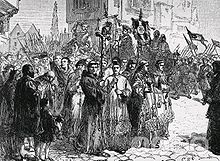
Of course, just because you are king and you wish to have things your way does not mean that everyone agrees with your actions. Thus was the case with Henry the VIII. With his passing of the Act of Supremacy, and the Dissolution of the Monasteries, a popular uprising was sparked called the Pilgrimage of Grace in October 1536. The traditional historical view portrays the Pilgrimage of Grace as “a spontaneous mass protest of the conservative elements in the North of England angry with the religious upheavals instigated by King Henry VIII”.
The first uprising occurred in Lincolnshire, England in October 1536 and lasted about two weeks. While it did not last long, the revolt did represent a major threat to the government. This was because those partaking in the rebellion were not just the “commoners”, but English Nobles were also involved in the Lincolnshire Uprising. There is some evidence that some nobles may even have orchestrated the uprising – but others were forced to join it or were threatened with death if they did not participate. The king could not use local militia to quell the uprising because it was feared that they would join the rebels. Therefore, troops had to be brought in from other areas of the kingdom.
By October it is believed that the uprising had grown to almost 40,000. They received a decent welcome because they were well disciplined and orderly. But as the uprising heated up, many of the nobles realized that their participation could result in negative consequences. Therefore, when the first opportunity availed itself for them to retreat, the Nobles did just that. With the loss of the Nobles, many of the commoners also retreated. King Henry had always dealt with those who opposed him in quick and harsh terms. But in this case, he was forced to deal with a much more serious rebellion in Yorkshire which took Henry’s mind off the uprising in Lincolnshire. The Yorkshire uprising is the one known as “The Pilgrimage of Grace”. It also included some nobles, but it was primarily made up of commoners. But this uprising differed from the one in Lincolnshire because of their leadership. Robert Aske, a lawyer from Yorkshire was a skilled organizer. It was he who coined the phrase “Pilgrimage of Grace”. It gave the uprising an air of holiness and Aske hoped it would cause Henry VIII to cease his attacks on the church and the monasteries, and consider returning England to following the Pope. Aske hoped that once Henry witnessed their efforts as a spiritual pilgrimage, he might change his mind. But Henry was not to be trusted.
King Henry had ordered the Duke of Norfolk and the Earl of Shrewsbury to end the uprising. One problem was the lack of men the Duke and the Earl could muster to form an army to confront them. Aske, still hoping for a settlement agreed to meet with the Duke of Norfolk. Norfolk collected the demands from the rebels and persuaded them to disband while he took them to the king. Henry received the demands but stalled in giving his response. His hope was to give time for Norfolk to find a way to crush the rebellion. Aske and other leaders met to write-up what became known as the “24 Articles” – nine specifically religious demands and six specifically political demands and nine covering a mix of political and religious topics. Norfolk worked out an agreement with the rebels that he would take the articles to the king, a Parliament would discuss them, and all pilgrims would receive a pardon if they disbanded now that their “Articles” were handed over.
Aske and the other leaders of The Pilgrimage of Grace thought they had achieved a victory –but the king was just buying time. Aske traveled to London to meet the king who was able to get names from Aske of those who participated in the rebellion. Aske returned to Yorkshire convinced the king was a decent man and began to support King Henry. But the other leaders began to get nervous when the promised pardon did not arrive. In the meantime Norfolk was able to assemble an army. Aske and his leaders agreed to meet with King Henry to answer questions. Upon reaching London they were arrested, tried, and convicted of treason. All were executed in London, except Aske, who was executed in Yorkshire.
Pastor Dave
Please collect toilet tissue and facial tissues for Trinity’s Table.
 Lutheran Schreff