
July 31, 2017 — Devotions: Lutherans in North America: Ordination

July 31, 2017
Devotions: Lutherans in North America: Ordination of Lutherans in America
The colonials needed pastors – and the supporting churches in Amsterdam and Germany could not supply enough ministers to the Lutherans in colonial America. One of the first solutions was to have ministers take students of theology into their homes and do private tutoring. Obviously there were no schools of theology yet in North America. Not only did the ministers take students into their homes, but the students would observe their tutors to become acquainted with practical parish work. One of these ministers was Henry Muhlenberg. According to records, once a student passed “a brief examination in ancient languages and theology”, the candidate student would be licensed “to preach, catechize, and administer the Holy Sacraments…” for a period of one year and only in places where they were appointed. This license could be renewed annually until such a time as the student was deemed ready for ordination.

Over time the requirements were relaxed due to the demand for ministers. As long as there was evidence of “righteousness of the heart and personal experience of repentance, faith and devotion…” students were more quickly deemed prepared for the ministry. In 1749, Henry Muhlenberg purchased 49 acres of land near Philadelphia on which he hoped to establish, among other institutions, a theological seminary. Eventually he would abandon his plans due to a lack of funds. He would write his “Reverend Fathers” again and again for the need of “…at least a sort of seminary” be established in colonial America. In 1773 John C. Kunze founded an academy in Philadelphia “to furnish the preparation preliminary to the further training of young men for the office of the ministry”. When Philadelphia was occupied by British troops in 1777 this school ceased to exist. Following the revolution, in 1787 Luther and German Reformed leaders united to found Franklin (later Franklin and Marshall) College in Lancaster, PA. It will take until the early 1800’s that a school of theology would come to exist for Lutherans in America. Until then, students would be tutored privately for careers in the ministry. (Adapted and adopted from The Lutherans in North America, revised edition, E. Clifford Nelson)

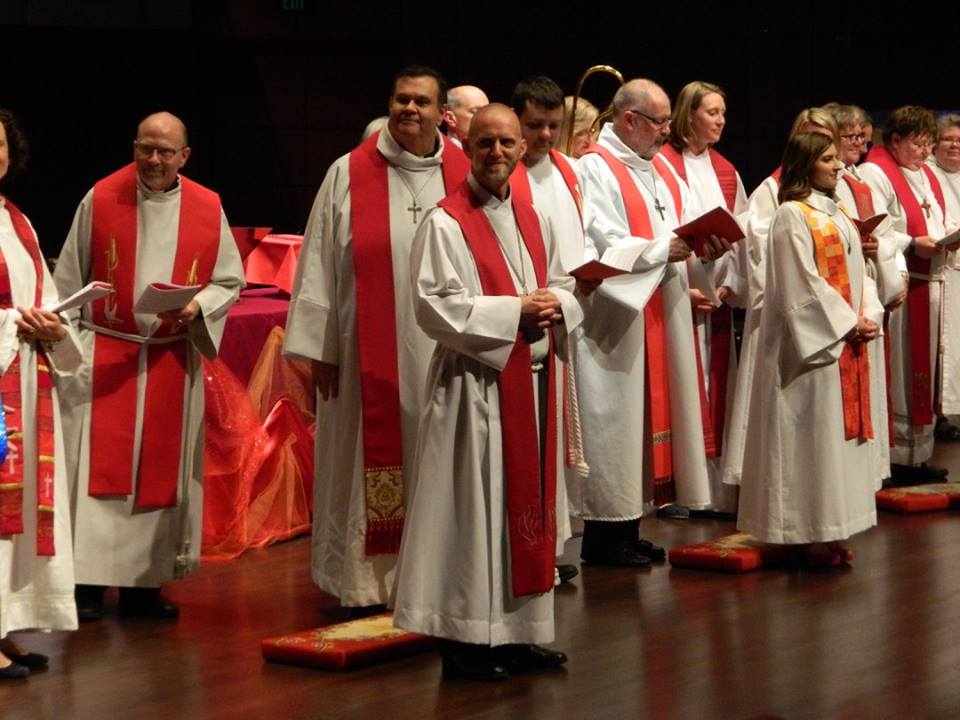
Ordination would be the practice that colonial American ministers would bring from Europe for the preparation of ministers. Ordination was not seen as conferring any special powers – it was seen as a formal and public authorization of certain persons signifying they were set aside to perform ministerial functions. And the ordination would be a public, not a private event. It would be held as part of a corporate assembly and not by just an individual (which was the practice of the pretenders). Ordination today is one of the most powerful services a Lutheran can attend. I encourage you to find the time to attend an ordination service – it is a profoundly, spiritually uplifting service.

Pastor Dave

Please bring bars of soap for Trinity’s Table.

July 30, 2017 — Pentecost +8A

July 30, 2017 — Pentecost +8A

“He put before them another parable: “The kingdom of heaven is like a mustard seed that someone took and sowed in his field; it is the smallest of all the seeds, but when it has grown it is the greatest of shrubs and becomes a tree, so that the birds of the air come and make nests in its branches.” He told them another parable: “The kingdom of heaven is like yeast that a woman took and mixed in with three measures of flour until all of it was leavened. “The kingdom of heaven is like treasure hidden in a field, which someone found and hid; then in his joy he goes and sells all that he has and buys that field. “Again, the kingdom of heaven is like a merchant in search of fine pearls; on finding one pearl of great value, he went and sold all that he had and bought it. “Again, the kingdom of heaven is like a net that was thrown into the sea and caught fish of every kind; when it was full, they drew it ashore, sat down, and put the good into baskets but threw out the bad. So it will be at the end of the age. The angels will come out and separate the evil from the righteous and throw them into the furnace of fire, where there will be weeping and gnashing of teeth. “Have you understood all this?” They answered, “Yes.” And he said to them, “Therefore every scribe who has been trained for the kingdom of heaven is like the master of a household who brings out of his treasure what is new and what is old.”” Matthew 13:31-33, 44-52

“Jesus’ parables remind us that the faith we preach and the kingdom we announce finally isn’t an intellectual idea but an experience, an experience of the creative and redemptive power of God that continues to change lives. And sometimes the only way to get beyond our head and into our hearts is to, as Emily Dickenson advised, “Tell all the truth but tell it slant.” And so parables come at us sideways, catching us by surprise to take our breath away at the beauty and depth of God’s promises. “This week’s passage presents us with a series of parables that evoke distinct elements of God’s kingdom. The first two parables are about the surprising presence, even invasiveness, of God’s reality and reign… I have to admit that for much of my life, I’ve fallen prey to the temptation to read these parables as something like a proverb: “big things sometimes have small beginnings” or “don’t judge something based on its size.” Makes sense on a superficial level, as each parable talks about something small – a mustard seed or a bit of yeast – blossoming into something much grander. Until you realize, however, that neither mustard seed nor yeast was viewed positively in Jesus’ world. Mustard was a weed, dreaded by farmers the way today’s gardeners dread kudzu, crabgrass, or bindweed. It starts out small, but before long has taken over your field. Similarly, yeast was a contaminant and almost always represents the pernicious nature of sin when mentioned in the Bible.Why, then, compare the kingdom of God to a pernicious weed and pollutant? Because both mustard seed and yeast have this way of spreading beyond anything you’d imagined, infiltrating a system and taking over a host. Might God’s kingdom be like that – far more potent than we’d imagined and ready to spread to every corner of our lives? How might we regard routine invitations to read the Bible, pray, and come to Sunday worship if we thought these things might lead to our lives being infiltrated, changed, and taken over by God’s reality and rule?” (David Lose, “Parables That Do Things”, davidlose.net, July 21, 2014)

Here is what I see when I hear these two parables. Sometimes the kingdom of heaven will be obvious to us – the veil between heaven and earth becomes so thin that we just know it is present – times like when we gather at church – when we sing one of the old-time hymns – when acts of love are done among us – when we pray – when we help someone in need. It is in these moments that we feel the kingdom is so close to us. The surprising thing about the kingdom of heaven is that it will often pop up where we least expect – where we least predict – in the people we least expect. Sometimes it will grow quickly, and then disappear. Other times it will be so small we miss it, until it grows in amazing ways. And my friends, that is what G-d’s word should be about – it is about the word of G-d planted either as a small seed or as something hidden within – and over time, it grows, but we know not how – and can grow to be taller, and wider and deeper – and it can have an impact on our lives and the lives of others – so much more than we could have ever imagined.

So we keep doing what we do even though what we do in the church sometimes seems so small – so insignificant – so mustard seed sized we just want to quit. But we can’t quit, because these parables seem to say to us that sometimes it is through things that seem insignificant and ineffectual that the kingdom of heaven comes. So we keep planting seeds, keep hiding God’s word of leaven. We may not see the result immediately, or even in our lifetime. But Jesus promises that all that we do in the name of Jesus Christ does matter, no matter how little. And the seeds we sow today may just sprout into something magnificent years from now – only because we didn’t stop – we didn’t give up – we kept up in trust and faith.

Pastor Dave