
June 24, 2017 — Timeline of the Reformation: Diet of Worms

June 24, 2017
Devotions: Timeline of the Reformation: 1521 – Diet of Worms
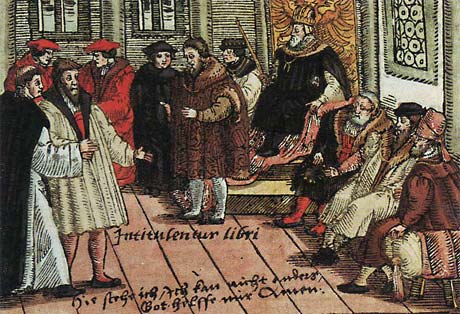
The Diet of Worms of 1521 was another pivot-point for the Protestant Reformation – at least from the Lutheran perspective. Following the three treatises that Luther published in 1520, there obviously was concern regarding his safety and the charges of heresy by the Holy Roman Empire. A Diet was the deliberative and legislative body of the Holy Roman Empire. Probably the most famous Diets would include the several held in Worms (1495, 1521) the Diets of Speyer (1526, 1529) and several held in Nurember. In June of 1520 Pope Leo X condemned 41 of Luther’s 95 Theses, but he gave Luther time to recant his writings. In response Luther would burn the papal bull in public and, as you would expect, he refused to renounce his writings. While he should have been arrested and put to death after his excommunication on January 3, 1521, Elector Frederick III the Wise intervened. It was decided that Luther would appear in front of the Diet in Worms, under the safety of the Elector, who promised him safe passage. On April 17, 1521 Luther appeared in front of the Diet. When they asked him if the books stacked in front of him were in fact his writings, he agreed that they were. When asked to recant his writings he refused – not immediately, for he asked for some time to reflect. The next day he met in front of the assembly, and refused to repudiate his works unless convinced by error of Scripture or reason. He famously said:

 “If I now recant these, then, I would be doing nothing but strengthening tyranny. Unless I am convinced by the testimony of the Scriptures or by clear reason (for I do not trust either in the pope or in councils alone, since it is well known that they have often erred and contradicted themselves), I am bound by the Scriptures I have quoted and my conscience is captive to the Word of God. I cannot and will not recant anything, since it is neither safe nor right to go against conscience. May God help me. Amen.” Disorder broke out at the conclusion of Luther’s statement and the emperor Charles V dismissed the Diet for the day. Private conferences followed the days’ events. Luther fled and was given safe passage to the Castle in Wartburg by Frderick III the Wise. It was during his time in Wartburg that Luther began his German translation of the Bible.

Pastor Dave

Please collect one pack of diapers size 1 or 2 for Trinity’s Table.

June 23, 2017– Timeline of the Reformation: Luther’s Treatises

June 23, 2017
Devotions: Timeline of the Reformation: 1520 – Luther’s Treatises
The Babylonian Captivity of the Church

Martin Luther stood before the Holy Roman Emperor at the Diet of Worms in 1521. A stack of Luther’s books stood on the table in front of him. The chair of the meeting asked him if he acknowledged that these books were his, and if he wished to confess his books or recant. Luther, after deliberating for a day, gave his famous answer: “I cannot and will not retract anything. … Here I stand. God help me. Amen.”

What books was Luther pressured to recant? Among them were three key writings from 1520 that described the specific types of reforms Luther was advocating. One of these 1520 treatises is The Babylonian Captivity of the Church. In this book Luther spoke in specific about the sacramental system of the Roman Church. Not only did he summarize his thoughts on the sacraments, but he spoke on the number of sacraments he believed were necessary for the faith. The irony of the situation is that while he was preparing his writing, the papal bull announcing his excommunication was also being prepared, and would arrive in Wittenberg just a week after his publication of “The Babylonian Captivity of the Church”. In other words, while Luther was putting the sacramental system of the church on trial, he was about to be put on trial himself.

In his book, Luther wrote that as Babylon held Israel captive, now the papacy was holding Christians in bondage by Rome’s theology and use of the sacramental system. The Roman Catholic Church has seven sacraments, and Martin Luther addresses each sacrament individually. He maintains that only three of the seven should in fact be sacraments: baptism, communion, and penance. But these three, he writes, are being held captive by the Roman Church. At the heart of each sacrament is God’s promise and faith which clings to the promise. For instance, Luther writes that the sacrament of the altar is Christ’s testament. A testament is a promise made by a person about to die. Since the mass, being a testament, is a promise, then access to the mass and its gifts is not gained by merits or works, but solely by faith.

For example, Luther writes that G-d deals with G-d’s people through a promise: we in turn deal with G-d through faith in the promise, not by works. Faith and the promise must go together. Luther writes that the Roman Church holds the sacraments in captivity by suppressing the promise and faith, replacing them with works and merits. The problem is not the rites attached to the mass, but the way the rites distract from the Words of Christ (the promise). For example, in baptism, the church overlooked faith and instead emphasized penance. Luther will go on to look at each sacrament to see if there is a divine promise attached to it that calls for faith. Luther will conclude that without the promise of faith, the sacrament should not be a sacrament, or they should redefine what a sacrament is. So, Luther writes that it seems best to restrict the name “sacrament” to divine promises with a sign attached to them. By this definition the number of sacraments is further reduced from three to two: baptism and the sacrament of the altar. Penance, which Luther earlier named a sacrament, does not have a sign. Accordingly, Luther argues that either penance should not be considered a sacrament, or a different definition of sacrament should be formed. (adapted from January 12, 2016 The Babylonian Captivity of the Church, by Rev. Aaron Moldenhauer)

Pastor Dave

Please collect one pack of diapers size 1 or 2 for Trinity’s Table.