
June 6, 2017 — Personalities of the Reformation: John of Leiden

June 6, 2017
Devotions: Personalities of the Reformation: John of Leiden
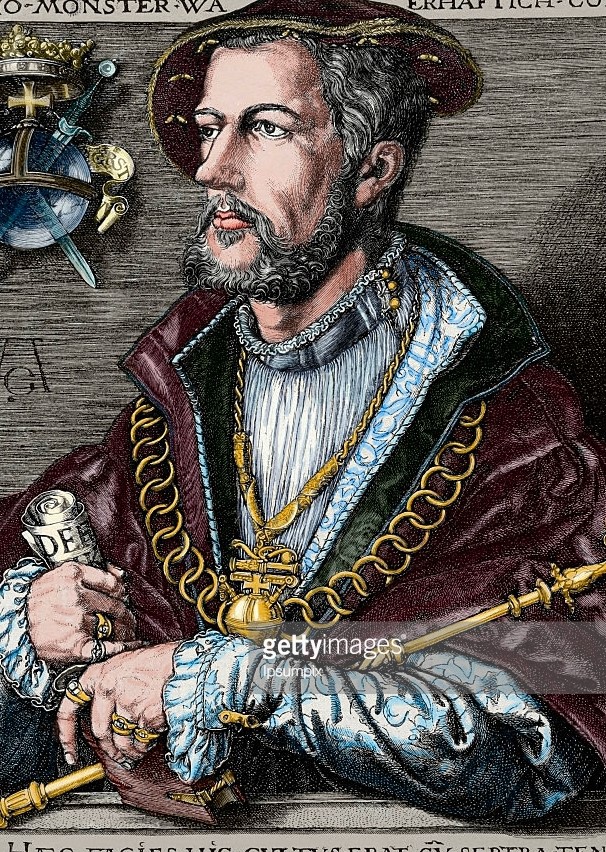
 
John of Leiden was born on February 2, 1509 in Leiden, Netherlands, and died on January 22, 1536 in Munster, Germany. He was a tailor, a merchant, and an innkeeper before becoming a follower of the Anabaptist movement. He was baptized by John Matthys of Haarlem in 1533. He became an evangelist for Anabaptist theology and was sent by John Matthys to various parts of the Netherlands. At first he followed the generally peaceful Anabaptist views, those of praying while waiting for the coming of the Kingdom of G-d. But over time he would convert to the movement of calling the faithful to use the sword against the unbelievers in order to establish the kingdom of G-d on earth.
 
In January of 1534, John of Leiden moved to Munster in Westphalia, Germany. John Matthys would soon come to take over power of the city and began to establish the kingdom of G-d. Under his direction, Munster was “purged” of the “godless” nonbelievers. Matthys would be killed in April 1534 and John of Leiden would replace him as the Anabaptist leader. As leader in Munster, John of Leiden reinforced: Community of goods was the basis of the whole Baptist movement. For its sake the great fight was waged at Münster. It was not, however, the chief factor in determining the character of the Münster Baptist government, that factor being the siege. The town was a great war-camp; the demands of war took precedence of all other matters, and sentiments of freedom and equality were active only in so far as they were compatible with military dictatorship.
 
In July 1534, John of Leiden introduced polygamy, which of course met a lot of opposition. Later that year he would “Crown” himself King of the New Jerusalem. He continued to slip into “un-reality” parading around Munster in regal costumes, and suggesting he could lead his followers to defeat the gathering army. The army that surrounded the city of Munster was an army of Catholics and Protestants. This army captured the city in 1535 and the Anabaptist leaders John of Leiden, Bernhard Krechting, and Berhard Knipperdolling were tortured and killed. The following describes their demise:  The three were chained to stakes in the Münster public square, tortured with flesh-ripping tongs for more than an hour, killed with daggers thrust into their hearts, and their remains hoisted in cages in the city cathedral as a warning against any kindred misbehavior in the future. And the point was taken: the appalling deaths of these men also marked the death of early Anabaptism’s pretensions to secular political power. (1536: The Munster Rebellion leaders, executedtoday.com, January 22, 2012)
 
Historians will go on to regard this episode of Anabaptist practice as an aberration of their movement, however this small but radical form of Anabaptist practice led to a constant persecution of Anabaptists by Lutherans, Calvinists, and Catholics. The more pacifist Anabaptists like Menno Simons and Dirk Philips would rally in the Netherlands and northern Germany. (much of the information used for this devotion was taken from britannica.com, Anabaptist, Protestantism)
 
Pastor Dave
 
Please collect two items of your choice for Trinity’s Table this week.
June 5, 2017 — Personalities of the Reformation: Thomas Muntzer

June 5, 2017
Devotions: Personalities of the Reformation: Thomas Muntzer

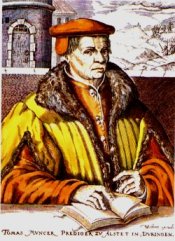
Thomas Muntzer was born in Stolberg, Thuringia in 1489 (now central Germany) – and he would die on May 27, 1525 in Muhlhausen, Germany much. Not is known about his early years. He was ordained as a priest sometime before 1514. Sometime before Luther nailed the 95 Theses to the church door in Wittenberg, Muntzer became part of the Reformation movement. He, like Luther, was frustrated with priestly privilege, and the abuses and the hierarchy of the Catholic Church. Muntzer grew to a deeply entrenched belief that “all true parsons must have revelations, so that they are certain of their cause.”
 
In 1521, the year of the Diet of Worms controversy, Muntzer spoke out in Prague criticizing clergy who would not confess the need for continuing revelation, saying “…these villainous and treacherous parsons are of no use to the church…” Muntzer would, of course, become part of what would become part of the Radical Reformation movement. Radical here means the idea that society needed a complete restructuring in anticipation of the impending Millennium, and that would require new revelation. Luther would not share the idea of the necessity of a “conversion experience”, nor believe Muntzer’s idea that the Holy Spirit gave new revelations in the present day. In fact, in 1523 Luther would use a term about Muntzer that might be translated as “fanatic” to describe a faith that relied so much on “modern-day prophetic revelation”. Muntzer would gain support from the people he preached to, but certainly upset the political status quo.
 
While serving a post at St. John’s Church in Allstedt, Germany he was reported to the Elector, Frederick the Wise for banning infant baptism and teaching that the bread and wine of the Eucharist did not contain the real presence of Christ. John Frederick ordered Muntzer to come and preach in front of him and colleagues in July of 1524. For his text Muntzer chose the second chapter of Daniel. Muntzer would go on to preach that “…in dangerous matters as those which true preachers and princes have to deal with…it would never be possible to guard themselves securely against error on all sides, and to act blamelessly, if they did not rely on revelations from God.” Muntzer would strongly imply that he was a new Daniel, positioned to reveal G-d’s mind to the political elite. When Muntzer had his sermon printed, Luther came out in opposition of his beliefs. Violence would follow Muntzer and his followers, some stemming from Luther’s outspoken opposition. Muntzer would be forced to leave Allstedt for Mulhausen in central Germany. Muntzer would lead uprisings against his political and spiritual opponents. Saxon soldiers would put down the uprising and arrest Muntzer. Under torture he confessed to sedition and recanted his views that were most revolutionary. Eventually Muntzer would write: “I, too, am heartily content that God has ordained things in this way.” He lamented that people were not yet ready for the kingdom and that the princes must continue to rule. Thomas Muntzer was beheaded on May 27, 1525, outside Mulhausen, where his impaled head and body were displayed as a warning to agitators who might agree with Muntzer’s ideas. (rsc.byu.edu, Thomas Müntzer and the Radical Reformation, Steven C. Harper)
 
Despite the many Biblical quotations in Müntzer’s writings, it was his doctrine that true belief was dictated by spiritual experience. The Bible was for him evidence only of spiritual experiences of the past: the words of the Bible still had to be validated by the working of the Spirit in the believer’s heart. The doctrines of essential suffering, of spiritual revelation, of denial of the fear of Man – all combined with the expectation of the Apocalypse to place the ‘Elect’ person in total opposition to feudal authority, and opposition to both Catholic and Lutheran teaching. However, this was no individualistic path to salvation: the importance Müntzer laid on communal activities are central to his ministry. Thomas Muntzer, like many of the Radical Reformers, would have been an interesting person to meet.
 
Pastor Dave
 
Please collect two items of your choice for Trinity’s Table this week.