
June 8, 2017- Personalities of the Reformation: Sebastian Franck

June 8, 2017
Devotions: Personalities of the Reformation: Sebastian Franck
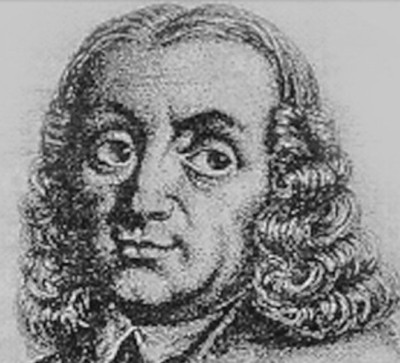

 
Sebastian Franck, born circa 1499 and died circa 1543 was a German Protestant Reformer, theologian, humanist, and eventually a Radical Reformer. He like many of his time was ordained a Roman Catholic Priest, but he converted to Lutheranism in 1525. He would become increasingly dissatisfied with Lutheran doctrine, and also would grow to hold in disdain the concept of an institutional church. He soon developed his own vision of an “invisible spiritual church”. Turns out Franck, like a number of his contemporaries, was a prolific writer. His first book was a German translation of a book directed against Sacramentarians and Anabaptists by Andrew Althamer. In 1528 he married Ottilie Beham, the sister of Sebald Beham, a pupil of the artist Albrecht Durer. In the same year he wrote a treatise against drunkenness. In 1529 he moved to Strassburg. Here he developed a friendship with Kaspar Schwenkfeld. In 1531 he published one of his seminal works, “Chronica: Time Book and Historical Bible”. In this book he outlined Catholic heresies and their heretics. He was imprisoned by Roman Catholic authorities and was forced to leave Strassburg. He would flee to Esslingen to make a living as a soapboiler, and then moved onto Ulm, Germany. In 1539 he was forced to leave Ulm by Lutheran critics. Franck combined his humanist teachings with his passion for freedom of the religion of the spirit. Luther would call him a “mouthpiece of the devil.” But his courage did not fail him, and in his last year, in a public Latin letter, he exhorted his friend Johann Campanus to maintain freedom of thought in face of the charge of heresy.
 
This would be the legacy of Sebastian Franck – his openness to religious faiths of various cultures and traditions, and his life-long opposition to the institutional church. He was one of the most modern thinkers of his time. Franck believed that G-d communicates with individuals through a portion of the divine that remains within each person. G-d was the eternal goodness and love which are found in all people, and the “true church” was composed of those who allowed the spirit of G-d to work with them. He did not view Redemption as a historical event, and considered Original Sin and the Crucifixion as symbols of eternal truth. He viewed the bible as full of contradictions, but still held eternal truths, just veiled in the message. (all portions of this devotion are adapted and adopted from newworldencyclopedia.org, Sebastian Franck, New World Encyclopedia, and wikipedia)
Sacramentarians: Those Christians during the Protestant Reformation who denied not only the Roman Catholic transubstantiation but also the Lutheran sacramental union. Historically speaking, this term often referred to Calvinist Protestants. As addressed in the Westminster Confession of Faith: “the Lord’s supper really and indeed, yet not carnally and corporally, but spiritually, receive and feed upon Christ crucified, and all benefits of his death: the body and blood of Christ being then not corporally or carnally in, with, or under the bread and wine; yet, as really, but spiritually, present to the faith of believers in that ordinance as the elements themselves are to their outward senses.”
 
Perhaps Franck could be considered a forerunner of the Ecumenism movement, the idea of promoting unity among the Christian churches. In fact he would not be the only one to promote unity among believers. Hans Denck (June 10 devotion) would write on the same acceptance of those who had differing views on the G-dly life. Perhaps it would stem from the persecution many of them endured in seeking a relationship with G-d.
 
Pastor Dave
 
Please collect two items of your choice for Trinity’s Table this week.
 

June 7, 2017 — Personalities of the Reformation: Kaspar Schwenkfeld

June 7, 2017
Devotions: Personalities of the Reformation: Kaspar Schwenkfeld

 
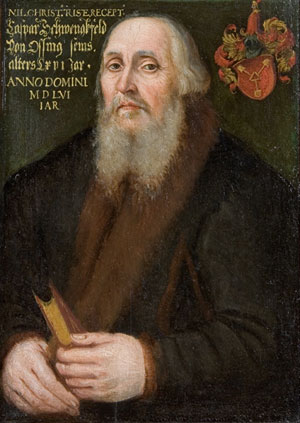
On December 10, 1561, Kaspar Schwenkfeld died. He was born into the noble class in Silesia (now part of either Germany or Poland) in 1489. Silesia was a small province in central Europe. Schwenkfeld experienced a vision or a visitation from G-d in 1519. Along with his vision, he was greatly influenced by the writings of Martin Luther. But he would go on to suggest that reformers like Martin Luther went too far and too fast and focus too much on the outward expression of their faith. The more Schwenkfeld studied the scriptures, the more problems he would develop with Luther’s Justification by Faith through Grace, the freedom of the will, and the futility of human works. He also developed a different understanding of the presence of Christ in the Eucharist. He believed the true Christian ate the spiritual body of Christ which would grow as a planted seed and transform the individual into the image of G-d and the person of Christ.
 
In 1541 he published the “Great Confession on the Glory of Christ” . Many deemed the work heretical. In it he taught that Christ had two natures, divine and human, but the human nature was a “celestial flesh” not fallen like ours. This flesh was increasingly divinized while Christ was on earth, so he was slowly transfigured, resurrected and taken up to heavenly glory. But it was Christ’s invisible glorified flesh that believers ate in the Lord’s supper.
 
The number of followers of Schwenkfeld diminished after the Thirty Years’ War in 1648. By 1700 there were only about 1500 followers remaining in lower Silesia. Many of these would flee to the lands of Count Zinzendorf before coming to Pennsylvania in the 1530’s. Five congregations of Schwenkfelders persisted in Pennsylvania at the start of the 21st-century. (Kaspar Schwenkfeld Took a Separate Path, christianity.com, Diana Severance, Ph.D. edited by Dan Graves, MSL)
 
Thirty Years’ War: The Thirty Years’ War (1618-48) began when Holy Roman Emperor Ferdinand II of Bohemia attempted to curtail the religious activities of his subjects, sparking rebellion among Protestants. The war came to involve the major powers of Europe, with Sweden, France, Spain and Austria all waging campaigns primarily on German soil. Known in part for the atrocities committed by mercenary soldiers, the war ended with a series of treaties that made up the Peace of Westphalia. The fallout reshaped the religious and political map of central Europe, setting the stage for the old centralized Roman Catholic empire to give way to a community of sovereign states. A major impact of the Thirty Years’ War was the extensive destruction of entire regions, denuded by the foraging armies. Episodes of famine and disease significantly decreased the populace of the German states and Bohemia, the Low Countries and Italy, while bankrupting most of the combatant powers. While the regiments within each army were not strictly mercenary in that they were not guns for hire that changed sides from battle to battle, the individual soldiers that made up the regiments for the most part probably were. Armies were expected to be largely self-funding from loot taken or tribute extorted from the settlements where they operated. This encouraged a form of lawlessness that imposed often severe hardship on inhabitants of the occupied territory.
 
Count Nikolaus Ludwig von Zinzendorf: Born into Austrian nobility and raised by his grandmother, Count Zinzendorf showed an early inclination toward theology and religious work. As the godson of P.J. Spener, he was raised in a strong Pietist tradition. In October 1721 he became the king’s judicial counselor at Dresden. After less than a year at court, he bought the estate of Berthelsdorf from his grandmother, hoping to form a Christian community for oppressed religious minorities. Almost immediately a Moravian named Christian David showed up at his door and became his first tenant. Ten Moravian Protestants arrived before December and founded a settlement on the count’s land. They named it Herrnhut—”the Lord’s watch.”By May 1725, 90 Moravians were gathered at Herrnhut. Because of the spirited preaching at the Berthelsdorf parish church, the population of this “small city” had reached 300 by 1726. The count was still a devout Lutheran and tried to keep the refugees within the parish church. His goal was to form ecclesiolae in ecclesia—”little churches within the church”—to act as a leaven, revitalizing and unifying churches into one communion. But with the diversity at Herrnhut, discord soon arose. When it did, Zinzendorf moved to Herrnhut with his family. He went from house to house counseling those who needed it and created a “Brotherly Agreement” of manorial rules. He also appointed watchmen, almoners, and other caretakers. “There can be no Christianity without community,” he said. (christianitytoday.com, Nikolaus von Zinzendorf: Christ-centered Moravian “brother”)

Lutherans would begin coming to Pennsylvania in the early to mid 1600’s – many encouraged by William Penn’s promise of religious freedom, and many because of the devastation of the Thirty Year’s War, along with fleeing famine and disease. Justus Falckner was the first Lutheran pastor ordained in North America, ordained in a Swedish Lutheran Church in 1703, in what is now South Philadelphia. He was assigned to serve Dutch congregations in the Manhattan area.
 
Pastor Dave
 
Please collect two items of your choice for Trinity’s Table this week.