

June 29, 2017
Devotions: Timeline of the Reformation: The Marburg Colloquy 1529
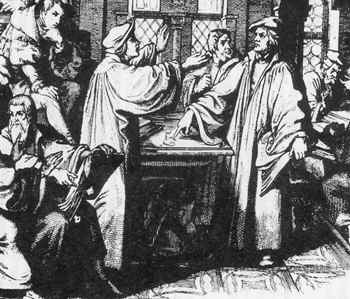
The Marburg Colloquy is the title given to the meeting that was held between Ulrich Zwingli and Luther – this meeting was deemed necessary for the Protestants to have some united front heading into the future, especially for upcoming events like the Diet of Augsburg in 1530 (next devotion). Philip of Hesse, (known most prominently as the Landgrave of Hesse, or as Philipp the Magnanimous: he was a leading political advocate for the right of Lutheran princes to reform their churches against the objections of the Holy Roman Empire and the Catholic Church) wanted to unify the Protestant leaders believing that a divided Reformation movement would be vulnerable to emperor Charles V.
Philip’s hopes for unity would be dashed after this meeting. Luther and Zwingli were not to agree on the sacrament of Holy Communion. Luther firmly believed in the real presence of Jesus in the sacrament, where Zwingli believed that communion was a commemoration of Christ’s sacrifices and that the presence of Christ in the bread and wine was merely symbolic. The most memorable point in their argument came over the phrase “hoc est corpus meum”, “This is my body”. Luther held that it meant “this is my body” meaning the real body of Christ, where Zwingli held that it meant “this signifies my body” meaning it represents but is not actually the body of Christ. Neither man would budge on their beliefs, such was the conviction of their faith. At the end of the meeting, Luther refused to shake hands with Zwingli and Luther would make his dislike of Zwingli very well known. Following the debate, Philip asked Martin Luther to draft a statement of Christian doctrine – what resulted was the “Articles of Marburg”. Included in the fifteen articles were agreements on doctrine such as original sin, atonement and baptism – none of which were disputed or even discussed at the colloquy. As such, there was no real progress made as Philip had hoped. . (adapted and adopted with various changes from historylearningsite.co.uk, The Marburg Colloquy, C N Trueman “The Marburg Colloquy” March 17, 2015; christianhistoryinstitute.org, TURNING POINT: LUTHER’S LOST OPPORTUNITY, Bruce Heydt)
What was accomplished was the fact that neither Luther nor Zwingli backed down nor did they cave in to political pressure. And, as history has shown, the Reformation was not impeded by their lack of agreement. So the Marburg Colloquy may have not accomplished the unity Philipp the Magnanimous hoped, but in practice the differences in their beliefs would not be the downfall, but actually would unify their resolve to seek change.
Pastor Dave
 Lutheran Schreff