

June 19, 2017
Devotions: Timeline of the Reformation: 1517 – The 95 Theses
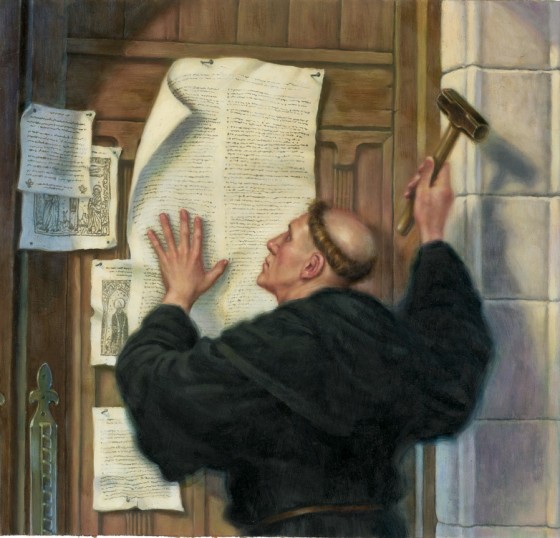
For many, the date of October 31, 1517 is the official beginning to the Protestant Reformation. On this date, Martin Luther nailed his 95 Theses or points of debate to the church door in Wittenberg, Germany. Every pivot-point in history needs an event to which people can point to and say “It began here”. And the Protestant Reformation was such a pivot-point. We know the story – sort of. Martin Luther was a priest and a monk who desperately wanted to find a G-d of love. He joined the monastery after nearly being struck by lightning and shouting to St. Anne “If you save me I will become a monk.” He lived through the ordeal, dropped out of Law School and joined a monastery. While there, he undertook the life of the monk – getting up at 2:00 am for prayers and study, attending services six times a day, and taking seriously his sinfulness. He would sleep on the cold, wet floor – he would self-flagellate – he would do the things he hoped would earn him G-d’s love and Grace. Nothing brought him closer to G-d. His teacher and mentor encouraged him to leave the monastery and go back to the University to teach. And so he did, in Wittenberg. Luther spent those years teaching and writing – and continuing to disagree on the direction and teaching of the church he loved. In 1517 Luther penned a document attacking the Catholic Church’s corrupt practice of selling “indulgences” to absolve sin. His “95 Theses,” which propounded two central beliefs—that the Bible is the central religious authority and that humans may reach salvation only by their faith and not by their deeds—was to spark the Protestant Reformation. Although these ideas had been advanced before, Martin Luther codified them at a moment in history ripe for religious reformation. In the opening to his 95 Theses he wrote:
Out of love for the truth and from desire to elucidate it, the Reverend Father Martin Luther, Master of Arts and Sacred Theology, and ordinary lecturer therein at Wittenberg, intends to defend the following statements and to dispute on them in that place. Therefore he asks that those who cannot be present and dispute with him orally shall do so in their absence by letter. In the name of our Lord Jesus Christ, Amen.
Luther sent the Theses in a letter to Albert of Brandenburg, the Archbishop of Mainz – the date of the letter was October 31, 1517. He may have also posted them on the All Saints’ church door in Wittenberg which was the custom of the time to announce the possibility of a debate. The Theses were quickly printed, and reprinted and distributed and initiated a pamphlet war between Johann Tetzel (the indulgence king) which inevitably spread the word far and wide. He was tried for heresy, and at the Diet of Worms would be excommunicated from the church.
Luther did not consider indulgences to be as important as other theological matters which would divide the church, such as justification by faith or the bondage of the will. However, the nailing of the Theses and the debate that it sparked is that pivot-point that most scholars point to where the Christian Church was changed, for better or worse, forever.
Pastor Dave
Please collect one pack of diapers size 1 or 2 for Trinity’s Table.
 Lutheran Schreff