

June 17, 2017
Devotions: The Counter-Reformation: Thomas Cajetan
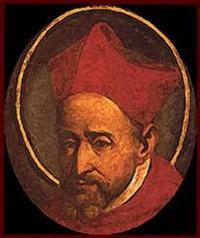
Thomas Cajetan’s real name was Tommaso de Vio. The name Tommaso was taken as a monastic name, while the surname Cajetan derives from his native city of Gaeta. He was born on February 20, 1469 and died on August 9, 1534. At the age of fifteen he entered the Dominican order, against the will of his parents. He was educated in Naples, Bologna, and Padua, devoting himself to the study of the philosophy of St. Thomas Aquinas. He studied humanism which was sweeping Europe at that time.
He was an Italian Cardinal and Catholic theologian – and he was part of the revival of Scholasticism during the sixteenth century. Cardinal Cajetan is probably best known for his opposition to the teachings of Martin Luther. At the Diet of Augsburg Cajetan was called upon to test the teachings of Luther. He also was one of nineteen Cardinals who refused to annul the marriage of King Henry the VIII to Catherine of Aragon, causing the king to break with the Roman Catholic Church and establish the Church of England.
Treatises written by Cajetan in 1517, before he had any knowledge of Luther’s theses, show that Luther was justified in his assertion that the Church had not yet arrived at a firmly established position on the doctrine of dispensation. The doctrine of Dispensation. Have you heard about Dispensationalism? If you follow the “Left Behind” book series and movies, you know a little about this doctrine. It is a way to read the bible that considers biblical history as deliberately divided by G-d into defined periods or ages. Each age of G-d’s plan is to be administered by humanity (who will also be held accountable) in a particular method of stewardship. Here is how one Lutheran pastor speaks to the issue of Dispensationalism:
There are of course many Lutherans who read such things as Late Great Planet Earth and the novels by LaHaye and Jenkins, but for the most part, dispensationalism is foreign language in our parishes. I wonder if this is because Lutheran hermeneutics concerns itself first of all with Christ, the Scriptures as the cradle of Christ, etc. Since the Scriptures are first of all the cradle of Christ, and then are read through the law/gospel dialectic, there’s little space for talk of dispensations, dividing up of time into periods, nor do we look the Scriptures as a road map for where history will go. We look to the Scriptures to see where Christ is. Bibles with dispensationalist commentaries (like the Scofield Bible) would distract and detract from that of utmost importance. Lutheran eschatology also plays a role. Because all is taken care of in Christ (justification by faith alone without the works of the law), we need not be busy reading the “signs of the times”, something American Christians are especially busy doing. If Christ is coming today (and for all I know he is), I wish to be caught planting a tree, or blogging, or having a nice supper with my spouse. Fulfilling our daily vocations IS being prepared for Christ’s coming, and this by the power of the Holy Spirit.” (Lutherans and Dispensationalism, March 2, 2005, Clint Schnekloth)
Cajetan also seemed to regard the doctrine of confession as a subject open to controversy. In 1519, Cajetan helped draw up the bill of excommunication against Luther. (newworldencyclopedia.org, Cardinal Cajetan)
Scholasticism: is a method of learning taught by the academics of medieval universities sometime around 1100 to 1500 CE. Scholasticism originally began as a reconciliation of the philosophy of the classical philosophers with medieval Christian theology. It was not a philosophy or theology in itself, but a tool and method for learning which emphasized dialectical reasoning. The primary purpose of scholasticism was to find the answer to a question or resolve a contradiction. It is most well known in its application in medieval theology, but was eventually applied to classical philosophy and many other fields of study.
Pastor Dave
Please collect bottles of shampoo and packs of diapers for Trinity’s Table.
 Lutheran Schreff