

June 3, 2017
Devotions: Personalities of the Reformation: Primoz Trubar
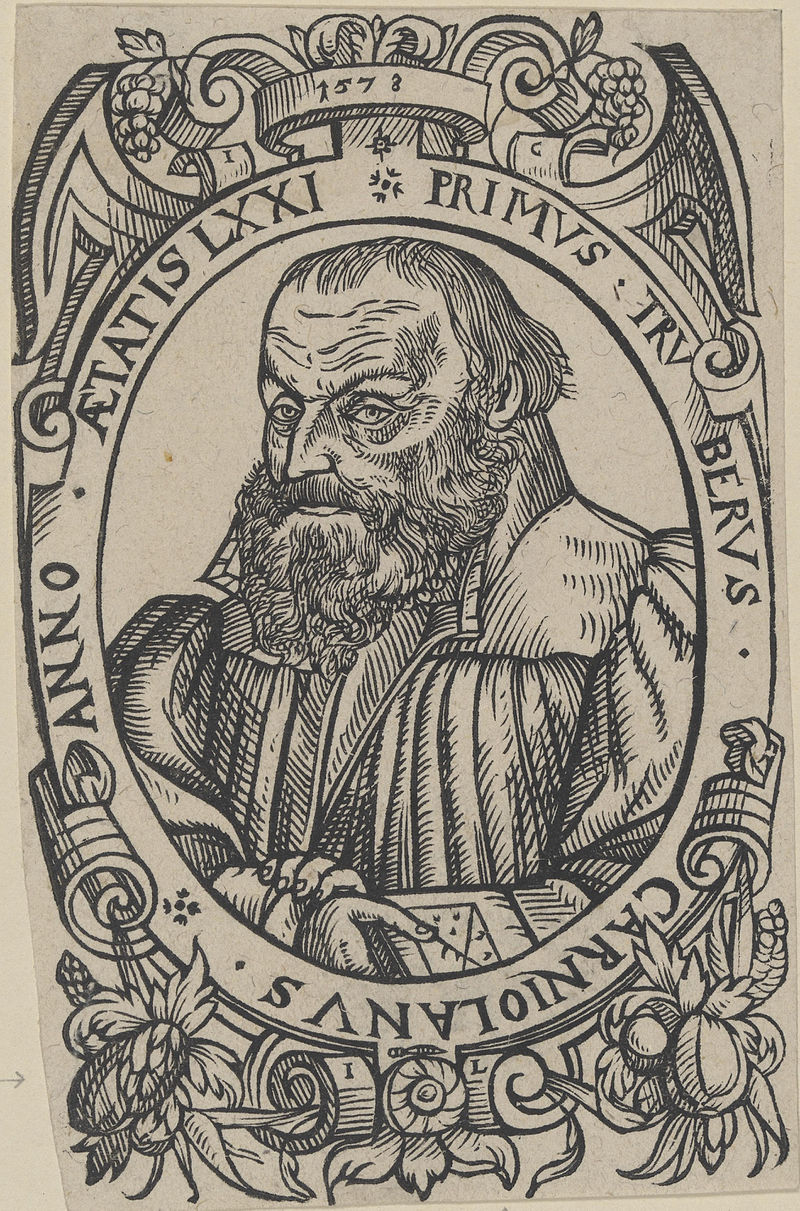
Primoz Trubar was born in 1508 and died on June 28, 1586, in the village of Rasica, central Slovenia, in the Duchy of Carniola which was under the Hapsburg Monarchy. He moved to Trieste (seaport in Northeastern Italy) and under the tutorship of the Roman Catholic bishop Pietro Bonomo he met the humanist Erasmus. In 1528 he enrolled at the University of Vienna, but did not complete his studies. In 1530 he returned to the Slovene Lands and gradually was moved to support Protestantism. He was expelled from Ljubljana, the capitol of Slovenia in 1547. In 1550 as a Protestant preacher in Rothenburg (Bavaria Germany) he wrote the first two books in Slovene, Catechimus and Abecedarium. Catechismus also contained the first Slovene musical manuscript in print.
We remember Trubar because he was a Slovenian Protestant Reformer and is remembered for introducing Lutheranism to Slovenia. He is lauded as the author of the first Slovene language printed book. He was the founder and the first superintendent of the Protestant Church of the Duchy of Carinola. Most importantly, he is remembered for creating the foundations of the Slovenian literary language. He was rebuffed through the introduction of the Counter-Reformation by the Austrian Hapsburgs.
Altogether, Trubar authored 22 books in Slovene and two books in German. He was the first person to translate parts of the Bible to Slovene. He translated the Gospel of Matthew in 1555 and published a translation of the New Testament by 1577. From 1561 and 1565 Trubar was the manager and supervisor of the South Slavic Bible Institute. Trubar died in Derendingen, now part of the city of Tubingen, Germany, where he is also buried.
Austrian Hapsburgs: also known as the Austrian Habsburg Monarchy must not be confused with the House of Habsburg. The Habsburg Monarchy is the countries and provinces that were ruled by the junior Austrian branch of the House of Habsburg (1521 to 1780). Under the Hapsburg Monarchy each province was governed by its own customs and not always ruled by the same person, with junior members of the family ruling certain lands as private holdings. In the 17th century, the Catholic Church suppressed Protestantism which severely hindered the development of literature in the Slovene language. The Enlightenment in Central Europe, particularly under the Habsburg Empire, was a positive period for the Slovenian people. It accelerated economic development and facilitated the appearance of a Slovenian middle class. (parts were adapted from “slovenia.si/slovenia/history, A Time of Revival”)
Catechimus: Along with Primoz Trubar’s 1550 book, Abecedarium (Abecedary-an inscription consisting of the letters of an alphabet, almost always listed in order – typically, abecedaria (or abecedaries) are practice exercises) Catechismus was the first book published in Slovene. Catechismus served as part of a foundation of the establishment of a national identity for Slovenes. It contains hymns and a litany, all with musical notation. Based on the German patterns, they are original poems in four different forms of stanzas comprising altogether 500 verses.
Counter-Reformation in Slovenia: Although at one time the majority of the Slovenian population followed Protestant teachings, Slovenia became re-Catholicized under archduke Ferdinand of Inner Austria. Re-Catholization had strong support from Catholic Jezuiat order, which took over schools in Ljubljana and educated people in Catholic faith. Catholic Hren, a famous counter-reformator, asked the Pope to allow him to use the Slovenian translation of the Bible, but all other Protestant books were burned. During the time of Counter-Reformation almost nothing was published in Slovenian language and in general it was a huge step back for Slovenian literature. There were, however, many churches built in the Baroque style in Ljubljana (the capitol of Slovenia) in order to attract believers to the Catholic church. A small Slovenian Protestant community remained in Prekmurje (north-east Slovenia), which was under Hungarian rule, and who did not treat the Protestants as harshly as the Hapsburgs.
Pastor Dave
Please bring in sunscreen and hand sanitizer for Trinity’s Table.
 Lutheran Schreff