

June 1, 2017 — Devotions: Personalities of the Reformation: Joachim Vadian
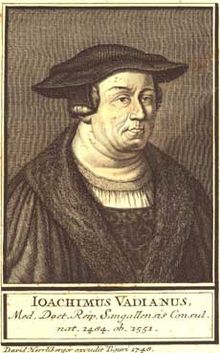
Joachim Vadian lived from November 29, 1484 to April 6, 1551. He was a humanist, professor, rector of the University of Vienna 1516-1517, physician, burgomaster, and Protestant Reformer from Switzerland. He knew and was a staunch supporter of Zwingli. He also was a strong force against the growing Anabaptist movement. In Vienna, he changed his name to “Joachimus Vadianus”; like so many other humanists, he preferred a Latin name to express his admiration for the classic masters. He was able to evade the “Black Plague” by moving to Villach, Austria.. He worked as a teacher and studied music. After completing his studies in 1509 with a degree of Master of Arts, he returned to St. Gallen. He would go on to study the scriptures. He would return to Vienna and have some success as a writer. From 1512 on he held the chair of poetry at the University of Vienna – gaining some reputation for authoring Latin poems. In 1517, the year Luther nailed the 95 Theses on the church door in Wittenberg, Vadian graduated as a doctor of medicine, and moved back to his hometown, St. Gallen. He was appointed the city physician and married Martha Grebel, the sister of Conrad Grebel who would later become a leading figure of the Anabaptist movement.
He was chosen burgomaster (mayor) for St. Gallen first in 1526 and nine times thereafter, but was the real leader of the city from 1526 to his death. From 1522 on, he sided with the Reformation movement and henceforth was its most important proponent in St. Gallen and thus is remembered for leading the conversion of St. Gallen to Protestantism. Vadian wrote several theological texts after 1522, helping to spread Protestant Reformation views. He died in St. Gallen. In his testament, he donated his large private library to the city. His collection became the nucleus of the library of St. Gallen which is named “Vadiana”. (revolvy.com) (adapted and borrowed from “Global Anabaptist Mennonite Encyclopedia Online website”)
The Anabaptist teachings are explicitly condemned in five separate articles within the Augsburg Confession. When the Formula of Concord was written, the writers saw fit to include a final twelfth article which included a listing of the erroneous teachings of various groups, including the Anabaptists. Why was this done? It seems that the teachings of the radical reformers had often been lumped together with the teachings of the Lutherans or the Lutherans were often blamed for the emergence of such groups as the Anabaptists. At Augsburg in 1530, Johann Eck accused the Lutherans of various false teachings which were in fact teachings of the Anabaptists (hence the specific condemnation of Anabaptistic teachings in the Augsburg Confession).
Therefore, when the Formula of Concord was written, the authors’ goal was to only confess what was believed, taught, and confessed within the Lutheran Church. However, the writers still saw fit to list out and condemn the false teachings of the various “factions and sects” so the whole world would know that the Lutherans did not believe, teach, or confess these things. This is clearly seen in the Introduction to Article XII of the Solid Declaration of the Formula of Concord:
“However, we do not want the condemned errors of the factions and sects we just mentioned to be silently ascribed to us. For the most part these groups, as is the nature of such spirits, secretly stole in at certain places. They did this especially at a time when no place or room was given to the pure Word of the Holy Gospel…Poor, simple people, in their simplicity (who could not help but feel the clear idolatry and false faith of the papacy), embraced whatever was called the Gospel and was not papistic. We cannot avoid testifying against these groups publicly, before all Christendom. We have no part or fellowship with their errors, be they many or few. We reject and condemn them all. They are wrong and heretical, and are contrary to the Scriptures of the prophets and apostles and to our Christian Augsburg Confession, which is well grounded in God’s Word.” (Concordia: The Lutheran Confessions, FC, SD, XII:7-8)
Radical Reformation: The Radical Reformation is a term usually referring to those 16th century groups who rejected both the Roman Catholic tradition and the ongoing Protestant alternatives to it, in the name of what they considered truer forms of Christianity, most notably those who became known as the Anabaptists. As a result, they were persecuted by Catholics and Protestants alike and their ideas and lives were bitterly attacked, often without a genuine knowledge of what they stood for. Early forms of the Radical Reformation were often millenarian, focusing on the imminent end of the world. This was particularly notable in the rule of John of Leiden over the city of Münster in 1535, which was ultimately crushed by the forces of the Catholic Bishop of Münster and the Lutheran Landgrave of Hesse. After the fall of Münster, several small groups continued to adhere to revolutionary Anabaptist beliefs. The largest and most important of these groups, the Batenburgers, persisted in various forms into the 1570s. In contrast to Roman Catholicism, Lutheranism, the Reformed churches such as Zwinglian and Calvinist movements (Presbyterian), the Radical Reformation generally abandoned the idea of the “Church Visible” as distinct from the “Church Invisible.” Thus, the Church only consisted of the tiny community of believers, who accepted Jesus Christ by adult baptism, called a “believer’s baptism”. Later forms of Anabaptism were much smaller, and focused on the formation of small, separatist communities. Among the many varieties to develop were Mennonites, Amish, and Hutterites. (adapted and borrowed in part from theopedia.com website, “Radical Reformation”)
Anabaptist: Christians who believe that baptism is only valid when the candidate confesses his or her faith in Christ and wants to be baptized. This believer’s baptism is opposed to baptism of infants, who are not able to make a conscious decision to be baptized. Other Christian groups with different roots also practice believer’s baptism, such as Baptists, but they are not Anabaptists. The Amish, Hutterites, and Mennonites are direct descendants of the early Anabaptist movement. The Schwarzenau Brethren, Bruderhof, and the Apostolic Christian Church are considered later developments among the Anabaptists.
Pastor Dave
Please bring in sunscreen and hand sanitizer for Trinity’s Table.
 Lutheran Schreff