

May 22, 2017
Devotions: Personalities of the Reformation: John Knox
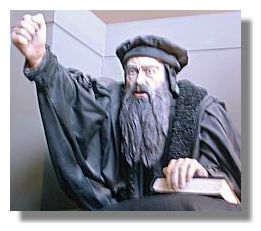
John Knox was born around 1514, at Haddington, a small town south of Edinburgh. Around 1529, at age 15 he entered the University of St. Andrews and went on to study theology. He was ordained in 1536, but became a notary, then a tutor to the sons of local lairds (lower ranking Scottish nobility). Around Scotland, there were many people angry with the Catholic church. The church owned more than half of the real estate. The church gathered an annual income of nearly 18 times that of the king. Many Bishops and priests in the church were political appointments. Many of the priests lived lives of consorting with concubines and siring illegitimate children. While these events were happening in and around Scotland, there were others bringing Lutheran literature into the country. The church called it “heresy” and tried to suppress it. Sometime around 1540, John Knox was influenced by converted reformers, and joined in the Protestant movement. Through a series of events, Knox would be arrested and imprisoned. He would flee to England, and then to France, and finally to Geneva where he would meet John Calvin. Calvin would call Knox a “brother…for the faith”– and Knox was equally impressed with Calvin.
Back in Scotland, Protestant congregations were forming with great vigor. From this movement a group calling themselves the “Lord’s of the Congregation” were vowing to make Protestantism the religion of the land. They compelled Knox to return to Scotland, which he did for a short time, but was soon forced to return to Geneva. He soon began to write some of his most controversial publications such as Admonition to England, and Appellations to the nobility and Commonality of Scotland. In the later he extended to the people the right and duty to rebel against unjust rulers. Knox returned to Scotland in 1559, and he again deployed his formidable preaching skills to increase Protestant militancy. Within days of his arrival, he preached a violent sermon at Perth against Catholic “idolatry,” causing a riot. Altars were demolished, images smashed, and religious houses destroyed. Knox and five of his colleagues would go on to write a Confession of Faith, the First Book of Discipline, and The Book of Common Order—all of which cast the Protestant faith of Scotland in a distinctly Calvinist and Presbyterian mode.
Knox would finish out his years as a preacher in an Edinburgh church, helping to shape Protestantism in Scotland. During this time, he wrote his History of the Reformation of Religion in Scotland. Though he remains a paradox to many, Knox was clearly a man of great courage: one man standing before Knox’s open grave said, “Here lies a man who neither flattered nor feared any flesh.” Knox’s legacy is large: his spiritual progeny includes some 750,000 Presbyterians in Scotland, 3 million in the United States, and many millions more worldwide.
(adapted from JOHN KNOX: Presbyterian with a Sword, from christianitytoday.com website)
Here is how one writer put the influence of John Knox in history:
– Knox was a man who ‘hit-it-in the face’. Knox once stated, “Railing and sedition they are never able to prove in me, till that first they compel Isaiah, Jeremiah and Ezekiel, St. Paul, and others to recant; of whom “I have learned plainly and boldly to call wickedness by its own name, a fig a fig, and a spade a spade.”
– On another occasion Knox stated, “What I have been in my country, albeit this unthankful age will now know, yet the ages to come will be compless to bear witness to the truth. And thus I cease, requiring of all men who have anything to object against me that they will do it as plainly as that I make myself and all my doings manifest to the world; for to me it seems a thing most unreasonable that, in this my decrepit age, I should be compelled to fight against shadows and howlats that dare not abide the light.”
We may not know a lot about the Presbyterian church, and understand their ideas such as predestination – or Calvin’s ideas of Christ’s presence (or lack of) in the Lord’s Supper – but we can learn a lot from the people who made it their life’s work to reform the Church of Jesus Christ.
Pastor Dave
Please bring in diapers and paper towels to donate to Trinity’s Table.
 Lutheran Schreff