

May 26, 2017
Devotions: Personalities of the Reformation: Johannes Oecolampadius
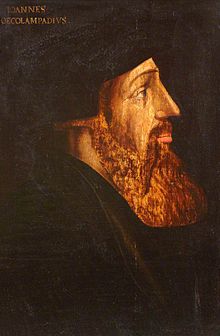
As a German humanist, preacher, and patristic scholar, Oecolampadius would become a close friend of the Swiss Reformer Zwingli, and would be a leader in the Reformation movement in Basel, Switzerland. As a student at Heidelberg, Oecolampadius left his studies to become tutor to the sons of the Palatinate’s elector and in 1510 became preacher at Weinsberg. He was a student of Greek, Latin and Hebrew. In 1515 Oecolampadius moved to Basel, where he assisted the Humanist scholar Erasmus in preparing his famous edition of the Greek New Testament.
But his interest would extend far beyond the scriptures. He would go on to translate works by some of the Greek Fathers of the church like Gregory of Nazianzus, John of Damascus, and Chrysostom. By 1518 he was a preacher in the town of Augsburg. He would enter a monastery in 1520, but his growing disillusionment with the Catholic church and in particular with Transubstantiation would push him away from the Catholic faith and toward Martin Luther. He would return to Basel in 1523 and would become a professor at the university. As a professor he would gain wide notoriety for lecturing in three languages. He would go on to debate against the Catholic church for the Protestant movement. His time with Zwingli would stick with him, as he would go on to write “On the Correct Interpretation of the Words of the Lord” supporting the view that the Eucharist was only a remembrance and not a reenactment of Christ’s sacrifice on the cross. He also was a prominent figure at the “Colloquy of Marburg” where he defended Zwingli’s position against Luther.
Zwingli would go on to be killed in the Battle of Kappel, and Oecolampadius would die soon afterward, some believing it was from the shock of the death of his friend. (adapted from the website article Johann Oecolampadius: German Humanist, britannica.com)
Battle of Kappel: an armed conflict in 1531 between the Protestant and the Catholic cantons of the Old Swiss Confederacy during the Reformation movement in Switzerland.
Although many of the same names keep coming up, like Zwingli, and Huss, and Luther, names like Oecolampadius and Laski are not common household names in our conversation about the Reformation. And yet, they were there at some of the most notable debates and would write some of the most influential tracts in favor of certain aspects of the Reformation. Not everyone agreed with Martin Luther and Philipp Melanchthon, yet they would be giants for the churches in Scotland, Poland, and Switzerland, and in movements that would become Presbyterianism, and even the Anabaptists. So many eyes focused on the abuses of the Catholic church, yet the eyes of faith were not always ready to see their points of view.
Pastor Dave
Please bring in diapers and paper towels to donate to Trinity’s Table.
 Lutheran Schreff