
May 3, 2017 — Personalities of the Reformation: Jerome of Prague

May 3, 2017
Devotions – Personalities of the Reformation – Precursors
Jerome of Prague
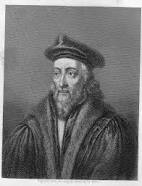
Jerome of Prague, also called Hieronymus, lived from 1379 – May 30, 1416. He was a Czech scholastic philosopher, theologian, church reformer, and professor. Jerome was one of the chief followers of Jan Huss and was burned also for heresy against the Church of Rome.

He dedicated his life to eradicate those church doctrines and dogmas he found to be corrupt. He was constantly in and out of jail throughout his life. Jerome tended to teach radical ideas pertaining to Roman Catholic doctrine, namely that God’s teachings were directly accessible to a Christian without need for the church or church officials. He taught that one should obey the direct teachings of Jesus, even when they conflicted with those of the Catholic Church. He was largely a follower of the ideologies of both church reformers John Wycliffe and Jan Hus. As his teachings were contrary to those of the Roman Catholic Church, he was constantly on the run from authorities. Hus, although much less disruptive in his approach, was a mentor for Jerome. His radical ideas eventually brought about his death by execution as a heretic to the church.

He was condemned to die in the flames as Hus had. For two days the Council of Constance kept him in suspense, hoping to frighten him into a recantation. The Cardinal of Florence personally reasoned with him. Jerome remained steadfast. When a cap was made for him painted with red devils, he said, “Our Lord Jesus Christ, when he suffered death for me, a most miserable sinner, did wear a crown of thorns upon his head; and I for his sake will wear this adorning of derision and blasphemy. He sang hymns on his way to execution. Because of his vigor and health he was a long time dying in the flames. On this day, May 30, 1416, he and his paper crown were burned. but made him a martyr for the Protestant Reformation and the followers of Jan Huss and the“Hussites”.” (wikipedia; Into The Fire Went Jerome of Prague, Dan Graves, christianity.com website)

First there was Wycliffe, then Huss, and then there was Jerome. He is not to be confused with St. Jerome who died on September 30, 420. He was a follower of John Huss, and he too was burned in the flames of martyrdom. Jerome was in and out of jail throughout most of his life for his teachings such as “…that God’s teachings were directly accessible to a Christian without need for the church or church officials.” Luther would go on to translate the New Testament from Latin into German so that the people could read the Word of G-d without the need for Priests to read it and interpret it for them.

You see, people died for the opportunity for all people to be able to read the Word of G-d and seek the meaning of scripture in their lives. We should remember every day people have died so that we could have the opportunity to read the bible in our homes, in our work places, in our churches, and in the streets.

Pastor Dave

* Collect bottles of shampoo and conditioner this week for Trinity’s Table.
May 2, 2017 — Personalities of the Reformation: John Huss

May 2, 2017
Devotions – Personalities of the Reformation – Precursors
John Huss

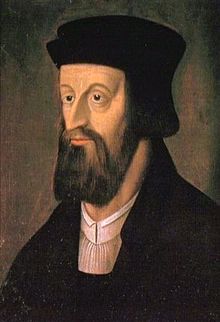
Huss was born to peasant parents in “Goosetown,” that is, Husinec, in the south of today’s Czech Republic. (In his twenties, he shortened his name to Huss—”goose,” and he and his friends delighted in making puns on his name; it was a tradition that continued, especially with Luther, who reminded his followers of the “goose” who had been “cooked” for defying the pope). To escape poverty, Huss trained for the priesthood: “I had thought to become a priest quickly in order to secure a good livelihood and dress and to be held in esteem by men.” He earned a bachelor’s, master’s, and then finally a doctorate. Along the way he was ordained (in 1401) and became the preacher at Prague’s Bethlehem Chapel (which held 3,000), the most popular church in one of the largest of Europe’s cities, a center of reform in Bohemia (for example, sermons were preached in Czech, not Latin). The writings of John Wycliffe had stirred his interest in the Bible, and these same writings were causing a stir in Bohemia (technically the northeastern portion of today’s Czech Republic, but a general term for the area where the Czech language and culture prevailed). The University of Prague was already split between Czechs and Germans, and Wycliffe’s teachings only divided them more. Early debates hinged on fine points of philosophy (the Czechs, with Wycliffe, were realists; the Germans nominalists). But the Czechs, with Huss, also warmed up to Wycliffe’s reforming ideas; though they had no intention of altering traditional doctrines, they wanted to place more emphasis on the Bible, expand the authority of church councils (and lessen that of the pope), and promote the moral reform of clergy. When Alexander V’s successor, the antipope John XXIII (not to be confused with the modern pope by the same name), authorized the selling of indulgences to raise funds for his crusade against one of his rivals, Huss was scandalized and further radicalized. The pope was acting in mere self-interest, and Huss could no longer justify the pope’s moral authority. He leaned even more heavily on the Bible, which he proclaimed the final authority for the church. Huss further argued that the Czech people were being exploited by the pope’s indulgences, which was a not-so-veiled attack on the Bohemian king, who earned a cut of the indulgence proceeds.

With that Huss lost the support of his king. His excommunication, which had been tacitly dropped, was now revived, and an interdict was put upon the city of Prague: no citizen could receive Communion or be buried on church grounds as long as Huss continued his ministry. To spare the city, Huss withdrew to the countryside toward the end of 1412. He spent the next two years in feverish literary activity, composing a number of treatises. The most important was The Church, which he sent to Prague to be read publicly. In it he argued that Christ alone is head of the church, that a pope “through ignorance and love of money” can make many mistakes, and that to rebel against an erring pope is to obey Christ.

In November 1414, the Council of Constance assembled, and Huss was urged by Holy Roman Emperor Sigismund to come and give an account of his doctrine. Because he was promised safe conduct, and because of the importance of the council (which promised significant church reforms), Huss went. When he arrived, however, he was immediately arrested, and he remained imprisoned for months. Instead of a hearing, Huss was eventually hauled before authorities in chains and asked merely to recant his views.

When he saw he wasn’t to be given a forum for explaining his ideas, let alone a fair hearing, he finally said, “I appeal to Jesus Christ, the only judge who is almighty and completely just. In his hands I plead my cause, not on the basis of false witnesses and erring councils, but on truth and justice.” He was taken to his cell, where many pleaded with him to recant. On July 6, 1415, he was taken to the cathedral, dressed in his priestly garments, then stripped of them one by one. He refused one last chance to recant at the stake, where he prayed, “Lord Jesus, it is for thee that I patiently endure this cruel death. I pray thee to have mercy on my enemies.” He was heard reciting the Psalms as the flames engulfed him. His executioners scooped up his ashes and tossed them into a lake so that nothing would remain of the “heretic,” but some Czechs collected bits of soil from the ground where Huss had died and took them back to Bohemia as a memorial.” (christianitytoday.com, John Huss)

Like Martin Luther, Huss was a prolific writer. He, like Luther, spoke against what he saw as the abuse of the power of the Pope. In one of his writings titled “The Church” he argued “…that Christ alone is head of the church, that a pope “through ignorance and love of money” can make many mistakes, and that to rebel against an erring pope is to obey Christ.” But unlike Luther, he was not only asked to recant his writings, but was arrested and died in the flames of martyrdom. Again, it gives us pause to see the lengths those before the Reformation stood up for their beliefs against the abuses of the church.

Pastor Dave

Collect bottles of shampoo and conditioner this week for Trinity’s Table.