
May 9, 2017 — Personalities of the Reformation: Martin Bucer

May 9, 2017
Devotions: Personalities of the Reformation – Martin Bucer

Martin Bucer lived from November 11, 1491 (8 years almost to the day after the birth of Martin Luther (November 10, 1483). Bucer was a German reformer for the Protestant movement who was influenced by both Luther and Calvin. He also was influenced by Anglican doctrines. Interestingly enough, Bucer was a part of the Dominican Order, but after meeting Martin Luther sometime around 1518, one year after Luther’s famous 95 Theses episode, Bucer left the Order and annulled his monastic vows. Here is what Wikipedia says about our friend Martin Bucer…
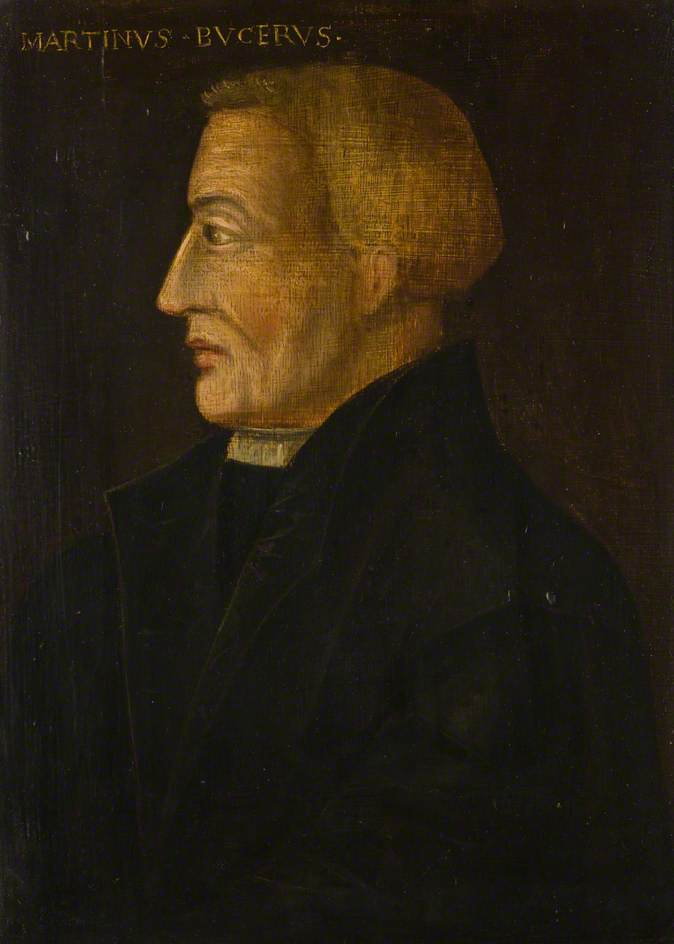
(c) The University of Edinburgh Fine Art Collection; Supplied by The Public Catalogue Foundation

“Bucer’s efforts to reform the church in Wissembourg resulted in his excommunication from the Roman Catholic Church, and he was forced to flee to Strasbourg. There he joined a team of reformers. Bucer believed that the Catholics in the Holy Roman Empire could be convinced to join the Reformation. Through a series of conferences organized by Charles V he tried to unite Protestants and Catholics to create a German national church separate from Rome. He did not achieve this, as political events led to the Schmalkaldic War and the retreat of Protestantism within the Empire. In 1548, Bucer was persuaded, under duress, to sign the Augsburg Interim which imposed certain forms of Catholic worship. However, he continued to promote reforms until the city of Strasbourg accepted the Interim, and forced him to leave. In 1549, Bucer was exiled to England, where, under the guidance of Thomas Cranmer, he was able to influence the second revision of the Book of Common Prayer. He died in Cambridge, England at the age of 59. Although his ministry did not lead to the formation of a new denomination, many Protestant denominations have claimed him as one of their own. He is remembered as an early pioneer of ecumenism.”

Schmalkaldic War – At the 1521 Diet of Worms Emperor Charles V had Martin Luther banned and the proliferation of his writings prohibited, which in 1529 provoked the Protestation at Speyer by several Lutheran estates. The tensions culminated to an open conflict over the Lutheran Augsburg Confession of 1530, the Apology of which, written by Philipp Melanchthon, was rejected by the Emperor. In turn several Lutheran states led by Elector John Frederick I of Saxony and LangravePhilip I of Hesse met at the town of Schmalkalden, where they established the Schmalkaldic League in 1531.In June 1546, Pope Paul III entered into an agreement with Holy Roman Emperor Charles V to curb the spread of the Reformation. Shortly thereafter, Maurice, the Duke of Albertine Saxony (also Elector), invaded the lands of his rival and stepbrother in Ernestine Saxony, John Frederick, beginning the brief, but devastating, conflict known as the Schmalkaldic War. The military might of Maurice combined with that of Charles V proved to be overwhelming to John Frederick and the Protestant Schmalkaldic League. On April 24, 1547 the armies of the Schmalkaldic League were decisively defeated at the Battle of Muhlberg.

Augsburg Interim – Charles V had won a military victory, but realized that the only chance he had to effectively contain Lutheranism as a movement was to pursue political and ecclesiastical compromises in order to restore religious peace in the Empire. The series of decrees issued by the Emperor became known as an “Interim” because they were only intended to govern the church temporarily pending the conclusions of the general council convened at Trent by pope Paul III in December 1545. Included in the provisions of the Interim was that the Lutherans restore the number of sacraments (which the Lutherans reduced to two – Baptism, the Lord’s Supper) and that the churches restore a number of specifically Roman ceremonies, doctrines, and practices which had been discarded by the Lutheran reformers, including also transubstantiation, and the rejection of the doctrine of justification by Grace, through Faith Alone. The God-given authority of the pope over all bishops and the whole Church was reaffirmed, but with the proviso that “the powers that he has should be used not to destroy but to uplift”. In stark contrast to Charles V’s past attitude, significant concessions were made to the Protestants. What was basically a new code of religious practices permitted both clerical marriage and communion under both kinds. The Augsburg Interim was rejected by a significant number of Lutheran pastors and theologians.” (Wikipedia)

And we worry about squabbles in the church today…..

Pastor Dave

Please bring in toilet paper or paper towels this week for Trinity’s Table.
May 8, 2017 — Personalities of the Reformation: Theodore Beza

May 8, 2017
Devotions: Personalities of the Reformation – Theodore Beza

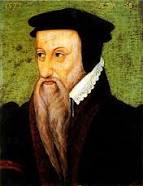
Theodore Beza was born on June 24, 1519 and died on October 13, 1605. Beza was a French Protestant theologian and scholar – and he played an important part in the Protestant Reformation.

Beza was a member of the “Monarchomaque” orginally made up of French Huguenot’s who opposed absolute monarchy rule at the end of the 16th century. He was also a follower and disciple of John Calvin. After studying law at Orleans, France (1535–39), Beza established a practice in Paris, where he published Juvenilia (1548), a volume of amorous verse that earned him a reputation as a leading Latin poet. On recovering from a serious illness, he underwent a conversion experience and in 1548 traveled to Geneva to join John Calvin, then deeply involved with his reforms of Swiss political and educational institutions. A year later Beza became a professor of Greek at Lausanne, where he wrote in defense of the burning of the anti-Trinitarian heretic Michael Servetus (died 1553). For several years Beza traveled throughout Europe defending the Protestant cause. He returned to Geneva in 1558. The academy in Geneva was organized in 1558 and Beza now assumed the role of Greek instructor and in March he also assumed the pastorate of a city church. He would also begin to go out and intervene for certain members of the nobility who were being persecuted for their conversion to Protestantism and through his efforts he quickly developed a reputation as the most capable spokesman for the French Reformation. He would serve for seven months with the Huguenot army as almoner and treasurer until Guise was assassinated on February 18, 1563 thus ending the conflict. Beza and his wife returned to Geneva in May of the same year to find Calvin in poor and declining health. Calvin would die in May of the following year, so the intermediate twelve months were spent in preparation for a transfer of authority from Calvin to Beza. When Calvin did die, Beza performed the funeral and was elected moderator of the local presbytery. (wikipedia)

In 1559 the first synod of the Huguenot church met secretly in Paris. It was there that the original draft of the Confession of La Rochelle was penned. During the next three years the church grew – but then a decade later, in 1572, on the eve of the feast of Bartholomew the Apostle, things took a decidedly horrible turn with the persecution known as the St. Bartholomew’s Day Massacre (Massacre de la Saint-Barthélemy). Many of the most prominent Huguenots had gathered in Paris, a Catholic stronghold, for the wedding of the king’s sister Margaret to the Protestant Henry III of Navarre (the future Henry IV of France). Assassins attempted to kill Admiral Gaspard de Coligny, the military and political leader of the Huguenots. Two days later on August 23 the king ordered the assassination of Coligny and other Huguenot leaders. The massacres spread throughout Paris and to other French cities, lasting several weeks. Estimates of the dead vary between 5,000 and 30,000.

After years of conflict, the Huguenot churches were officially tolerated by King Henry IV under the terms of the Edict of Nantes in 1598. The edict mandated a freeze on Protestant places of worship in an effort to keep peace between Roman Catholics and 1.5 million Huguenots.(The Huguenot Christian, Part 1, Gregory E. Reynolds)

In one memorable confrontation with the Duke of Guise, Beza made this statement:
“Sire, it belongs, in truth, to the church of God, in the name of which I address you, to suffer blows, not to strike them. But at the same time let it be your pleasure to remember that the Church is an anvil which has worn out many a hammer.”

Michael Servetus – was a Spanish theologian, physician, cartographer, and humanist. He was the first European to correctly describe the function of pulmonary circulation (1553). He participated in the Protestant Reformation and later developed a nontrinitarian Christology. In 1531 Servetus published a work called the Errors of the Trinity, in which he said those who believed in the Trinity were really Tritheists (believers in three gods) or atheists. He said the gods of the Trinitarians were a 3-headed monster and a deception of the devil. Both Protestants and Catholics found the work blasphemous, and the emperor banned it. Condemned by both Catholics and Protestants alike, he was arrested in Geneva and burnt at the stake as a heretic by order of the city’s Protestant governing council.

Huguenot – The term has its origin in 16th-century France. Huguenots were French Protestants mainly from northern France, who were inspired by the writings of John Calvin and endorsed the Reformed tradition of Protestantism, contrary to the largely German Lutheran population of Alsace, Moselle, and Montbeliard. Hans Hillerbrand in his Encyclopedia of Protestantism claims the Huguenot community reached as much as 10% of the French population on the eve of the St. Bartholomew’s Day massacre, declining to 7–8% by the end of the 16th century.

Pastor Dave

Please bring in toilet paper or paper towels this week for Trinity’s Table.