

May 11, 2017
Devotions: Personalities of the Reformation – John Calvin
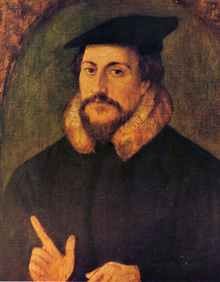
Born on July 10, 1509, in Noyon, Picardy, France, John Calvin was a law student at the University of Orléans when he first joined the cause of the Reformation. In 1536, he published the landmark text Institutes of the Christian Religion, an early attempt to standardize the theories of Protestantism. Calvin’s religious teachings emphasized the sovereignty of the scriptures and divine predestination—a doctrine holding that God chooses those who will enter Heaven based His omnipotence and grace. Calvin lived in Geneva briefly, until anti-Protestant authorities in 1538 forced him to leave. He was invited back again in September 1541 after the Libertines had fallen from power. It took Calvin 14 years before he could fully impose his version of liturgy, doctrine, organization of the church and moral behavior.
In 1541, added by the city council, Calvin drew up the Ecclesiastical Ordinances. He rejected the organization of the Medieval Church as contrary to the New Testament. He wanted a church modeled on the church in Apostolic times. There were to be no bishops. All ministers were equal. They had to preach, administer the sacraments and look after the spiritual welfare of the people. Moral discipline was also upheld by the ministers – but they were helped by the elders. The elders were civilian (laymen) who lived within the congregation and who were elected by the city council. Calvin was not keen on this but it provided a link between the Church and state. The elders and deacons (also laymen who looked after the relief of the poor were subject to popular appointment and in that respect they introduced an important element of democracy into the church. All officers in the church belonged to the consistory and if there was a power struggle between the ministers and the laymen the outcome of that power struggle determined whether the church became Erastian (i.e. followed the way Erasmus wished a church to go) or the state would become theocratic i.e. the church controlled all aspects of life. Eventually Geneva became theocratic.
Calvin’s services were plain and simple. He placed great importance on the sermon. His sermons were very logical and learned. Though he himself liked music, he distrusted its use in religious services believing that it distracted people from the matter in hand – the worship and the seeking knowledge of God. Musical instruments were banned from churches – though congregational singing was permitted and this proved to be both popular and an effective way of ‘spreading’ the message. All matters relating to worship came from the Scriptures – so psalms took the place of hymns in services. (historylearningsite.co.uk. The History Learning Site, Mar. 16, 2015, Oct. 20, 2016.)
Calvin used Protestant principles to establish a religious government; and in 1555, he was given absolute supremacy as leader in Geneva. As Martin Luther’s successor as the preeminent Protestant theologian, Calvin was known for an intellectual, unemotional approach to faith that provided Protestantism’s theological underpinnings, whereas Luther brought passion and populism to his religious cause. While instituting many positive policies, Calvin’s government also punished “impiety” and dissent against his particularly spare vision of Christianity with execution. In the first five years of his rule in Geneva, 58 people were executed and 76 exiled for their religious beliefs. Calvin allowed no art other than music, and even that could not involve instruments. Under his rule, Geneva became the center of Protestantism, and sent out pastors to the rest of Europe, creating Presbyterianism in Scotland, the Puritan Movement in England and the Reformed Church in the Netherlands.(biography.com, The Origins of Calvanism)
Institutes of the Christian Religion – The book was written as an introductory textbook on the Protestant faith for those with some previous knowledge of theology and covered a broad range of theological topics from the doctrines of church and sacraments to justification by faith alone, and Christian liberty. It vigorously attacked the teachings of those Calvin considered unorthodox, particularly Roman Catholicism which Calvin says he had been “strongly devoted” before his conversion to Protestantism. The Institutes is a highly regarded secondary reference for the system of doctrine adopted by the Reformed Churches usually called Calvinism.
John Calvin was a force to be reckoned with. While he was one of many who sought to reform the church, few were able to establish their own government as well to further their reforms.
Pastor Dave
Please bring in toilet paper or paper towels this week for Trinity’s Table.
 Lutheran Schreff