

May 25, 2017
Devotions: Personalities of the Reformation: Philipp Melanchthon
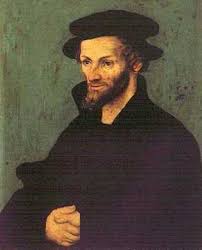
Philipp Melanchthon was born Philipp Schwartzerd on February 15, 1497 in Bretten, Palatinate (Germany) and died on April 19, 1560, about fourteen years after Luther (1546). Melanchthon was a giant in the protestant movement, and in the Lutheran development of theology. He would go on to write the Augsburg Confession in 1530. He was a humanist, theologian, reformer and educator. In 1521 Melanchthon published the Loci communes, the first systematic treatment of the new Wittenberg theology developed by Luther. Because of his academic expertise, he was asked to help in founding schools, and he played an important role in reforming public schools in Germany.
Luther and Melanchthon would become close friends, and in 1518 Melanchthon would commit himself to the Reformation causes following Luther’s posting of the 95 Theses in Wittenberg. By the end of 1519 he had already defended scriptural authority against Luther’s opponent Johann Eck, would have rejected the teaching of Transubstantiation (the doctrine adopted by the Catholic church explaining how the substance of the bread and wine in the Lord’s Supper is changed into the body and blood of Christ) and would make Justification by Grace through Faith the keystone of his theology. He would go on to write and publish many small books and earn a bachelor of theology degree at Wittenberg. His energy was phenomenal. It is reported he would begin his day at 2:00 AM and he would give lectures to as many as 600 students at 6:00. He married Katherine Krapp in 1520 and they would have four children. In 1521, during Luther’s stay on the church castle in Wartburg (following the Diet of Worms), Melanchthon would become the leader of the Reformation cause at Wittenberg, while Luther would hide out in Wartburg and begin translating the scriptures into the German language.
Melanchthon and Luther would not only spark the reformation of the Roman church, they would also be instrumental in the reformation of society as well.
After the First Diet of Speyer (1526), a precarious peace was patched up for the Reform movement. In 1528 he published Unterricht der Visitatoren (“Instructions for Visitors”) which was a statement of Evangelical doctrine, but it also contained an outline of education for the elementary grades, which was enacted into law in Saxony to establish the first public school system. Melanchthon’s educational plan was widely copied throughout Germany and at least 56 cities asked his advice in founding schools. It is not hyperbole to say that Melanchthon’s influence in Protestant Germany is hard to capture in just a short devotion. He, together with Luther and Martin Chemnitz (see May 15 devotion), would write some of the most influential documents for the Lutheran faith. He helped found the universities of Königsberg, Jena, and Marburg and reformed those of Greifswald, Wittenberg, Cologne, Tübingen, Leipzig, Heidelberg, and Rostock. His efforts earned him the title “Preceptor of Germany.” (adapted from Philipp Melanchthon: GERMAN THEOLOGIAN, by Clyde L. Manschreck, britannica.com)
Loci communes: written by Melanchthon in 1521, this book lays out Christian doctrine by discussing the “leading thoughts” from the Epistle to the Romans, and these thoughts were intended to guide the reader to a proper understanding of the Bible in general. Luther said of it that “Next to Holy Scripture, there is no better book”.
First Diet of Speyer (1526): in short was an Imperial Diet of the Holy Roman Empire in the Imperial City of Speyer (in present day Germany). The diet’s edict resulted in a temporary suspension of the Edict of Worms and aided the expansion of Protestantism.
Pastor Dave
Please bring in diapers and paper towels to donate to Trinity’s Table.
 Lutheran Schreff