

May 12, 2017
Devotions: Personalities of the Reformation – Andreas von Karlstadt
Andreas Rudolph Bodenstein von Karlstadt was born on December 24, 1486 and died December 24, 1541). He was a German Christian theologian and a significant figure in the Protestant Reformation. He was born in Karlstadt, Franconia (Bavaria, Germany).
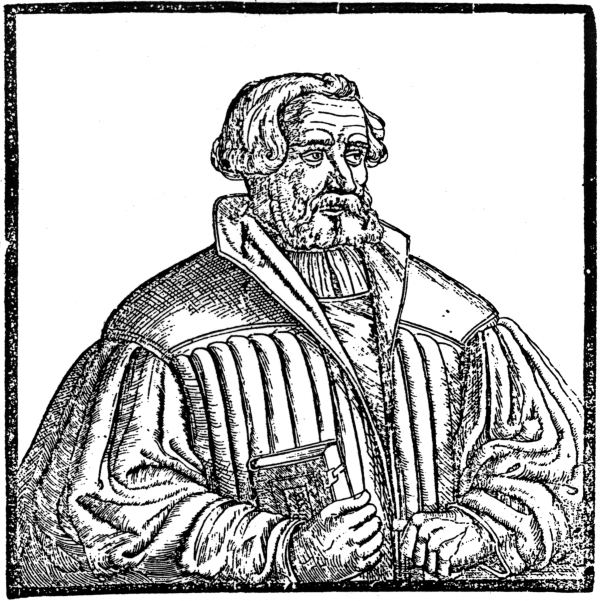
He was a “secular” cleric with no official ties to any monsastic order. His beliefs were challenged during his stay in Rome, where he alleges he saw large-scale corruption in the Roman Catholic Church, and on a document dated September 16, 1516 he wrote a series of 151 theses (not be confused with Luther’s 95 Theses, 1517 that attacked indulgences.) In 1519, Johann Eck challenged Karlstadt to the Leipzig Debate. There, Eck debated with Luther as well as Karlstadt. On June 15, 1520 Pope Leo X issued the papal bull Exsurge Domine that threatened Luther and Karlstadt with excommunication, and condemned several of their theses. Both reformers remained steadfast, and excommunication followed in 1521. After the Diet of Worms (January–May, 1521), and while Luther was hiding at Wartburg Castle, Karlstadt worked toward reform in Wittenberg. On Christmas Day 1521, he performed the first reformed communion service. He did not elevate the elements of communion, wore secular clothing during the service, and purged all references to sacrifice from the traditional mass. He shouted rather than whispered the words of institution (“This is my body….”, etc.) in German instead of Latin, rejected confession as a prerequisite for communion, and let the communicants take both bread and wine on their own during the service.
In early January 1522, the Wittenberg city council authorized the removal of imagery from churches and affirmed the changes introduced by Karlstadt on Christmas. On January 19 Karlstadt married Anna von Mochau, the fifteen-year-old daughter of a poor nobleman. On January 20 the imperial government and the Pope ordered Frederick the Wise, Elector of Saxony to undo the changes. Frederick let most of the mass revert to its Catholic form, but in a letter to the Wittenberg Council, he noted his personal compassion for Karlstadt.
Relationship with Martin Luther From Spring 1524, Luther started to campaign against Karlstadt, denying his right to publish and preach without Luther’s authorization. In June, Karlstadt resigned as archdeacon. In July, Luther published the Letter to the Saxon Princes, in which he argued that Thomas Muntzer and Karlstadt agreed, and were both dangerous sectarians with revolutionary tendencies. On August 22, 1524, Luther preached in Jena, Germany. Karlstadt hid in the crowd during Luther’s preaching, and wrote to Luther, asking to see him. This led to the well-known confrontation at the Black Bear Inn in a conversation recorded by a Martin Reinhardt and published within a month. There were a number of misunderstandings between the two men. For example, Luther said that he was convinced that Karlstadt had revolutionary tendencies, despite the fact that Karlstadt had all along rejected violence in the name of religion, and rejected Thomas Muntzer’s invitation to join the League of the Elect. Karlstadt’s answer was published in 1524 in Wittenberg, and is still extant. This showed that Karlstadt continued to reject the violence that led to the German Peasants’ War. Another defamation was Luther’s accusation that Karlstadt was not authorized to preach at the city church in Wittenberg during Luther’s stay at Wartburg. The conversation ended when Luther gave Karlstadt a guilder (gold coin) and told him to write against him. In September 1524 Karlstadt was exiled from Saxony by Frederick the Wise and George, Duke of Saxony. Luther also wrote against Karlstadt in his 1526 The Sacrament of the Body and Blood of Christ – Against the Fanatics. Fleeing Saxony, Karlstadt served as a minister in Switzerland in Alstatten and Zurich. In 1534, he went to Basel as minister of the university church and Professor of Hebrew and Dean of the university. He remained in Basel until he died of the plague on his 55th birthday, December 24, 1541.” (wikipedia)
As we move along the trail of the personalities of the period of time we call the Reformation, we begin to realize that Luther was just one of many individuals who were offended by and critical of the abuses of the church. And, we also begin to realize that these individuals often risked their lives in order to follow the convictions of their faith. Even within the Reformation movement, the leaders did not often agree – therefore we do not have one “Reformed” church, we have 33,000 denominations that grew from the forces of the Reformation.
Pastor Dave
Please bring in toilet paper or paper towels this week for Trinity’s Table.
 Lutheran Schreff