

May 10, 2017
Devotions: Personalities of the Reformation – Heinrich Bullinger
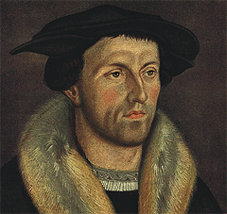
Heinrich Bullinger was born on July 18, 1504, in Bremgarten, Switzerland and died on September 17, 1575, in Zurich. He, too, was a convert from Roman Catholicism who first aided and then succeeded the Swiss Reformer Huldrych Zwingli (1484–1531) and who, through his preaching and writing, became a major figure in securing Switzerland for the Reformation.
While a student at the University of Cologne, Bullinger became increasingly sympathetic to the Reformation. Barred from Roman Catholic clerical positions, he taught at the cloister school of the Cistercian Order at Kappel, Switzerland, from 1523 to 1529. Having known Zwingli since 1523, Bullinger gradually accepted his theology and in 1528 assisted him in theological disputations at the Bern Convocation. The next year he succeeded his father as a pastor at Bremgarten. When Zwingli died in 1531, Bullinger took his place as main pastor at Zürich. His influence extended to other countries through correspondence with their rulers. In order to overcome differences on the Lord’s Supper with Martin Luther in the interests of church unity, Bullinger helped draft the First Helvetic Confession of 1536. When this effort failed, he subsequently reached agreement with the Reformer John Calvin in the Consensus Tigurinus (1549) and with other churches in his own Second Helvetic Confession (1566). This marked the beginning of the “Reformed tradition,” the fusion of Zwinglian and Calvinist thought.” (britannica.com, composed by The Editors of Encyclopædia Britannica July 20, 1998, last update)
Helvetic Confessions – two confessions of faith officially adopted by the Reformed Church in Switzerland. The First Helvetic Confession (also called the Second Confession of Basel) was composed in 1536 by Bullinger and other Swiss delegates, assisted by Martin Bucer of Strasbourg. It was the first Reformed creed of national authority, although it was sometimes criticized as being too Lutheran. In 1562 Bullinger wrote a lengthy theological statement of 30 articles, which he later revised and attached to his will. This document became known as the Second Helvetic Confession and was published in 1566 as the official creed of the Swiss cantons.
Reformed Tradition – The term “Reformed” was associated primarily with John Calvin’s work in the church of Geneva. According to Calvinism:
Salvation is accomplished by the almighty power of the triune God. The Father chose a people, the Son died for them, the Holy Spirit makes Christ’s death effective by bringing the elect to faith and repentance, thereby causing them to willingly obey the Gospel. The entire process (election, redemption, regeneration) is the work of God and is by grace alone. Thus God, not man, determines who will be the recipients of the gift of salvation. The five points of Calvanism are:
Total Depravity – The effect of the fall upon man is that sin has extended to every part of his personality
Unconditional Election – God has elected, based solely upon the counsel of his own will, some for glory and others for damnation
Limited Atonement – The Bible teaches that Christ died for those whom God gave him to save
Irresistible Grace – Christ, himself, teaches that all whom God has elected will come to a knowledge of him
Perseverance of the Saints — states that the saints (those whom God has saved) will remain in God’s hand until they are glorified and brought to abide with him in heaven (reformed.com/calvanism)
I encourage you to ask the pastor about The Augsburg Confession which highlights the basic tenets of the Lutheran faith. While there might be “Five Points of Calvanism”, I believe we should at least know about the most significant point of Lutheranism: Justification by Faith, through G-d’s Grace. We shall talk more about John Calvin in the next devotion.
Pastor Dave
Please bring in toilet paper or paper towels this week for Trinity’s Table.
 Lutheran Schreff