

May 6, 2017
Devotions – Personalities of the Reformation – Precursors
Wessel Harmenz Gansfort
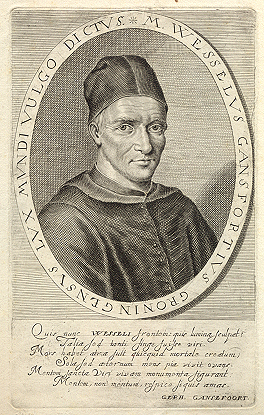
Wessel Harmenz Gansfort lived from 1419 – October 4, 1489. He was a theologian and early humanist. Many variations of his last name are seen and he is sometimes incorrectly called Johan Wessel. Like Wycliffe, Huss, and even Waldo before him, Gansfort has been called one of the precursors to the Reformation. Things he protested against included the paganizing of the papacy, superstitious and magical uses of the sacraments, and the authority of ecclesiastical tradition and their tendency for later scholastic theology to put a greater stress, regarding the doctrine of justification upon human will rather than on the work of Christ for salvation.
Among the exegetical insights which the Hebrew text afforded him were:
1. The idea that God must be addressed as both Father and Mother (based on his reading of Psalm 25:6);
2. An analysis that Exodus 3:14, rendered in Latin as Ego sum qui sum, should be translated as Ero qui ero (thereby undermining much of scholastic theology in which God is the supreme Being); and,
3. The understanding based upon his reading of Isaiah 8:3 that Christ came not only to save human beings but also the animals.
4.
In 1475, he was at Basel and, in 1476, at Heidelberg, teaching philosophy in the university. As old age approached, he grew to dislike the theological strife of scholasticism and turned away from that university discipline. After thirty years of academic life, he returned to his native Groningen, and spent the rest of his life partly as director of the Olde Convent, a sister convent of the Order of Tertiaries, and partly in the convent of St. Agnes at Zwolle.” (wikipedia)
What we do not realize is that, in medieval times, there were plenty of superstitions, unlike today, Amen? One of the practices of those in the Catholic church was to sneak the wafer from Holy Communion out of the church and use it as a charm, or for other superstitious practices (at least that was the fear). This is one of the reasons many Catholic worshipers do not receive the wafer in their hands, but instead have it placed on their tongues. Therefore there is no suspicion that they have tried to remove it from the nave. Every once in a while someone comes to the Lutheran church requesting the wafer in this manner.
We have a lot to learn about people – their different faith practices, and those who spent their lives seeking a closer relationship with G-d.
Pastor Dave
* Collect bottles of shampoo this week for Trinity’s Table.
 Lutheran Schreff