

May 5, 2017
Devotions – Personalities of the Reformation – Precursors
Peter Waldo
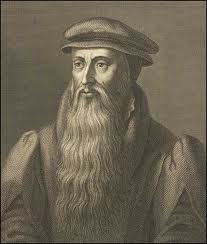
“We do not even know for sure that Peter Waldo’s first name was Peter; he was a rich merchant of Lyon France, who, while listening to a troubadour, came under deep conviction for sin in the latter part of the 12th—century. Troubadours (who had become popular in the 11th century) often sang ballads about saints. This particular troubadour recounted the story of Alexis, a fifth century mystic who abandoned wealth to live by begging and returned home unrecognized. The story touched Waldo, who immediately sought the surest path to heaven, which he saw in Christ’s words to the rich young ruler, “Go sell all you have, give to the poor, and come, take up your cross and follow me.”
As he gained spiritual maturity, Waldo began to preach and teach in the streets. Followers gathered around him. These were known by many names, such as the Poor Men of Lyon, The Poor of God, Waldensians, or Waldenses. At some point Waldo commissioned a scholar to translate parts of the New Testament into Provençal, the local language. Lay preachers carried this word from place to place. Later, Waldensian peddlars also spread the gospel. Bishops became upset that Waldo and his followers were encroaching upon their turf and doing the tasks they had left undone. In 1179, to counter their objections, Waldo and a disciple went to Rome to seek papal approval for their work. Pope Alexander III had them explain their position to a panel of three clergymen. No one seems to have taken them seriously and the pope did not approve their work, although he seems to have authorized them to preach wherever local bishops approved. This, of course, was to say nowhere. Shortly afterward, the Third Lateran Council condemned Waldensian teaching, but without excommunicating them. Driven from Lyon, the Waldensians settled in the high valleys of Piedmont, and in the Luberon region of France. In 1184, Pope Lucius III excommunicated Waldo, and in 1215 the Fourth Lateran Council agreed. For three centuries, Rome persecuted the Waldensians savagely. Driven from place to place, they clung to Scripture, and their lay preachers continued to spread reform views, which were far from heretical and in agreement with much that would later be found in the Franciscan movement and in Protestantism. Indeed, most Waldensians united with Protestants during the Reformation. Those who remained in the Alps, however, retained their separate identity. Italy finally awarded the Waldensians religious freedom in 1858.” (Waldo Sought a Truer Faith, christianhistoryinstitute.org)
Lay preachers and their efforts to spread the Gospel were upsetting the clergy – this is part of the story with Peter Waldo. How dare someone who is not clergy preach, teach, or share the sacrament? This is an argument that has proliferated in the church for quite a while. Just recently one of our lay ministers was confronted by a retired pastor who was “unhapy” that he, a lay minister, was distributing “consecrated” elements to shut-ins. How are we supposed to set aside those called to the ministry – or to Christian Education? The tradition of the Lutheran Church is to set aside those called to the rostered ministry by having them complete seminary education and appropriate other experiences as directed by “call committees”. But that does not mean that all christian education and related ministry should be completed only by those called to rostered ministry. There is plenty of space, and necessary involvement for lay leaders to help spread the Gospel – through word and deed – as long as there is appropriate efforts for them to be trained for “right practice”.
Without the help of lay ministers, the Lutheran Church of the 21st century will continue to struggle to meet the spiritual needs of the faithful, and to evangelize to seekers.
Pastor Dave
* Collect bottles of shampoo and conditioner this week for Trinity’s Table.
 Lutheran Schreff