

May 1, 2017
Devotions – Personalities of the Reformation – The Precursors: John Wycliffe
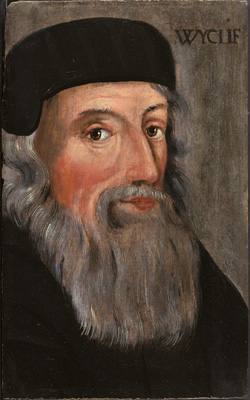
John Wycliffe lived from the mid-1320s to December 31, 1384. He was an English philosopher, theologian, Biblical translator, reformer, and seminary professor at Oxford. He was an influential dissident within the Roman Catholic priesthood during the 14th century. Wycliffe was born on a sheep farm 200 miles from London. He left for Oxford University in 1346, but because of periodic eruptions of the Black Death, he was not able to earn his doctorate until 1372. In 1374 he became rector of the parish in Lutterworth. He had a few setbacks regarding other positions in the church which some have seized upon as motives for his subsequent attacks on the papacy.
“Rome was demanding financial support from England, a nation struggling to raise money to resist a possible French attack. Wycliffe advised his local lord, John of Gaunt, to tell Parliament not to comply. He argued that the church was already too wealthy and that Christ called his disciples to poverty, not wealth. If anyone should keep such taxes, it should be local English authorities. Such opinions got Wycliffe into trouble, and he was brought to London to answer charges of heresy. The hearing had hardly gotten underway when it erupted into an open brawl, ending the meeting. Three months later, Pope Gregory XI issued five bulls (church edicts) against Wycliffe, in which Wycliffe was accused on 18 counts and was called “the master of errors.” At a subsequent hearing before the archbishop at Lambeth Palace, Wycliffe replied, “I am ready to defend my convictions even unto death…. I have followed the Sacred Scriptures and the holy doctors.” He went on to say that the pope and the church were second in authority to Scripture. Sounds like another Reformer to follow.
This didn’t sit well with Rome, but because of Wycliffe’s popularity in England and a subsequent split in the papacy (the Great Schism of 1378, when rival popes were elected), Wycliffe was put under “house arrest”. He deepened his study of Scripture and wrote more about his conflicts with official church teaching. He wrote against the doctrine of transubstantiation: “The bread while becoming by virtue of Christ’s words the body of Christ does not cease to be bread.” He challenged indulgences: “It is plain to me that our prelates in granting indulgences do commonly blaspheme the wisdom of God.” He repudiated the confessional. He reiterated the biblical teaching on faith: “Trust wholly in Christ; rely altogether on his sufferings; beware of seeking to be justified in any other way than by his righteousness.”
Believing that every Christian should have access to Scripture (only Latin translations were available at the time), he began translating the Bible into English, with the help of his good friend John Purvey. The church bitterly opposed it. Wycliffe replied, “Englishmen learn Christ’s law best in English. Moses heard God’s law in his own tongue; so did Christ’s apostles.” Wycliffe died before the translation was complete (and before authorities could convict him of heresy); his friend Purvey is considered responsible for the version of the “Wycliffe” Bible we have today. John Wycliffe left quite an impression on the church: 43 years after his death, officials dug up his body, burned his remains, and threw the ashes into the river Swift. Still, they couldn’t get rid of him. Wycliffe’s teachings, though suppressed, continued to spread. As a later chronicler observed, “Thus the brook hath conveyed his ashes into Avon; Avon into Severn; Severn into the narrow seas; and they into the main ocean. And thus the ashes of Wycliffe are the emblem of his doctrine which now is dispersed the world over.” (christianitytoday.com, John Wycliffe)
As we shall see in the postings to come, there were others beside Martin Luther who tried to translate the bible into the vernacular of their fellow citizens, who argued against the abuses of the Catholic church of the day, and who stood up for their beliefs, even to the point of death. We have a lot to learn from those whose faith led them to the ashes of martyrdom – for though we may not ever need to “take a stance” like them, we still will be challenged from time to time. How will we respond?
Pastor Dave
Collect bottles of shampoo and conditioner this week for Trinity’s Table.
 Lutheran Schreff