
April 22, 2017 — Origen

April 22, 2017
Lenten Devotions – Origen

“Things in themselves so supremely great, so far above man, so utterly above our perishable nature, as to be impossible for the race of rational mortals to grasp, as the will of God became possible in the immeasurable abundance of the Divine grace which streams forth from God upon men, through Jesus Christ the minister of His unsurpassable grace toward us, and through the cooperant Spirit. Thus, though it is a standing impossibility for human nature to acquire Wisdom, by which all things have been established—for all things, according to David, God made in wisdom—from being impossible it becomes possible through our Lord Jesus Christ, who was made for us wisdom from God and righteousness and sanctification and redemption.” (Origen on Prayer)

Because no definite dates are associated with Origen’s life, the church has selected this day, April 22, to recognize his contribution to the church. History attributes his dates on this earth from 184/185 – 253/254. He was a Greek scholar, an early Christian Theologian, and an ascetic (is a lifestyle characterized by abstinence from worldly pleasures, often for the purpose of pursuing spiritual goals.) He spent half his life in Alexandria. He was a prolific writer on issues such as textual criticism (a branch of textual scholarship, philology, and literary criticism that is concerned with the identification of textual variants in either manuscripts or printed books), biblical exegesis (a critical explanation or interpretation of a text, particularly a religious text), and hermeneutics (the branch of knowledge that deals with interpretation, especially of the Bible or literary texts.) Origen also wrote a great deal on theology, preaching and spirituality. He was and is one of the most influential figures in the early Christian church.

“Homilies on almost the entire Bible were prepared by Origen. There are 205, and possibly 279, homilies of Origen that are extant either in Greek or in Latin translations. The homilies preserved are on Genesis (16), Exodus (13), Leviticus (16), Numbers (28), Joshua (26), Judges (9), I Sam. (2), Psalms 36-38 (9), Canticles (2), Isaiah (9), Jeremiah (7 Greek, 2 Latin, 12 Greek and Latin), Ezekiel (14), and Luke (39). The homilies were preached in the church at Caesarea, with the exception of the two on 1 Samuel which were delivered in Jerusalem. Nautin has argued that they were all preached in a three-year liturgical cycle some time between 238 and 244, preceding the Commentary on the Song of Songs, where Origen refers to homilies on Judges, Exodus, Numbers, and a work on Leviticus.” (wikipedia)

We do not need to be a theologian or a writer to influence the faith of others. We just need to be willing to share how Jesus has affected and changed our lives. We too can be influential – maybe not to thousands – but even if just one person is influenced by our witness, then we too are great in the eyes of G-d.

Pastor Dave
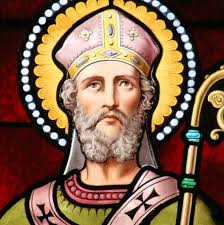
April 21, 2017 — St. Anselm

April 21, 2017
Lenten Devotions – St. Anselm

On this date, April 21, 1109, St. Anselm died: the church was poorer for losing a great mind and a zealous reformer. Anselm won a name for reform because he attempted to end abuses such as the slave trade. He urged the holding of regular synods and, while he was archbishop, enforced clerical celibacy within his “see” (the term Holy See comes from the Latin Sancta Sedes, meaning “Holy Chair,” i.e. the chair or throne, represents the position and authority of the Holy Father or a bishop, and the place where he resides in the territory of his jurisdiction). Because of his powerful intellect, some scholars consider him one of the creators of scholasticism. But his most notable gift to history was what has become known as the ontological proof for the existence of God. Here is his proof:
Can the existence of God be proven? Anselm’s argument went something like this: When we discuss the existence of God, we define him as a perfect being, greater than anything else which can be conceived. If God does not exist, then the name “God” refers to an imaginary being. This makes the definition of “God” contradictory, for to be real, to be living, to have power is greater than to be imaginary. It is clear I cannot even discuss the word “God” as defined if he does not exist, because I have to conceive of him as really existing in order for him to be greater than anything else, for a God who does not exist is not greater than anything else. In short, no philosopher can legitimately argue that God does not exist if he defines God as a perfect being greater than any which can be imagined; for to be perfect, God must have real existence. Those who acknowledge He exists do not have a problem with self-contradiction when they affirm his existence. Since we can indeed raise the question of God’s existence and argue the point, then God must exist.

Bertrand Russell, one of the greatest logicians and mathematicians of the Twentieth Century and no friend of Christianity, grappled with Anselm’s proof and at one time is said to have thought the proof worked. As Archbishop of Canterbury, the zealous Anselm struggled with King William for church rights. As a theologian, the pious Anselm is remembered for his book, Why Did God Become Man? In it he argued that each of us has run up such a debt of sin that there is no way we can repay God. Christ, as infinite God, has merit enough and to spare to pay our debts. Anselm died surrounded by friends who placed his body in ashes on the floor. He was probably canonized in 1494, although there is debate whether this occurred at all. His beatific status aside, Anselm will long be remembered as the author of the ontological proof.

Do you need proof that G-d exists? Thomas Aquinas wrote five arguments for the existence of G-d. Here is the first:
The “First-Cause Argument”:

– It’s impossible for a thing to be the cause of itself.
– If something is caused by another, then these causes must go back to infinity, or there must be a first, uncaused cause that begins the chain of causes in the universe.
– It’s not possible for causes to go back to infinity.
– Therefore, there must be a First Cause, which everyone calls “God.” (christianity.com website, Anselm’s Subtle Proof of God’s Existence, Dan Graves, MSL)

We have come to trust and believe in the existence of G-d through tradition, through theological expositions, through biblical and personal witness, and through sacraments. No matter how many proofs they develop on the existence of G-d, for me, the existence of G-d is proven each and every day by the presence of G-d in my life. My proof may not be your proof, but that is OK with me – G-d makes G-d’s presence in my life personal, communal, and relational.

Pastor Dave