
April 4, 2017 — Unless a Grain of Wheat……………Dies

April 4, 2017
Lenten Devotions – Unless a Grain of Wheat…Dies

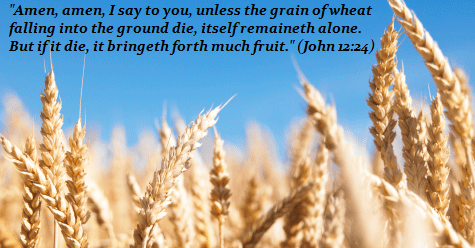
“Very truly, I tell you, unless a grain of wheat falls into the earth and dies, it remains just a single grain; but if it dies, it bears much fruit.” John 12:24
“A Dayak proverb puts the human quandary this way: “Where the heart is willing it will find a thousand ways, but where it is unwilling it will find a thousand excuses.”

The church celebrates Lent as a time of repentance. In Lent we assess our behaviors that stand in need of forgiveness. When Jesus says in today’s Gospel text “those who love their life lose it,” Jesus speaks to human life. Stewards recognize that we, perhaps out of survival and self-preservation, cling to possessions. The gospel addresses this impulse in many ways. When Luke displays the church at its spotless best, he writes, “All who believed were together and had all things in common” (Acts 2:44). This is Luke’s rendering of a new creation – the church. We see the perfection of the church in its ability to share with one another. It is to this noble path that God calls his church. We who say we want to live in peace often shatter harmonious community over questions about possessions. Lent is the season of Christian self-denial. For this reason, this text beckons believers to follow Jesus’ lead. “Unless a grain of wheat falls into the earth and dies, it remains just a single grain; but if it dies, it bears much fruit.”

When stewards practice selfless giving on behalf of others, then they defy their own instinct for self-preservation. Our culture today lives under the myth of scarceness: it is only by hoarding and keeping possessions that we can assure ourselves of continuous survival. Yet Jesus teaches that within life in God there are ways of living that transcend simple survival. Jesus even reminds stewards, “Whoever serves me must follow me, and where I am, there will my servant be also. Whoever serves me, the Father will honor.” (Lenten Devotional Stewardship Principles, We walk together as stewards in God’s church, ELCA, 2012, March 25)

It is a difficult teaching to say that we are to lose our life rather than to love it – for the sake of the Gospel. Over the years we have seen this played out where people have been martyred for their faith. In reality, few will go the distance to sacrifice themselves for the sake of the teaching of Jesus Christ. But we can live in the manner where we choose first the Kingdom of G-d rather than give into the Kingdom of the world each and every day. That means living in the manner where we put others first. It means prioritizing our time to put G-d at the top of the list and other things at the bottom. Lent is the time for spiritual spring cleaning, and for re-prioritizing our schedules, always with the words of Jesus in our ears “Those who serve me, the Father will honor.” (John 12:26)

This week collect one roll of paper towel to bring in for Trinity’s Table.

Pastor Dave

April 3, 2017 — Marsilius of Padua and John of Jandun

April 3, 2017
Lenten Devotions – Marsilius of Padua and John of Jandun

“Then they sent to him some Pharisees and some Herodians to trap him in what he said. And they came and said to him, “Teacher, we know that you are sincere, and show deference to no one; for you do not regard people with partiality, but teach the way of God in accordance with truth. Is it lawful to pay taxes to the emperor, or not? Should we pay them, or should we not?” But knowing their hypocrisy, he said to them, “Why are you putting me to the test? Bring me a denarius and let me see it.” And they brought one. Then he said to them, “Whose head is this, and whose title?” They answered, “The emperor’s.” Jesus said to them, “Give to the emperor the things that are the emperor’s, and to God the things that are God’s.” And they were utterly amazed at him.” Mark 12:13-17

On this date April 3, 1327, the pope issued a bull denouncing John of Jandun and Marsilius of Padua as “sons of perdition and fruits of malediction.” Who were Marsilius of Padua and John of Jandun?

Marsilius of Padua denounced the papacy, blaming the popes for the miseries of Italy. Papal excommunication and interdicts had interfered with lawful governments, he alleged, subjecting Italy to crime, wars, corruption and many other blights. In his book Defensor pacis, Marsilius reasoned that the state should run its own affairs without interference from the church.

Two kinds of government exist: that which rules with the consent of people and that which rules without. The latter is tyranny. The ideal government not only rules with the consent of the people but by election, said Marsilius. Believe it or not, he was writing in the fourteenth century.

If he had his way, the people would elect both their council and ruler. Marsilius stopped short of full separation of powers…Like the reformers who came after him, Marsilius argued that popes have no scriptural basis for their authority. Christ claimed no earthly power for himself. “My kingdom is not of this world,” he said. Likewise, the apostles made no grab for power. Their discipline did not extend beyond the walls of the church. By contrast, Popes and other churchmen often interfered with the administration of nations when instead of grabbing power they should have been serving. In making such arguments, Marsilius assumed that the scriptures alone are the rule of faith. Not even church councils could replace the authority of God’s word. Such an attack on the claims of the Medieval church could not be ignored. Marsilius’ book was completed June 24, 1324. Within two years he and his collaborator, John of Jandun, were forced to flee for asylum from Paris to Bavaria.

During his lifetime the book was little studied. After his death, it took on more importance. According to Catholic Encyclopedia, “Marsilius certainly selected for emphasis just those ideas that would become important in the future.” Copies of the book survived their double condemnation and it was printed in 1517, the same year Luther posted his 95 theses. In fact, Luther was accused of resurrecting Marsilius’ ideas. The English reformers Cranmer and Hooker studied the work when constituting the English church. Condemnation of a work seldom destroys its influence. (Marsilius of Padua and John of Jandun, Dan Graves, Christianity.com)
Martin Luther was not the only person of the 14th through 16th centuries who argued that the Pope was mis-using his authority, and that the church was becoming a source of tyranny for the people. Let the government do the work of government, and the church do the work of the church – and let not the government interfere with the work of the church, nor the church interfere with the work of government. There will be plenty of problems within each – for each will be filled with greed, influence peddling, and other faults because, well, each is filled with people. The struggle will be for people to learn to govern one another with justice and peace, and to worship the Lord with the freedom Christ has won for us.

Paul, in his letter to the church in Galatia, will write: “For freedom Christ has set us free. Stand firm, therefore, and do not submit again to a yoke of slavery.” Lutheran theology has understood the relationship between church and state in terms of G-d’s two ways of ruling in the world. Luther called it “Two Kingdoms”. St. Augustine made the same distinction in his “City of God” and the “City of the World”. Luther argued G-d governs the world in two ways: “through orders of creation, such as government and marriage, which stem from God’s desire that all people everywhere live in peace and harmony, and through his Word and Gospel, though these apply only to Christians.” These two domains of power and grace are interdependent because the Gospel itself cannot preserve societal peace and justice, civil government cannot effect salvation. Or in other words, in North America, Lutherans accept the separation of church and state while Lutherans still work to ensure we are ruled by good government.

This week collect one roll of paper towel to bring in for Trinity’s Table.

Pastor Dave