

April 25, 2017
Lenten Devotions – Daniel Defoe
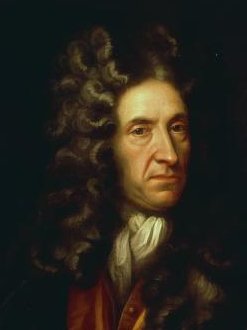
Daniel Defoe’s fictional work “The Life and Strange Adventures of Robinson Crusoe” is published on this day, April 25, 1719. The book, about a shipwrecked sailor who spends 28 years on a deserted island, is based on the experiences of shipwreck victims and of Alexander Selkirk, a Scottish sailor who spent four years on a small island off the coast of South America in the early 1700s. Like his hero Crusoe, Daniel Defoe was an ordinary, middle-class Englishman, not an educated member of the nobility like most writers at the time. Defoe established himself as a small merchant but went bankrupt in 1692 and turned to political pamphleteering to support himself. A pamphlet he published in 1702 satirizing members of the High Church led to his arrest and trial for seditious libel in 1703. He appealed to powerful politician Robert Harley, 1st Earl of Oxford, who had him freed from Newgate prison and who hired him as a political writer and spy to support his own views. To this end, Defoe set up the Review, which he edited and wrote from 1704 to 1713. It wasn’t until he was nearly 60 that he began writing fiction. His other works include Moll Flanders (1722) and Roxana (1724). He died in London in 1731, one day before the 12th anniversary of Robinson Crusoe’s publication.
“And he (Paul) found a Jew named Aquila, a native of Pontus, having recently come from Italy with his wife Priscilla, because Claudius had commanded all the Jews to leave Rome. He came to them, and because he was of the same trade, he stayed with them and they were working, for by trade they were tent-makers.” Acts 18:2-3
Like Paul, Aquila and Priscilla were also tentmakers…This characterization of Paul as an artisan who worked with his hands coheres with the picture Paul paints of himself in his letters (I Corinthians 4:12; I Thessalonians 2:9). If the Paul of the letters viewed such manual labor negatively, there is no indication he does so in Acts. Paul stayed and worked with Aquila and Priscilla. Paul moves from intellectual debate with Athenian philosophers to manual labor with Corinthian artisans, and in so doing “becomes all things to all people” ( I Corinthians 9:22).
His economic self-sufficiency was no doubt important, not only given the length of his stay (eighteen months), but also because of Corinth’s reputation for hosting philosophical charlatans and other “peddlers” who sold their intellectual “wares” to the highest bidders…It is little wonder…for an audience familiar with such practices that Luke would characterize Paul as engaging in work for self-support in order to distinguish himself from these hucksters in much the same way that Paul in writing to the Corinthians would seek to distance himself from “so many who are peddlers of God’s word” (II Corinthians 2:17). (Parsons, Acts (Paideia: Commentaries on the New Testament), 250-51) (A Trivial Devotion, July 9, 2014)
Like Paul was an ordinary tent maker, Daniel Defoe was “…an ordinary, middle-class Englishman, not an educated member of the nobility like most writers at the time.” But both men used their experiences, skills and trades to have a huge influence on people. Yes Paul was a Pharisee of the “highest degree”, but once Jesus helped him to “see the light”, he too began to use his writing skills to encourage others in the faith. We do not always need to be highly educated to influence people, we simply need to take our life experiences and share them with the world – whether the world is a small town like Lemoyne, or the literary world of fiction. It is in understanding our vocation, our call, and our passion where we have the best chance to make a difference in people’s lives.
This week please collect bottles of house cleaner for Trinity’s Table.
Pastor Dave
 Lutheran Schreff