

April 24, 2017
Lenten Devotions – Johann Reuchlin
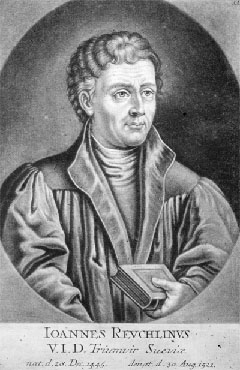
“On this day, April 24, 1514, a tribunal declared Johann Reuchlin not guilty of heresy. Who was Johann Reuchlin? Born on January 29, 1455 he lived until June 30, 1522. “He was a German-born humanist and a scholar of Greek and Hebrew, whose work also took him to modern-day France, Austria, Switzerland, and Italy. Most of Reuchlin’s career centered on advancing German knowledge of Greek and Hebrew. Reuchlin’s talent for singing brought him to the attention of the Margrave of Baden who made him a companion of his son. In love with learning, the singer seized every opportunity his new position afforded to educate himself. Languages were his forte. He wrote the first Latin dictionary to be published in Germany and a Greek grammar. Hebrew was his dearest love. He ferreted out the rules of Israel’s ancient language by study of Hebrew texts and converse with every rabbi who appeared within his range. His authority became widely recognized. Reputation was nearly the cause of his ruin. A converted Jew and a Dominican inquisitor extracted from Emperor Maximilian an order to burn all Hebrew works except the Old Testament, charging they were full of errors and blasphemies. Before the edict could be carried out, the Emperor had second thoughts and consulted the greatest Hebrew scholar of the age: Reuchlin.
Reuchlin urged preservation of the Jewish books as aids to study, and as examples of errors against which champions of faith might joust. To destroy the books would give ammunition to the church’s enemies, he said. The emperor revoked his order. In 1517 Luther posted his 95 theses. “Thanks be to God,” said the weary Reuchlin. “At last they have found a man who will give them so much to do that they will be compelled to let my old age end in peace.” Thanks to Reuchlin, the Talmud and Kabbala were preserved. Although he died a broken man, freedom for academic production was strengthened because of his ordeal. Soon his studies formed the basis for better translations of the Old Testament. Furthermore, his influence assured Melanchthon a position among the learned and a place in the Reformation.” (wikipedia, and chirstianity.com, Reuchlin Found Not Guilty, Dan Graves, MSL)
Reuchlin began his translations of the Old Testament before Martin Luther began his translations of the New Testament. Luther’s German Bible put the bible into the hands of everyday Germans so they could read the Bible themselves instead of relying on Priests to read it to them. Reuchlin’s knowledge of Hebrew made it possible for non-biblical Hebrew works to be preserved. Both men were instrumental in increasing the German people’s knowledge of the bible and other religious writings. Martin Luther translated the New Testament while being sequestered in the Wartburg Castle following the Diet of Worms episode.
“Luther translated from the Greek text, using Erasmus’ second edition (1519) of the Greek New Testament, known as the Textus Receptus. Luther did not translate from the Latin Vulgate translation, which is the Latin translation officially used by the Roman Catholic Church. To help him in translating into contemporary German, Luther would make forays into nearby towns and markets to listen to people speaking. He wanted to ensure their comprehension by translating as closely as possible to their contemporary language usage. His translation was published in September 1522, six months after he had returned to Wittenberg. In the opinion of the 19th century theologian and church historian Philip Schaff,
The richest fruit of Luther’s leisure in the Wartburg, and the most important and useful work of his whole life, is the translation of the New Testament, by which he brought the teaching and example of Christ and the Apostles to the mind and heart of the Germans in life-like reproduction. It was a republication of the gospel. He made the Bible the people’s book in church, school, and house. (wikipedia)
This week please collect bottles of house cleaner for Trinity’s Table.
Pastor Dave
 Lutheran Schreff