

April 11, 2017
Lenten Devotions – St. Peter’s Basilica
“Now when Jesus came into the district of Caesarea Philippi, he asked his disciples, “Who do people say that the Son of Man is?” And they said, “Some say John the Baptist, but others Elijah, and still others Jeremiah or one of the prophets.” He said to them, “But who do you say that I am?” Simon Peter answered, “You are the Messiah, the Son of the living God.” And Jesus answered him, “Blessed are you, Simon son of Jonah! For flesh and blood has not revealed this to you, but my Father in heaven. And I tell you, you are Peter, and on this rock I will build my church, and the gates of Hades will not prevail against it.” Matthew 16:13-18
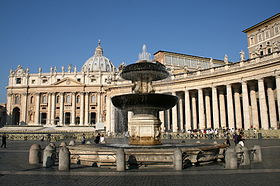
St. Peter’s basilica was first constructed by Constantine. Catholic tradition states that St. Peter is buried at the site of the basilica – considered to be the first Pope. Many other Popes have been buried at the basilica as well. The original church was falling apart, and so Pope Julius II laid the corner stone for the renovation project on this date, April 11, 1506, after unceremoniously tearing down the old building. Construction began a week later. St. Peter’s Basilica is one of the Papal Basilicas (previously styled “patriarchal basilicas”)and one of the four Major Basilicas of Rome, the other Major Basilicas (all of which are also Papal Basilicas) being the Basilicas of St. John Lateran, St. Mary Major, and St. Paul outside the Walls. The rank of major basilica confers on St. Peter’s Basilica precedence before all minor basilicas worldwide. However, unlike all the other Papal Major Basilicas, it is wholly within the territory, and thus the sovereign jurisdiction, of the Vatican City State, and not that of Italy.
It is the most prominent building in the Vatican City. Its dome is a dominant feature of the skyline of Rome. Probably the largest church in Christendom, it covers an area of 2.3 hectares (5.7 acres). (Wikipedia)
One method employed to finance rebuilding St. Peter’s basilica was in the sales of indulgences — a letter that remitted the sins of the buyer or those who had died for whom the indulgences were purchased. A major promoter of these indulgences was Albrecht, Archbishop of Mainz and Magdeburg. He appointed the German Dominican preacher Johann Tetzel to facilitate the sale of indulgences. In 1517, Martin Luther would nail his 95 Theses to the church door in Wittenberg – his list of complaints and abuses of the church (in his opinion) including the sale of indulgences. The rest is, as they say, Reformation history.
Please collect a tube of toothpaste for Trinity’s Table to bring on Easter Sunday morning.
Pastor Dave
 Lutheran Schreff