

March 27, 2017
Lenten Devotions – Elizabeth Dirks, First Woman Minister/Deaconess Of the Reformation
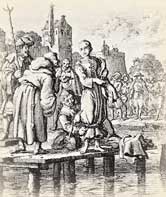
“Elizabeth Dirks was a trailblazer and a woman of great courage. Raised in a nunnery in East Friesland, she learned to read Latin and read the Bible through and through. She became certain that monasticism was not the way taught in Scripture. With the help of milkmaids she escaped and became a follower of peaceful Menno Simons. She was one of the first Reformation women ministers, probably a deaconess. In 1549, Catholic authorities arrested her. When they found her Bible they knew they had the person they were looking for. Mistakenly, they thought she was the wife of Menno Simons. When they tried to get her to take an oath at her interrogation, she refused, saying Christ had taught that our yes should mean yes and our no mean no. Rather than burn her, as was customary, they tied her in a bag and drowned her on this day, March 27, 1549.” (Elizabeth Dirks Drowned as Anabaptist, Dan Graves, Christianity.com)
“So he came to a Samaritan city called Sychar, near the plot of ground that Jacob had given to his son Joseph. Jacob’s well was there, and Jesus, tired out by his journey, was sitting by the well. It was about noon. A Samaritan woman came to draw water, and Jesus said to her, “Give me a drink.” (His disciples had gone to the city to buy food.) The Samaritan woman said to him, “How is it that you, a Jew, ask a drink of me, a woman of Samaria?” (Jews do not share things in common with Samaritans.) Jesus answered her, “If you knew the gift of God, and who it is that is saying to you, ‘Give me a drink,’ you would have asked him, and he would have given you living water.” The woman said to him, “Sir, you have no bucket, and the well is deep. Where do you get that living water? Are you greater than our ancestor Jacob, who gave us the well, and with his sons and his flocks drank from it?” Jesus said to her, “Everyone who drinks of this water will be thirsty again, but those who drink of the water that I will give them will never be thirsty. The water that I will give will become in them a spring of water gushing up to eternal life.” The woman said to him, “Sir, give me this water, so that I may never be thirsty or have to keep coming here to draw water.” Jesus said to her, “Go, call your husband, and come back.” The woman answered him, “I have no husband.” Jesus said to her, “You are right in saying, ‘I have no husband’; for you have had five husbands, and the one you have now is not your husband. What you have said is true!” The woman said to him, “Sir, I see that you are a prophet. Our ancestors worshiped on this mountain, but you say that the place where people must worship is in Jerusalem.” Jesus said to her, “Woman, believe me, the hour is coming when you will worship the Father neither on this mountain nor in Jerusalem. You worship what you do not know; we worship what we know, for salvation is from the Jews. But the hour is coming, and is now here, when the true worshipers will worship the Father in spirit and truth, for the Father seeks such as these to worship him. God is spirit, and those who worship him must worship in spirit and truth.” The woman said to him, “I know that Messiah is coming” (who is called Christ). “When he comes, he will proclaim all things to us.” Jesus said to her, “I am he, the one who is speaking to you.” Many Samaritans from that city believed in him because of the woman’s testimony, “He told me everything I have ever done.” So when the Samaritans came to him, they asked him to stay with them; and he stayed there two days. And many more believed because of his word. They said to the woman, “It is no longer because of what you said that we believe, for we have heard for ourselves, and we know that this is truly the Savior of the world.” John 4:5-42
We have many examples of women with great faith and determination in the bible, and the woman at the well is one of those women. Even though she has had a tough life, even though she is tired and broken, in her encounter with Jesus, she is given new life and new vigor – enough so to become a great evangelist. “Many Samaritans from that city believed in him because of the woman’s testimony, “He told me everything I have ever done.” Though she did everything she could to avoid people before she met Jesus, after her encounter with the one who “knows everything we have ever done”, she is empowered to bring people to Jesus – just like Elizabeth Dirks, 1500 years after the death of Christ. We may not die for our faith, but we will have opportunities to say or do the unpopular because of our faith. Standing up for our faith takes courage – but we are simply following the example of so many who have lived and died for the same faith.
This week please collect a tube of toothpaste each day for Trinity’s Table and bring them into church on Sunday April 2.
Pastor Dave
 Lutheran Schreff