

March 29, 2017
Lenten Devotions – John Lightfoot Theologian and Hebrew Scholar
“John Lightfoot was born on this day, March 29, 1602 in an England which was only just regaining the knowledge of Hebrew. Four hundred years before, King Edward I had kicked the Jews out of his nation. Many left manuscripts behind, which allowed scholars such as Roger Bacon to understand the ancient tongue. However, Hebrew studies were frowned upon by the church. Bacon himself was accused of using Hebrew to communicate with the devil. Even as a youngster, John (Lightfoot) proved to be a natural-born scholar, especially good with Greek and Latin. However, he had only the minimum acquaintance with Hebrew. That changed after the twenty-year-old became a Church of England curate (a minister in charge of a parish) in Shropshire, England.” (John Lightfoot Theologian and Hebrew Scholar, Dan Graves, Christianity.com)
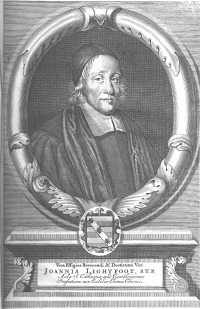
John Lightfoot was another Cambridge-educated man. He had a reputation for oratory. His early career was chiefly scholarly and pastoral in several assignments. In his later career he wrote numerous commentaries on the Bible and became something of a Hebrew scholar. Studying Jewish writings, he showed from rabbinic teachings that Jesus was clearly identifiable as the Messiah. “Even the Lord’s prayer is derived from expressions that had long been familiar in the schools and synagogues of Judea.” His book Horae Hebraicae explained the New testament in light of knowledge he had gleaned from the writings of rabbis. Many later commentators consulted it. John was also prominent in the formulation of the Westminster Confession of Faith.” (monergism.com website)
“Now there was a disciple in Damascus named Ananias. The Lord said to him in a vision, “Ananias.” He answered, “Here I am, Lord.” The Lord said to him, “Get up and go to the street called Straight, and at the house of Judas look for a man of Tarsus named Saul. At this moment he is praying, and he has seen in a vision a man named Ananias come in and lay his hands on him so that he might regain his sight.” But Ananias answered, “Lord, I have heard from many about this man, how much evil he has done to your saints in Jerusalem; and here he has authority from the chief priests to bind all who invoke your name.” But the Lord said to him, “Go, for he is an instrument whom I have chosen to bring my name before Gentiles and kings and before the people of Israel; I myself will show him how much he must suffer for the sake of my name.” So Ananias went and entered the house. He laid his hands on Saul and said, “Brother Saul, the Lord Jesus, who appeared to you on your way here, has sent me so that you may regain your sight and be filled with the Holy Spirit.” And immediately something like scales fell from his eyes, and his sight was restored. Then he got up and was baptized, and after taking some food, he regained his strength. For several days he was with the disciples in Damascus, and immediately he began to proclaim Jesus in the synagogues, saying, “He is the Son of God.” Acts 9:10-20
“Go, for he is an instrument whom I have chosen to bring my name before Gentiles and kings and before the people of Israel; I myself will show him how much he must suffer for the sake of my (Jesus) name.” Jesus tells Ananias to go, even though he is afraid, for the Lord has chosen Saul for a purpose. Sometimes the Lord chooses the most unexpected person for a purpose. Saul of course is the perfect example, for being a persecutor of those who are following “The Way” of Jesus, choosing him would have gone against logical thinking. John Lightfoot may not be as much an enigma in the Lord’s choosing, still he needed to take his learning in a new direction. And in doing so, he became as much a witness for Jesus as Paul – but not as well known.
We do not need to be famous to be a witness for Jesus, nor do we need to be the most educated. We just need to have a willingness to follow when the Lord says “I have chosen you”.
This week please collect a tube of toothpaste each day for Trinity’s Table and bring them into church on Sunday April 2.
Pastor Dave

 Lutheran Schreff