
On This Date — February 24, 1868

February 24, 2017
President of Andrew Johnson, vote for impeachment

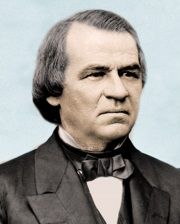
On this date, February 24, 1868, the US House of Representatives votes to impeach President Andrew Johnson by a vote of 126 to 47.
andrew-johnson

“The House of Representatives…decided to impeach the president, charging him with “high crimes and misdemeanors” as required by the Constitution. After becoming president following the assassination of Abraham Lincoln, Johnson wanted to complete Lincoln’s plan to reunite the country swiftly. The Civil War (1861-1865) had just ended. His plan was to promote passage of an amendment outlawing slavery, then allow the Confederate states to once again send representatives to Congress and govern themselves. Johnson, however, lacked Lincoln’s good judgment. While Congress was in recess, the newly powerful Southern states passed “Black Codes,” limiting the rights of freed slaves. An angry Congress proposed a law that would repress those codes; Johnson vetoed it. Congress in return, on April 9, 1866, passed the first override in U.S. history, protecting the civil rights legislation. And on it went. Johnson was charged with breaking the law, among other things. During his trial before the Senate (where impeachment hearings are held, according to the Constitution), the charges were shown to be so weak that seven Republicans refused to convict the Democratic president. The votes thus fell one short of the two-thirds necessary for conviction. Johnson did not attend his trial. When he heard the results, the president broke into tears.” (americaslibrary.gov, Vote to Impeach Andrew Johnson)

The impeachment of Johnson was the first of an incumbent President since the office of the president was created. As mentioned above, the impeachment was the culmination of a lengthy political battle pitting Johnson and the Republican majority in Congress. The disagreement was over how best to deal with the Southern states following the civil war, and Johnson’s veto of Congress’ attempt to halt illegal legislation passed by the Southern states – a piece of legislation passed by those states to limit the rights of freed slaves. Congress passed the Civil Rights Bill. Johnson vetoed it. Congress mustered the 2/3 majority needed to override the veto. There would not be another attempt to impeach a President for 106 years.

This all happened in 1866. Have we resolved all arguments over civil rights in America? Of course not. As should be the case, the discussion of civil rights continues in this country, resulting in a variety of laws passed in the 21st century around same sex marriage and transgender issues, among other important issues facing our country. The more we stay in the conversation with one another, the more we will be able to discuss issues and find ways to make sure the civil rights of all people are held in the highest regard. Must we always agree? Again, of course not. But as long as our discussions remain “civil”, then maybe the rights of all people will be upheld.

Pastor Dave

On This Date — February 23, 155

February 23, 2017
Polycarp, Bishop of Smyrna

Polycarp lived from 69 CE to 155 CE. He was burned at the stake on this date, February 23, 155, by the Roman government who had persecuted the Christian church for approximately 300 years. Here is one account about the early Christian persecution:
“Between 125 and 160, Christians enjoyed a precarious toleration. Few martyrdoms are recorded in this era of prosperity that marked the climax of the Greco-Roman achievement. With the accession of Marcus Aurelius as emperor in 161, however, the situation changed. First, the Christians were becoming exceedingly unpopular; they were blamed for causing natural disasters by refusing to worship the deities that protected communities. Christians were also accused of immorality, unnatural vice, and black magic, all calculated to bring the rest of the population into peril. An urban mob demanded the arrest of Polycarp, bishop of Smyrna, during what the ecclesiastical historian Eusebius of Caesarea termed “great persecutions that disturbed the province of Asia” (perhaps in February 156, but more likely 166–69). Other Christians had been seized, tried, and executed before Polycarp was arrested. One, a Phrygian, had rushed toward martyrdom—only to recant at the sight of the beasts in the amphitheater.

polycarp

Polycarp was brought before the proconsul, who begged him to have respect for his great age (he was probably nearly 100), saying, “Swear by the genius of Caesar” and denounce “the atheists.” But Polycarp, seeing “the lawless heathen” in the amphitheater, “waved his hands at them, and looked up to heaven with a groan and said, ‘Away with the atheists.’ ” The proconsul persisted, “Swear, and I will release you. Curse Christ.” And Polycarp replied, “Eighty-six years have I served him, and he has done me no wrong; how can I blaspheme my King who saved me?” He was condemned to death and burned alive.” (“Persecution in the Early Church: Did You Know?” Beginning as a despised, illicit religious sect, Christianity endured 300 years of hostility to emerge as the dominant force in the Roman Empire – by Everett Ferguson)

“So Satan went out from the presence of the Lord and afflicted Job with painful sores from the soles of his feet to the crown of his head. Then Job took a piece of broken pottery and scraped himself with it as he sat among the ashes. His wife said to him, “Are you still maintaining your integrity? Curse God and die!” He replied, “You are talking like a foolish woman. Shall we accept good from God, and not trouble?” In all this, Job did not sin in what he said.” Job 2:7-10

Polycarp is asked to “Curse Christ” and the Proconsul would release him. He did not. Job was asked by his wife to “Curse G-d and die”. He did not. Both were under great pressure to abandon the G-d they loved and served, but neither flinched in the face of persecution and personal tragedy. We have so many examples of people who served the G-d we love, who worked for Christ who died for our salvation, and enjoyed lives of plenty and faithfulness. We also have many examples of people who served the G-d we love, and worked for Christ, but who were persecuted, imprisoned, martyred, beaten, and belittled throughout their lives. Most likely, those of us who are living in America will never experience the kind of persecution or tragedy that many have endured. And yet, we will still have opportunities to stand up for our faith in the face of injustice. Hopefully we will never allow ourselves to reject our faith or denounce Christ when confronted with the opportunity to do the right thing – the right thing being living the Christ-like life and publicly professing our faith.

Pastor Dave