
On This Date– February 2, 1887

February 2, 2017
Groundhog Day

“As they (the Hittites, the Amorites, the Canaanites, the Perizzites, the Hivites, and the Jebusites) fled before Israel, while they were going down the slope of Beth-horon, the Lord threw down huge stones from heaven on them as far as Azekah, and they died; there were more who died because of the hailstones than the Israelites killed with the sword. On the day when the Lord gave the Amorites over to the Israelites, Joshua spoke to the Lord; and he said in the sight of Israel, “Sun, stand still at Gibeon, and Moon, in the valley of Aijalon.” And the sun stood still, and the moon stopped, until the nation took vengeance on their enemies. Is this not written in the Book of Jashar? The sun stopped in midheaven, and did not hurry to set for about a whole day. There has been no day like it before or since, when the Lord heeded a human voice; for the Lord fought for Israel. Then Joshua returned, and all Israel with him, to the camp at Gilgal.” Joshua 10:11-15
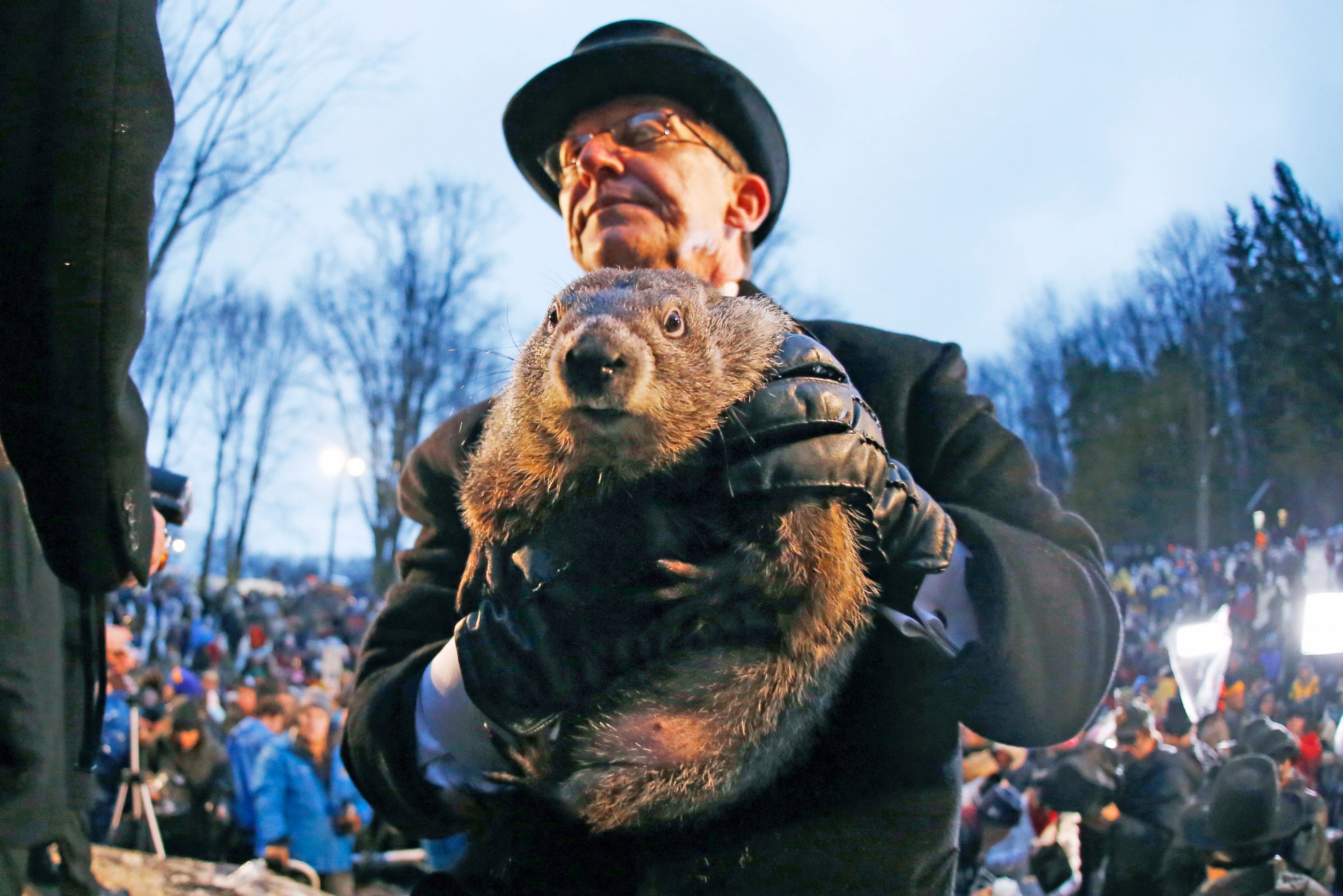
groundhog-day

On this date, February 2, 1887, the first Official recognition of Groundhog Day is observed in Punxsutawney, Pennsylvania. The first documented reference to Groundhog Day can be found in a diary entry, dated February 1841, by a Pennsylvania storekeeper named James Morris:

“Last Tuesday, the 2nd, was Candlemas day, the day on which, according to the Germans, the Groundhog peeps out of his winter quarters and if he sees his shadow he pops back for another six weeks nap, but if the day be cloudy he remains out, as the weather is to be moderate.”

From England comes the poem:
If Candlemas be fair and bright, Winter has another flight.
If Candlemas brings clouds and rain, Winter will not come again.

And from Scotland comes the poem:
If Candlemas Day is bright and clear, There’ll be two winters in the year.

So it seems that the celebration of Groundhog Day comes from a mix of pagan and religious origins. One of this cranky reverend’s favorite movies is Groundhog Day. From that movie comes these two quotes by weatherman Phil Connors:

Quote #1: “You want a prediction about the weather? You’re asking the wrong Phil. I’m going to give you a prediction about this winter? It’s going to be cold, it’s going to be dark and it’s going to last you for the rest of your lives!”

Quote #2: “When Chekhov saw the long winter, he saw a winter bleak and dark and bereft of hope. Yet we know that winter is just another step in the cycle of life. But standing here among the people of Punxsutawney and basking in the warmth of their hearths and hearts, I couldn’t imagine a better fate than a long and lustrous winter.”

The Cranky Reverend prays that this will be a short and lustrous winter.

Pastor Dave

On This Date– February 1, 1587

February 1, 2017
Mary Stuart, Queen of Scots

“At that time Herod the ruler heard reports about Jesus; and he said to his servants, “This is John the Baptist; he has been raised from the dead, and for this reason these powers are at work in him.” For Herod had arrested John, bound him, and put him in prison on account of Herodias, his brother Philip’s wife, because John had been telling him, “It is not lawful for you to have her.” Though Herod wanted to put him to death, he feared the crowd, because they regarded him as a prophet. But when Herod’s birthday came, the daughter of Herodias danced before the company, and she pleased Herod so much that he promised on oath to grant her whatever she might ask. Prompted by her mother, she said, “Give me the head of John the Baptist here on a platter.” The king was grieved, yet out of regard for his oaths and for the guests, he commanded it to be given; he sent and had John beheaded in the prison. The head was brought on a platter and given to the girl, who brought it to her mother. His disciples came and took the body and buried it; then they went and told Jesus.” Matthew 14:1-12

mary-stuart-queen-of-scotland

On this date, February 1, 1587, Queen Elizabeth I of England signs death warrant for her cousin, Mary Stuart, Queen of Scots. She was beheaded on February 18, 1587. In the eyes of many Catholics, Elizabeth I was the illegitimate heir to the throne, and Mary Stuart, as the senior descendant of Henry VIII’s elder sister, was the rightful queen of England. After an unsuccessful attempt to regain the throne of Scotland, Mary fled southwards seeking the protection of her first cousin once removed, Queen Elizabeth I of England. Perceiving her as a threat, Elizabeth had her confined in various castles and manor houses in the interior of England. After eighteen and a half years in custody, Mary was found guilty of plotting to assassinate Elizabeth, and was subsequently beheaded.

Each one of us experiences situations and people every day where we want to lose our heads over how we are treated, how we are taken advantage of, and how we are tossed aside. It is true, my friends, that people will always disappoint us. But G-d never forsakes us, nor does G-d toss us aside, nor disappoint. G-d is a continual source of strength, sustenance, guidance, and love. John the Baptist and Mary Stuart lost their heads out of human weakness. And yet it was out of human weakness, in our case G-d used the cross of Jesus Christ so, as Hebrews 4:15ff says, “we do not have a high Priest (Jesus Christ) who is unable to sympathize with our weakness, but one who in every respect has been tempted as we are, yet without sin.” And not only was he tempted, but he was put to death on a cross for our sake, so that we may approach the throne of Grace with confidence, knowing we receive mercy and Grace from Jesus that sustains us in times of need.

When you are pushed beyond your limit, frustrated beyond strength, and attacked on all sides from evil, approach the throne of Grace, Jesus Christ, who offers us mercy, love and Grace in abundance.

Pastor Dave