
On This Date — February 6, 1564

February 6, 2017
John Calvin, Theologian,

On this day, February 6, 1564, John Calvin preached his last sermon. Calvin had, like Martin Luther, been an influential leader of the Reformation. He was unable to walk to the pulpit and had to be carried in a chair for his final sermon. As he preached, and often his sermons went on for more than an hour, blood began to fill his mouth. He was carried out and to his home and never preached again. He died in May of the same year.
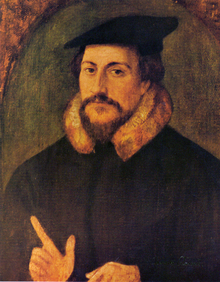
john_calvin_

“John Calvin was an influential French theologian and pastor during the Protestant Reformation. He was a principal figure in the development of the system of Christian theology later called Calvinism, aspects of which include the doctrines of predestination and of the absolute sovereignty of God in salvation of the human soul from death and eternal damnation, in which doctrines Calvin was influenced by and elaborated upon the Augustinian and other early Christian traditions. Various Congregational, Reformed and Presbyterian churches, which look to Calvin as the chief expositor of their beliefs, have spread throughout the world.” Calvin was a tireless writer who generated much controversy. He also exchanged cordial and supportive letters with many reformers, including Melanchthon and Heinrich Bullinger. In addition to his seminal Institutes of the Christian Religion, Calvin wrote commentaries on most books of the Bible, confessional documents, and various other theological treatises.

Originally trained as a lawyer, he broke from the Catholic church around 1530. After religious tensions erupted in widespread deadly violence against Protestant Christians in France, Calvin fled to Switzerland, where in 1536 he published the first edition of the Institutes. In that same year, Calvin was recruited to help reform the church in Geneva, where he regularly preached sermons throughout the week; but the governing council of the city resisted the implementation of Calvin’s and Farel’s ideas, and both men were expelled. Calvin proceeded to Strasbourg, where he became the minister of a church of French refugees. He continued to support the reform movement in Geneva, and in 1541 he was invited back to lead the church. Calvin spent his final years promoting the Reformation in Geneva and throughout Europe. (Wikipedia)

John Calvin was an instrumental figure of the Reformation. Due to his missionary work in France, his message spread into the Netherlands. Calvinism was taught and eventually was instrumental to the development of the Heidelberg Catechism in 1563, which was adopted as the confessional standards in the Dutch Reformed Church. During the English Civil War the Calvinistic Puritans produced the Westminster Confession which became the confessional standard for the Presbyterian church. (information came from Wikipedia)

During this 500th anniversary of the Reformation, we all would benefit from studying not only the life of Martin Luther, but the lives of many of the men and women of the Reformation.

Pastor Dave

Epiphany 5A — February 5, 2017

February 5, 2017
Epiphany 5A

“You are the salt of the earth; but if salt has lost its taste, how can its saltiness be restored? It is no longer good for anything, but is thrown out and trampled under foot. “You are the light of the world. A city built on a hill cannot be hid. No one after lighting a lamp puts it under the bushel basket, but on the lampstand, and it gives light to all in the house. In the same way, let your light shine before others, so that they may see your good works and give glory to your Father in heaven. “Do not think that I have come to abolish the law or the prophets; I have come not to abolish but to fulfill. For truly I tell you, until heaven and earth pass away, not one letter, not one stroke of a letter, will pass from the law until all is accomplished. Therefore, whoever breaks one of the least of these commandments, and teaches others to do the same, will be called least in the kingdom of heaven; but whoever does them and teaches them will be called great in the kingdom of heaven. For I tell you, unless your righteousness exceeds that of the scribes and Pharisees, you will never enter the kingdom of heaven.” Matthew 5:13-20

“We’re in the second of five weeks of passages from Jesus’ Sermon on the Mount as recounted by Matthew. And we are again faced with the insidious temptation to hear Jesus’ words as requirement rather than blessing, as command rather than commissioning. But take note: Jesus doesn’t say, “If you want to become salt and light, do this….” Or, “before I’ll call you salt and light, I’ll need to see this from you….” Rather, he says both simply and directly, “You are the salt of the earth. You are the light of the world.” It is, as with last week’s Beatitudes, sheer blessing, commendation, affirmation, and commissioning.

Do recall the statistics about a children’s self-esteem in relation to the messages they hear? Psychologists suggest that for every negative message elementary-aged children hear about themselves, they need to hear ten positive ones to restore their sense of self-esteem to where it had been previously. (Frankly, I don’t know if anyone has studied this in groups other than young children, but I suspect that number doubles during adolescence and then recedes to about 10-1 again by adulthood!)

Children, to put it another way, become what they are named. Call a child bad long enough, and he or she will believe you and act bad. Call a child (or teen or adult for that matter) worthless or unlovable or shameful, and eventually he or she — all of us! — will live into the name we’ve been assigned. In the same way, call us good or useful, dependable, helpful, or worthwhile, and we will grow into that identity and behavior as well.” (David Lose, Salt & Light, January 30, 2011, working preacher website)

What could he mean, “You are Salt, and You are Light”?
Coming on the heels of the Beatitudes, which can only be understood as radical blessings, Jesus is once again Blessing his disciples. In Jewish Rabbinic metaphorical language, Salt meant Wisdom. So in teaching his disciples about meekness, kindness, humility and the like, Jesus is continuing to teach his disciples telling them that they have been salted in wise practical faith. By telling them they are “Salt of the Earth”, he is blessing them and reminding them not to be fooled, or to be fools of the earth, fools in the sinful ways of earthly living. And he is also telling them that they will be instrumental in spreading that “Salt”, that “Wisdom” to others. He is asking them to salt their relationships with kindness, humility, meekness, patience, and forgiveness.

But Jesus did not stop there. He also told them “You are the light of the world”. Now, I don’t have to tell anyone here how important light is to our lives. In fact, some of you may have been without lights after this last ice storm. And so, being in the throes of winter, we all know how much we are longing for more light in our lives. For Jesus, light has a profound meaning. In the Gospel of John, Jesus is described as the light that “shines in the darkness, and the darkness did not overcome it.” When Robert Louis Stevenson was just a boy, he watched a lamp lighter lighting the lamps as he walked down the street. Stevenson said to his pal “I am watching a man put holes in the darkness.” Jesus is the one who has come into the world to poke holes in the deep darkness of sin in this world. And we are called to bear that light, and to spread that salt.

Pastor Dave