

February 9, 2017
John Hooper, Bishop
On this day, February 9, 1555, John Hooper, Puritan Bishop of Gloucester, England, was burned at the stake for his opposition to the Roman Catholic Church.
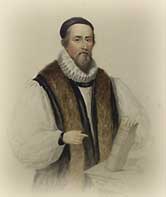
“John Hooper was a fervent Puritan. Although he had opposed making Lady Jane Grey queen, he was one of the first bishops arrested when the Catholic Queen Mary came to the English throne. John’s strong opposition to Roman Catholic practices was well known. A man with a severe disposition, he had been harsh in his statements. He had even made enemies among fellow reformers. However, he proved himself a worthy leader when he was finally made bishop of Gloucester. He would have been bishop sooner, but he refused to wear the designated gown. A stint in jail changed his mind. As bishop, he worked with great zeal. He examined all of his clergymen and found that some did not even know the Lord’s Prayer, the Ten Commandments or the Apostles’ Creed. He set out to remedy this, and to educate the people, preaching every day, often up to four or five times. He was known for his kindness to the poor. The people of Gloucester loved him.
At 8 a.m. (on the day he was burned at the stake) the men who were to see that he was burned came for him. The sheriff’s men were armed with clubs. John took one look at the weapons and said, “Master Sheriffs, I am no traitor, and you have no need to make such a work to take me to the place where I must suffer. If you had told me, I would have gone to the stake, and have troubled none of you.” When he arrived at the stake, John knelt and prayed… He was shown what was said to be a pardon from the queen: his–if only he would change his religious opinions. “If you love my soul, away with it!” he exclaimed, repeating the words for emphasis. He then asked the people to pray the Lord’s prayer with him, which they did. The fire had to be rebuilt three times. During his ordeal, John repeated many times, “O Jesus, Son of David, have mercy on me and receive my soul,” and similar pleas.” And so he made a brave end. The stump of the stake at which he was burned was rediscovered in the twentieth century and shown to the curious. His writings influenced generations of Puritans and evangelicals. (John Hooper Burned in Gloucester, Christianitytoday.com, by Dan Graves)
In just six months the Peace of Augsburg would be finalized – it was a treaty between Charles V, Holy Roman Emperor, and an alliance of Lutheran Princes (known as the Schmalkaldic League). The Peace was signed on September 25, 1555 at Augsburg, Germany. It officially ended the religious struggle between the two groups…allowing rulers to choose either Lutheranism or Roman Catholicism as the official religion of their state. The Peace established the principle Cuius region, eius religio (whose realm, his religion) which allowed princes of each state to select which religion their state would permit between Lutheranism and Catholicism. Subjects, citizens or residents who did not wish to conform to the prince’s choice were given time to relocate to different regions in which their religion was accepted.
Just like Deitrich Bonhoeffer was executed just weeks before his concentration camp was liberated, John Hooper, though he was in England, knowing the tide was turning throughout Europe regarding the Reformation, one might think had John Hooper lived just a few years longer, perhaps he may not have been burned at the stake. In reality it would take until 1689 with Parliament passing the Act of Toleration of 1689 for Protestants to be protected from persecution in England. Even Paul Harvey could not have told John Hooper the “rest of the story”.
Pastor Dave
 Lutheran Schreff