

February 6, 2017
John Calvin, Theologian,
On this day, February 6, 1564, John Calvin preached his last sermon. Calvin had, like Martin Luther, been an influential leader of the Reformation. He was unable to walk to the pulpit and had to be carried in a chair for his final sermon. As he preached, and often his sermons went on for more than an hour, blood began to fill his mouth. He was carried out and to his home and never preached again. He died in May of the same year.
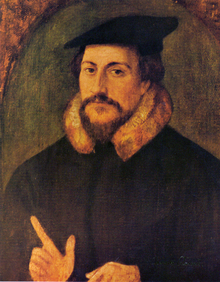
“John Calvin was an influential French theologian and pastor during the Protestant Reformation. He was a principal figure in the development of the system of Christian theology later called Calvinism, aspects of which include the doctrines of predestination and of the absolute sovereignty of God in salvation of the human soul from death and eternal damnation, in which doctrines Calvin was influenced by and elaborated upon the Augustinian and other early Christian traditions. Various Congregational, Reformed and Presbyterian churches, which look to Calvin as the chief expositor of their beliefs, have spread throughout the world.” Calvin was a tireless writer who generated much controversy. He also exchanged cordial and supportive letters with many reformers, including Melanchthon and Heinrich Bullinger. In addition to his seminal Institutes of the Christian Religion, Calvin wrote commentaries on most books of the Bible, confessional documents, and various other theological treatises.
Originally trained as a lawyer, he broke from the Catholic church around 1530. After religious tensions erupted in widespread deadly violence against Protestant Christians in France, Calvin fled to Switzerland, where in 1536 he published the first edition of the Institutes. In that same year, Calvin was recruited to help reform the church in Geneva, where he regularly preached sermons throughout the week; but the governing council of the city resisted the implementation of Calvin’s and Farel’s ideas, and both men were expelled. Calvin proceeded to Strasbourg, where he became the minister of a church of French refugees. He continued to support the reform movement in Geneva, and in 1541 he was invited back to lead the church. Calvin spent his final years promoting the Reformation in Geneva and throughout Europe. (Wikipedia)
John Calvin was an instrumental figure of the Reformation. Due to his missionary work in France, his message spread into the Netherlands. Calvinism was taught and eventually was instrumental to the development of the Heidelberg Catechism in 1563, which was adopted as the confessional standards in the Dutch Reformed Church. During the English Civil War the Calvinistic Puritans produced the Westminster Confession which became the confessional standard for the Presbyterian church. (information came from Wikipedia)
During this 500th anniversary of the Reformation, we all would benefit from studying not only the life of Martin Luther, but the lives of many of the men and women of the Reformation.
Pastor Dave
 Lutheran Schreff