

February 3, 2017
General William Tecumseh Sherman
“Then Amalek came and fought with Israel at Rephidim. Moses said to Joshua, “Choose some men for us and go out, fight with Amalek. Tomorrow I will stand on the top of the hill with the staff of God in my hand.” So Joshua did as Moses told him, and fought with Amalek, while Moses, Aaron, and Hur went up to the top of the hill. Whenever Moses held up his hand, Israel prevailed; and whenever he lowered his hand, Amalek prevailed. But Moses’ hands grew weary; so they took a stone and put it under him, and he sat on it. Aaron and Hur held up his hands, one on one side, and the other on the other side; so his hands were steady until the sun set. And Joshua defeated Amalek and his people with the sword. Then the Lord said to Moses, “Write this as a reminder in a book and recite it in the hearing of Joshua: I will utterly blot out the remembrance of Amalek from under heaven.” And Moses built an altar and called it, The Lord is my banner. He said, “A hand upon the banner of the Lord! The Lord will have war with Amalek from generation to generation.” Exodus 17:8-16
Sherman’s march through Mississippi, begins on this date, February 3, 1864.
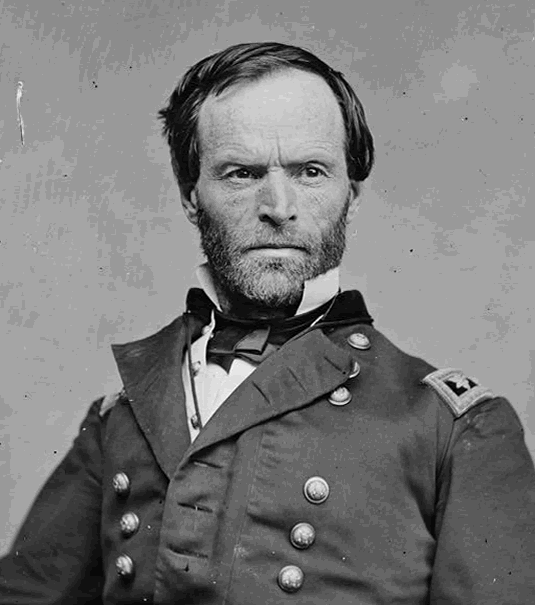
General William Tecumseh Sherman is probably best remembered for his spectacular 1864 “March to the Sea” in which he stormed 225 miles through Georgia with no line of communication in a Union campaign to take the American Civil War to the Confederate population. One critical phase of this growth was Sherman’s successful Meridian Campaign in February 1864. It was on this raid to protect the Mississippi River from Confederate guerillas that Sherman first demonstrated the ability to operate independently deep in enemy territory, far from headquarters. It was on this raid that Sherman pioneered the art of destroying Confederate war-making capability.
Meridian, where three railroads intersected, was a Confederate strategic point, lying roughly between the Mississippi capital of Jackson and the cannon foundry and manufacturing center of Selma, Alabama. It served as a storage and distribution center for not just the industrial products of Selma, but for grain and cattle from the fertile Black Prairie region to the immediate north. It all presented a tempting target for Sherman who did not want to sit idle waiting for weather sufficient to support the upcoming spring campaign.
Meridian was about 150 miles from Sherman’s location at Vicksburg that the Union had taken the previous summer in order to gain control of the Mississippi River. Sherman figured it would be an easy matter to finish his business in Meridian in plenty of time to return to Vicksburg and be ready for future operations; a precondition that Sherman’s commander, General Ulysses S. Grant, had given him. Thus, on February 3, he began his campaign “to break up the enemy’s railroads at and about Meridian, and to do the enemy as much damage as possible in the month of February, and to be prepared by the 1st of March to assist General [Nathaniel] Banks in a similar dash at the Red River [Louisiana] country…”( Sherman’s Meridian Campaign: A Practice Run for the March to the Sea, By Kevin Dougherty)
The Civil War was a dark period in the history of this country. For those of us who live in this land 154 years after the fact, it is incomprehensible to fathom the death and destruction that a civil war can bring – bring to towns, cities, people, families, churches, and government. In many ways the Civil War is still being fought in this country – between those who cannot agree on the root cause of the war, and in the inability of the citizens of this country to find a way to be civil to one another when they disagree with one another. If we have learned nothing else from the Civil War, possibly we might learn that a campaign of “slash and burn”, “conquer and destroy” brings temporary satisfaction, but long term pain. And if the people of this country do not learn to listen, love, and respect one another, there will continue to be long term pain.
My friends, the war is over – let’s stop the destroying and get on with our collective healing.
Pastor Dave
 Lutheran Schreff